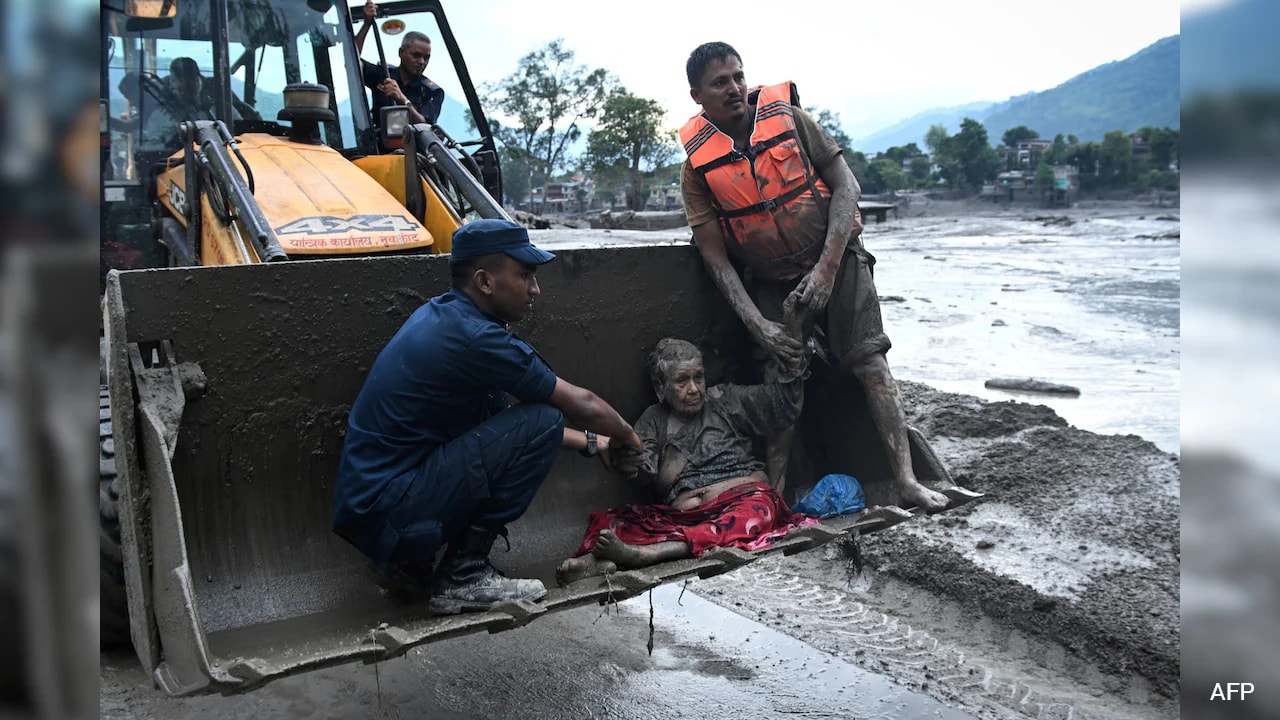
Water does not knock. It arrives with a low, subterranean growl, a heavy weight that bends steel, shatters timber, and turns the familiar soil of a lifetime into a churning brown throat swallowing the valley.
At ninety-one years old, Devi Maya Maharjan knew the sound of the Kali Gandaki. She had lived within earshot of its seasonal roar for nearly a century, watching it shrink under the punishing heat of dry autumns and swell into a liquid monster when the monsoon broke the sky wide open. But the rains of that particular week did not just fall; they assaulted the hillsides, turning ancient earth into sliding rivers of mud.
By the time the floodwaters breached the threshold of her home, the world had shrunk to a few terrifying feet of visibility. There was the mud. There was the roar. And there was the dark, rising line creeping up the whitewashed walls of her kitchen, measuring out her remaining minutes in inches.
Most of us measure survival in equations. We look at disaster mitigation reports, infrastructural budgets, and evacuation timelines drafted in air-conditioned municipal offices far from the mud. We talk about resilience as a policy objective, a bureaucratic metric to be tracked on spreadsheets. But resilience is not a spreadsheet. Resilience is a ninety-one-year-old woman standing on a wooden stool while the possessions of a lifetime float past her ankles like discarded paper.
Consider what happens next. The water does not care about age. It does not pause out of respect for grey hair or the historical memory held inside a wrinkled hand. The current surges. The floorboards groan. And a choice must be made in the breathless space of a single heartbeat: surrender to the dark weight, or find a way to stay above it.
Devi chose the air.
When rescue workers finally hacked their way through the choked debris of her neighborhood hours later, expecting the worst, they found something that defied the laws of probability. Perched precariously on a makeshift shelf of salvaged furniture, surrounded by the swirling detritus of a destroyed home, she was breathing. Her eyes were sharp, fixed on the gray horizon where the river met the sky. She had kept her head above water through sheer, stubborn refusal to let go of the earth that had claimed everyone else's panic.
That image—frail, indomitable, drenched in the mud of a changing climate—did not just capture a moment of local news. It became a mirror for an entire nation caught in the crosshairs of environmental volatility.
Nepal is a country sculpted by vertical extremes, where the majesty of the Himalayas masks a terrifying geological fragility. The mountains are young, restless, and constantly shedding their skin. When unseasonal cloudbursts hit these steep gradients, the valleys become funnels of destruction. Every year, flash floods and landslides rewrite the geography of remote settlements, washing away roads, bridges, and centuries of human heritage in a matter of minutes.
Yet, behind the dramatic aerial footage of ruined suspension bridges and marooned villages lies a quieter, more devastating reality. It is the reality of the elderly, the children, and the marginalized left behind when the early warning sirens fail or never exist at all.
I have walked those mountain paths after the water recedes. I have smelled the heavy, metallic stench of fresh mud mixed with rotting vegetation. I have seen the way a community stands in absolute silence, staring at a space where a neighbor’s house stood only yesterday, now replaced by a smooth, grey scar of silt. There is a profound loneliness that follows a natural disaster. The international aid trucks eventually leave. The television crews pack up their lenses and fly back to the capital. The headlines shift to political squabbles and economic forecasts.
But Devi stayed.
When her photograph traveled across the globe—a frail figure emerging from the brown deluge with an expression of fierce, unyielding dignity—it disrupted our comfortable narratives about vulnerability. We are conditioned to view the elderly as passive victims of circumstance, fragile glass to be shielded from the harsh winds of the world. We build our disaster response models around evacuation chairs and medical tents, treating people as coordinates to be rescued.
Devi shattered that template. She did not wait for a directive from a district disaster management committee. She did not analyze the meteorological data or debate the political failures of watershed management. She simply refused to drown.
There is an uncomfortable truth hidden in her survival. It tells us that when the safety nets of modern civilization fail—when early warning systems break down, when roads wash out, when the state is simply too far away and too slow to arrive—the ultimate line of defense is not a policy or a piece of technology. It is the raw, unquantifiable spirit of the human animal fighting for its breath.
We spend billions of dollars trying to engineer certainty into an uncertain world. We build higher concrete retaining walls along riverbanks. We launch satellite monitoring programs to track monsoon patterns down to the square kilometer. All of this is necessary. All of this saves lives. But concrete cracks. Satellites lose signal. The river always finds a way around the barrier.
When the wall breaks, what remains is character.
Months after the floodwaters receded and the mud in her courtyard had dried into a hard, gray crust, Devi sat on a low wooden bench outside her rebuilt doorway. The scars of the disaster were everywhere—in the raw timber of the new roof beams, in the missing family photographs that could never be replaced, in the nervous twitch of the village dogs whenever dark clouds gathered over the ridge.
She was shelling dried beans into a brass bowl, her fingers moving with a rhythmic, hypnotic certainty. When asked how she managed to hold on through those agonizing hours in the dark, she did not offer a grand philosophical statement about climate change or human triumph. She simply pointed a weathered finger at the rushing water below.
The river was smaller now, tamed by the dry season into a thin, glittering ribbon slicing through the grey boulders. But it was still there. It never really leaves.
The wind picked up, carrying the sharp scent of pine smoke and wet earth down from the upper pastures. Down in the valley, the rebuilding continued, slow and heavy and relentless. We build our houses on the floodplains because that is where the soil is rich, because that is where our ancestors buried their dead, because we are creatures of habit and hope. We gamble with the weather every single day, placing our fragile lives in the path of giants.
And somewhere in the middle of the dust and the memory, an old woman keeps working her hands through the harvest, staring down the water that tried to take her, daring it to try again.