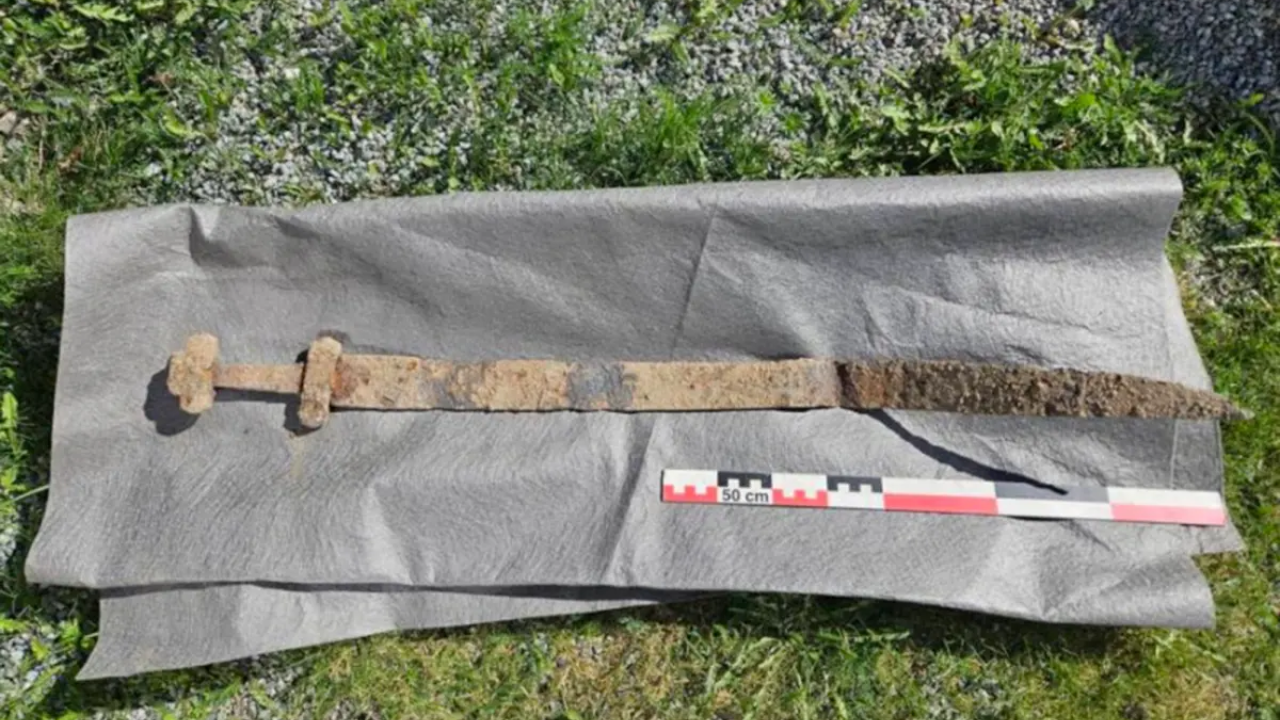
Every few months, the international media cycle falls head over heels for the exact same story. A six-year-old boy goes on a school trip or a family hike in Norway, stumbles over a piece of rusted iron, and congratulations: we have a viral news sensation. The headlines practically write themselves, dripping with romanticized notions of accidental destiny, childhood wonder, and the sudden, magical resurrection of the Viking Age.
It is a heartwarming narrative. It is also an absolute disaster for the preservation of human history.
The lazy consensus driving these viral stories is simple: field discoveries by untrained civilians are an unmitigated win for history. The public loves the "treasure hunter" trope. Media outlets crave the easy clicks that come with profiling a wide-eyed kid holding a millennial-old weapon. Even some local municipalities lean into the hype to boost regional tourism.
But as anyone who has actually spent decades managing heritage sites and navigating the brutal realities of cultural resource management will tell you, a sword yanked out of the mud by a curious child is often a historical crime scene in disguise. We need to stop celebrating the accidental extraction of antiquities and start talking about what is actually lost when a non-expert plays Indiana Jones.
The Myth of the Isolated Treasure
The fundamental flaw in the public's understanding of archaeology is the obsession with the object. To the untrained eye, a Viking sword is the ultimate prize. It is tangible, violent, and highly evocative.
To a professional archaeologist, the object is only a fraction of the data. The real value lies in the context.
When an artifact is pulled from the ground without meticulous, stratigraphic documentation, we lose the surrounding matrix. In archaeology, this is known as losing the context, and it is irreversible. The soil composition, the precise depth, the micro-botanical remains adhering to the rust, the positioning relative to nearby structural anomalies—this is the data that actually answers historical questions.
Imagine a scenario where a well-meaning finder yanks a late 9th-century sword from a peat bog. By removing it hastily to show a teacher or a parent, they completely destroy the fragile organic layers around it. We will never know if that sword was dropped during a chaotic retreat, buried carefully as a cenotaph, or placed deliberately into a body of water as a ritual votive offering to a forgotten deity.
The sword itself tells us that Vikings existed and made weapons. We already know that. The context tells us why it was there. Without that "why," the sword is just an expensive museum paperweight.
The Survivor Bias of Glacial and Soil Archaeology
The sudden uptick in these "accidental" discoveries across Scandinavia isn't a sign of luck. It is a symptom of environmental crisis. Climatic shifts are causing glaciers to retreat and permafrost to thaw at unprecedented rates, exposing organic materials—arrows, clothing, and weaponry—that have been sealed in a deep freeze for over a thousand years.
When the media frames these finds as whimsical strokes of good fortune, they mask a terrifying scientific reality: we are losing a race against time.
Artifacts preserved in ice or anaerobic bogs remain stable for centuries. The second they are exposed to oxygen and rising temperatures, a rapid process of degradation begins. Iron oxidizes. Wood rots. Leather dissolves.
When an amateur finds an artifact, days or weeks often pass before a trained conservator from an institution like the Museum of Cultural History in Oslo can stabilize it. During that window, irreversible decay occurs. Celebrating these finds as happy accidents ignores the structural failure of global heritage funding. We should not be relying on school children to do the work of heavily underfunded, systematically ignored state survey teams.
The Legal and Ethical Nightmare of Amateur Findings
Let's address the question that always dominates the comment sections of these viral articles: "Does the kid get to keep it?" or "How much money is it worth?"
The short answer is: nothing, and they shouldn't.
Norway’s Cultural Heritage Act (Kulturminneloven) is exceptionally clear. All antiquities older than 1537, and all coins older than 1650, are automatically the property of the state. If you find a Viking artifact, you are legally obligated to report it and hand it over.
Yet, the viral framing of these stories routinely fuels a toxic subculture of illegal metal detecting and amateur looting across Europe. By romanticizing the casual discovery, we validate the logic of the "nighthawk"—the illicit detectorists who trespass on protected archaeological sites under the cover of darkness, dig up artifacts for the black market, and destroy irreplaceable stratigraphic layers for personal profit.
I have seen historical landscapes completely gutted by treasure hunters who convinced themselves they were just doing "amateur archaeology." They use the same justification as the media: "If I didn't dig it up, it would just sit there forever."
That premise is entirely false. An artifact left undisturbed in a stable environment is safe. An artifact ripped out of the ground by someone looking for a dopamine hit or a payday is compromised.
What You Should Actually Do If You Step on a Piece of History
The public needs a complete paradigm shift regarding how we interact with the past. If you or your child find yourself standing over what appears to be an ancient relic on a hillside in Telemark or anywhere else, the absolute worst thing you can do is pick it up to take a selfie.
Instead, the protocol must be mechanical, boring, and utterly devoid of romantic flair:
- Freeze. Do not disturb the soil any further. Do not attempt to clear dirt away from the object.
- Drop a Pin. Use your smartphone to log the exact GPS coordinates. High-accuracy location data is the most valuable asset you can provide to researchers.
- Photograph the Environment. Take several high-resolution photos of the object in situ, including wide shots that show the surrounding terrain and landmarks.
- Walk Away. Leave the object exactly where it is.
- Contact Authorities. Report the find immediately to the local county municipality (Fylkeskommune) or the relevant national cultural heritage agency.
This approach is not glamorous. It does not make for a cute headline about a boy king discovering his medieval counterpart’s blade. But it preserves the integrity of the site, allowing professional teams to execute a controlled excavation that treats the entire area as a repository of data, not a lucky dip.
Stop Demanding Fairytales from Science
Archaeology is a rigorous, quantitative discipline that utilizes ground-penetrating radar, soil micromorphology, and radiocarbon dating to reconstruct the human story. It is not an treasure hunt.
When we reduce the discovery of our collective past to a series of feel-good human-interest stories, we trivialize the science and incentivize destructive behavior. The next time an article pops up on your feed celebrating an accidental ancient find, look past the smiling child and the rusted steel. Look at the trampled dirt, the missing data, and the quiet tragedy of a story that was erased the moment the object was lifted from its grave.