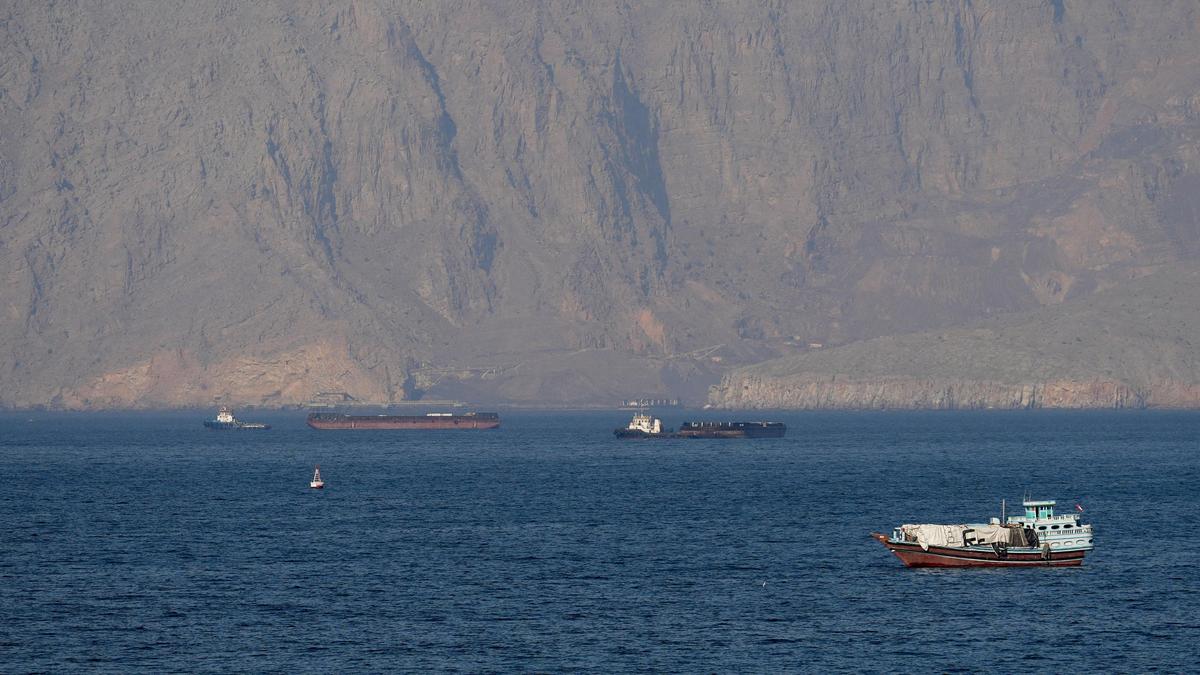
The Strait of Hormuz functions as the singular most critical artery in the global energy supply chain, facilitating the transit of approximately 21 million barrels of oil per day, or roughly 21% of global petroleum liquids consumption. When maritime assets become "stranded" or delayed within this corridor, the cost is not merely a localized operational delay; it is a systemic shock to global energy pricing and insurance premiums. The proposed Project Freedom initiative targets the mitigation of these specific friction points through a combined deployment of naval escort protocols, enhanced satellite surveillance, and diplomatic leverage. To evaluate the efficacy of such a policy, one must move beyond political rhetoric and analyze the three structural pillars of maritime security: physical transit protection, legal sovereignty over international waters, and the economic de-risking of commercial hull insurance.
The Triad of Maritime Obstruction
The concept of a "stranded" ship in the Persian Gulf generally stems from three distinct categories of disruption. Understanding these is essential for any strategy aiming to restore freedom of navigation.
- Kinetic and Asymmetric Threats: This includes the use of fast-attack craft, limpet mines, or unmanned aerial vehicles (UAVs) to disable propulsion or navigation systems.
- Regulatory and Legal Seizure: State actors often utilize "legal" pretexts—such as alleged environmental violations or collision claims—to justify the boarding and detention of vessels.
- Electronic Warfare Interference: GPS spoofing and signal jamming frequently cause vessels to drift into disputed territorial waters, providing the aforementioned legal pretext for seizure.
Project Freedom’s operational success depends on its ability to counteract these factors simultaneously. Providing a physical naval presence solves the first issue but does little to address the third without significant investment in hardened navigation technologies.
The Economic Impact of Transit Delays
A stranded vessel represents a massive liquidity trap. For a Very Large Crude Carrier (VLCC), the daily charter rate can fluctuate between $30,000 and $100,000 depending on market volatility. However, the true cost function is defined by the War Risk Surcharge.
When a geographic zone is declared a high-risk area by the Joint War Committee (JWC), insurance underwriters apply a premium that can reach 0.5% of the total value of the ship per transit. For a vessel valued at $100 million, this adds $500,000 in cost for a single voyage. Project Freedom attempts to suppress this cost function by lowering the probability of loss through active escorting. If the US Navy or a coalition force provides a continuous security umbrella, the justification for these surcharges diminishes, theoretically lowering the landed cost of energy.
The Mechanism of Escort Efficiency
Effective naval escorting is not a matter of simply placing a destroyer near a tanker. It requires a high-fidelity Maritime Domain Awareness (MDA) network. This involves:
- Persistent Overhead Surveillance: Utilizing Low Earth Orbit (LEO) satellite constellations to track every hull within 100 nautical miles of the chokepoint.
- Acoustic Monitoring: Deploying underwater sensors to detect the deployment of sea mines or the movement of quiet diesel-electric submarines.
- Encrypted Data Links: Ensuring that commercial vessels can receive real-time threat updates through military-grade communication channels without being vulnerable to spoofing.
Sovereign Rights and the UNCLOS Framework
The legal basis for Project Freedom rests on the United Nations Convention on the Law of the Sea (UNCLOS), specifically the right of Transit Passage. Unlike "innocent passage," which allows coastal states to suspend transit for security reasons, transit passage through international straits cannot be suspended by a bordering nation.
The friction in the Strait of Hormuz arises because Iran is not a party to UNCLOS, though it generally recognizes its provisions as customary international law. Project Freedom essentially serves as a kinetic enforcement of these legal norms. By positioning assets to prevent the boarding of commercial ships, the initiative shifts the burden of escalation back onto the obstructing state. The strategy moves from a reactive posture—negotiating for the release of ships—to a proactive posture of preventing the initial boarding.
Logistics of the "Freedom" Corridor
To move ships safely through the 21-mile-wide navigable channel, the initiative must manage the Flow Density Variable. The Strait is governed by a Traffic Separation Scheme (TSS), which consists of twond-mile-wide lanes (one inbound, one outbound) separated by a two-mile-wide buffer zone.
The limitation of any escort program is the ratio of security assets to commercial hulls. A single littoral combat ship cannot effectively protect a 10-ship convoy against a swarm attack of 20 or more small boats. Therefore, Project Freedom must utilize a Distributed Lethality model. This involves:
- Unmanned Surface Vessels (USVs): Using autonomous drones to act as "scouts" and physical barriers between tankers and approaching hostile craft.
- Rapid Response Airborne Assets: Maintaining carrier-based or shore-based rotary-wing aircraft capable of reaching any point in the Strait within five minutes.
- Cyber-Kinetic Integration: Disabling the command-and-control infrastructure of the harassing party before they reach the TSS.
Risk Factors and Strategic Limitations
While the initiative aims to stabilize the region, several bottlenecks remain. The primary risk is Inadvertent Escalation. A "freedom" operation that results in a direct kinetic exchange between state actors could lead to a total closure of the Strait, even if only temporary.
Furthermore, the strategy assumes that ship owners will comply with US-led escort protocols. Many global shipping firms are registered in neutral jurisdictions or carry flags of convenience (e.g., Panama, Marshall Islands). These entities may be hesitant to join a high-profile military escort if they believe it increases their profile as a target for retaliation elsewhere in the world.
The second limitation is the Inelasticity of the Global Tanker Fleet. If ships are delayed by even 48 hours for the formation of a convoy, the ripple effect on global refinery schedules is significant. Inventory management at discharge ports operates on a "just-in-time" basis. A policy that mandates convoys could inadvertently create the very supply constraints it seeks to avoid.
Technical Requirements for Implementation
For Project Freedom to move from a policy announcement to an operational reality, the following technical milestones must be achieved:
- Standardized Interoperability: Commercial ships must be equipped with secure transponders that allow military assets to distinguish them from potential threats in a crowded environment.
- Electromagnetic Spectrum Dominance: The ability to jam hostile drone frequencies while maintaining the integrity of the convoy's own communication and GPS signals.
- Regional Basing Agreements: Securing logistics and refueling hubs in neighboring littoral states to ensure 24/7 coverage without the need for constant carrier group presence.
The initiative represents a shift toward the securitization of trade routes as a primary function of foreign policy. By treating the Strait of Hormuz as a critical piece of global infrastructure rather than just a territorial waterway, the strategy seeks to decouple energy markets from regional geopolitical instability.
The most viable path forward involves the integration of private security contractors with state-level naval assets to create a multi-tiered defense depth. This reduces the direct political cost of military engagement while providing the high-volume coverage required for the hundreds of transits occurring monthly. The success of Project Freedom will be measured not by the number of ships "rescued," but by the eventual elimination of the war risk premium in the region.
The final strategic move is the deployment of a permanent "Blue-Gold" rotation of USV swarms paired with AEGIS-class destroyers. This creates a persistent, high-attrition barrier for any state actor attempting to interfere with the TSS. Simultaneously, a multilateral insurance fund should be established, backed by participating energy-consuming nations, to provide a sovereign guarantee against seizure, effectively bypassing the private insurance market’s volatility and stripping the incentive for ship-napping as a tool of economic warfare.