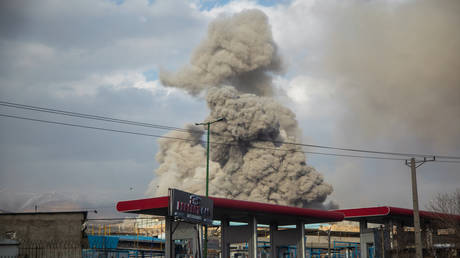
The wind in Khuzestan doesn't just blow. It carries weight. It carries a history of fire and a future of ash. When the first heavy drops of the "black rain" began to fall, the locals didn't run for cover because of a simple storm. They ran because the water hitting the pavement was the color of ink, a liquid eulogy for the oil fields burning on the horizon.
War is often measured in shell casings, territory lines, and the tragic geometry of troop movements. We count the dead. We count the displaced. But we rarely count the breath. We rarely measure the slow, silent strangulation of a coastline or the way a conflict half a world away can poison a child’s glass of water a decade later. In the crossfire of modern Iranian history, the environment hasn't just been a backdrop. It has been a casualty of high-intensity trauma.
The Ghost in the Lungs
Imagine a woman named Roya. She lives in Ahvaz, a city that has frequently claimed the unenviable title of the most polluted place on earth. Roya doesn’t need a sensor to tell her the air quality index. She feels it in the morning when she tries to take a deep breath and finds her chest tightening, a phantom grip that refuses to let go.
When conflict ignites, the immediate destruction is obvious. What is less obvious is the chemical cocktail released when industrial plants are leveled or oil wells are sabotaged. The "black rain" isn't a metaphor. It is the literal descent of particulate matter—soot, sulfur, and heavy metals—pulled from the smoke of burning refineries and dumped onto the farmlands that feed millions.
This isn't just a localized inconvenience. These particles are microscopic invaders. They bypass the body's natural filters, entering the bloodstream and settling in the deep tissue of the lungs. For Roya and her neighbors, the war never truly ended; it simply changed state from kinetic energy to cellular erosion. The spikes in respiratory distress and skin disorders following periods of heightened regional tension aren't coincidental. They are the biological ledger of a landscape under siege.
A Sea Without a Pulse
The Persian Gulf is a marvel of biology, a shallow, salty cradle that has sustained civilizations for millennia. But it is also a cul-de-sac. Because it is nearly enclosed, whatever enters its waters tends to stay there.
During periods of naval hostility or the targeting of offshore infrastructure, millions of barrels of crude oil have hemorrhaged into this delicate basin. To the casual observer, an oil spill is a black slick on the surface. To the marine biologist, it is a suffocating blanket. It cuts off the sunlight to the coral reefs—the rainforests of the ocean—and halts the process of photosynthesis.
Consider the dugong, the gentle "sea cow" that grazes on seagrass beds. When oil settles into the sediment, it doesn't just disappear. It lingers in the roots of the grass. The dugong eats the grass, the toxins build in its fat, and the reproductive cycle of an entire species begins to stutter and fail. This is the invisible price of a missile strike on a tanker. The explosion lasts seconds. The genetic damage to the Gulf’s biodiversity lasts generations.
The salt levels in the Gulf are already naturally high. When you add the debris of war—sunken vessels, unexploded ordnance, and the chemical runoff from scorched earth—the water becomes a brine of toxicity. Desalination plants, which provide the lifeblood of fresh water for the region, must work harder, consuming more energy and creating a feedback loop of environmental degradation that feels impossible to break.
The Scorched Earth of the Karun
The Karun River was once a symbol of Iranian fertility, a sprawling artery that turned the desert green. Today, it is a shadow of its former self, crippled by a combination of aggressive damming and the collateral damage of regional instability.
When a nation is focused entirely on survival or defense, the long-term stewardship of its water table becomes a luxury it feels it cannot afford. Waste management systems crumble. Industrial regulations are ignored in the name of wartime production. The river becomes a moving landfill for the byproducts of a society under pressure.
- Mercury and Lead: Found in high concentrations near former industrial battlegrounds.
- Nitrate Runoff: The result of desperate, over-fertilized farming on depleted soil.
- Salinity: As the freshwater flow drops, the sea pushes back, turning once-lush date groves into skeletal graveyards of gray wood.
The farmers in the Khuzestan plains don't talk about "environmental policy." They talk about the taste of their soil. They talk about how the dates, once the pride of the nation, now wither on the vine, choked by the salt that the river can no longer wash away.
The Psychological Erosion
There is a specific kind of grief associated with watching your home become uninhabitable. It’s called solastalgia. It is the homesickness you feel while you are still at home.
In the borderlands of Iran, this feeling is a constant companion. The dust storms, or "Haboobs," have grown more frequent and more intense. These aren't just sand; they are the dried-up remains of ancient wetlands like the Hawizeh Marshes, which were once a sanctuary for migratory birds and the unique culture of the Marsh Arabs. War and the strategic redirection of water have turned these wetlands into dust bowls.
When the wind rises, it picks up the desiccated bed of the marsh—rich with the residues of past conflicts—and carries it into the living rooms of millions. It covers the furniture. It blankets the cribs of newborns. It is a reminder that the environment is not something "out there" that we can protect or ignore. It is the very fabric of our daily existence.
The Silence of the Migration
Every year, millions of birds use the Iranian central plateau as a vital stopover on their journey from Siberia to Africa. They rely on the "islands" of green—the wetlands and forests—to refuel.
But birds do not understand borders, and they certainly do not understand no-fly zones or the chemical plumes of burning gas. When their stopover points are contaminated or destroyed, the chain of migration breaks. We often view the loss of a few bird species as a niche concern for hobbyists, but these animals are the sentinels of our planet's health. Their absence is a warning.
When the marshes go silent, it means the water is gone. When the water is gone, the people are next. The "environmental refugee" is no longer a theoretical concept for the future; it is a reality for thousands of families moving from the parched south toward the overcrowded hubs of the north, seeking a breath of air that doesn't taste like metal.
The Debt We Cannot Repay
We are accustomed to thinking of war as a debt paid in blood and money. We forget the debt we owe to the earth. Nature is a forgiving mother, but she is not a bottomless well.
The Iranian landscape is a testament to the fact that you cannot wound the land without wounding the people who stand upon it. The black rain, the dying reefs, and the salt-choked rivers are not separate problems. They are the same problem. They are the physical manifestation of a world that has forgotten that we do not inherit the earth from our ancestors; we borrow it from our children.
Roya sits on her balcony in Ahvaz as the sun sets, a deep, bruised purple behind a haze of dust. She wipes a layer of fine, gray grit from her tea table. It is the same grit that was there yesterday, and it is the same grit that will be there tomorrow. It is the dust of a thousand fires, the remains of a conflict that refuses to stay in the history books, choosing instead to settle in the lungs of the living.
The tragedy of the environmental disaster in Iran is not just that it happened. It is that it continues to happen every time we prioritize the machinery of destruction over the biology of survival. The earth doesn't care about our ideologies or our borders. It only knows when it can no longer breathe.
Would you like me to analyze the specific long-term health statistics of the Khuzestan region to further illustrate the impact of these environmental shifts?