A single ceramic tile on the belly of a multi-million dollar aircraft costs more than the farmhouse where the man launching a drone at it grew up. We have entered an era of profound, uncomfortable asymmetry. It is a time where the math of modern warfare has begun to cannibalize itself.
Think of a technician in a sterile, climate-controlled hangar in South Carolina. He is wearing white gloves. He is calibrating the radar-absorbent skin of an F-35 Lightning II, a machine that represents the pinnacle of human engineering, costing roughly $100 million. Every curve of that jet is designed to vanish from enemy screens. It is a ghost made of titanium and code.
Now, shift your gaze two thousand miles away to a dusty workshop in the Middle East. There is no climate control. There are no white gloves. There is a man with a soldering iron, some fiberglass, and a commercially available GPS unit meant for a delivery scooter. He is building a "suicide" drone for about $20,000.
The math is offensive. It is unsustainable.
The Night the Trillion Dollar Wall Cracked
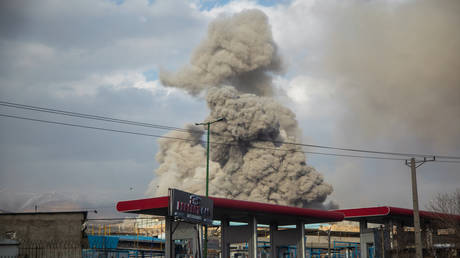
When reports surfaced of Iranian-led strikes successfully targeting high-value American assets—including the supposed invulnerability of the THAAD (Terminal High Altitude Area Defense) system and the deck of the USS Gerald R. Ford—the collective intake of breath in Washington was audible. These weren't just military skirmishes. They were a brutal audit of a balance sheet.
The THAAD is designed to intercept ballistic missiles in their terminal phase. It is a masterpiece of "hit-to-kill" technology. It is effectively trying to hit a bullet with another bullet in the blackness of space. But a masterpiece is fragile. When low-cost, slow-moving swarms of drones and inexpensive cruise missiles began to saturate these defenses, the "wall" didn't just hold; it became overwhelmed by the sheer volume of the mundane.
If you spend $2 million on an interceptor missile to knock down a $20,000 drone, you are losing the war even if you win the engagement. You are bleeding out through your wallet.
The Ghost in the Hangar
The F-35 was supposed to be the answer to everything. It was the "quarterback of the sky," a platform so advanced it would see the enemy before the enemy even knew a war had started. Yet, reports of these aircraft being hit or damaged on the ground or within contested airspace highlight a terrifying reality: stealth doesn't matter if the airfield is burning.
Precision is a luxury of the wealthy. Saturation is the weapon of the desperate.
Consider the USS Gerald R. Ford. It is the most expensive warship ever built, a $13 billion floating city. It is protected by layers of Aegis destroyers, Phalanx CIWS, and Rim-116 Rolling Airframe Missiles. It is a fortress. But when reports emerged of fires or near-misses from low-cost Iranian-supplied munitions, the psychological armor of the carrier strike group was pierced.
The Ford is a heavy-weight boxer. The swarm is a cloud of hornets. The boxer can kill any single hornet with a punch, but he cannot punch a thousand hornets at once. Eventually, he gets stung. And in modern naval warfare, a single "sting" from a shaped-charge drone can bypass billions of dollars of electronic countermeasures.
The Invisible Stakes of the Supply Chain
We often talk about "low-cost" strikes as if the only cost is the price tag of the drone. The reality is deeper. It is about the industrial capacity to replace what is lost.
The United States builds Ferraris. Iran and its proxies are building Honda Civics with explosives strapped to the hood.
If 16 U.S. aircraft are shot down or destroyed, the lead time to replace them is measured in years. The pilots—men and women who have spent a decade training—cannot be replaced by an assembly line. Each loss is a generational setback. Conversely, the factories producing "Shahed" style drones can be hidden in a basement, a garage, or a tunnel. They can lose a hundred drones today and have a hundred more ready by Tuesday.
This is the "Trillion-Dollar Flaw." We have optimized for quality to such an extreme that we have forgotten the brutal necessity of quantity.
The Human Element in the Crosshairs
Behind every headline about "THAAD knocked out" or "USS Ford ablaze," there is a terrifying human experience. Imagine being a radar operator on a destroyer. Your screen is cluttered. You see fifty, sixty, a hundred blips. Which one is a bird? Which one is a decoy? Which one carries the warhead that ends your life?
The stress of this asymmetry is a weapon in itself. It forces the high-tech power to stay at a permanent state of "Red Alert," burning through equipment and human sanity, while the attacker only needs to get lucky once.
We are witnessing the democratization of destruction. Technology that was once the exclusive province of superpowers—guided navigation, long-range propulsion, thermal imaging—is now available on the open market. The "invisible stakes" are that our expensive shields are becoming transparent.
The Reckoning of the High-Tech Doctrine
For thirty years, the West has operated under the assumption that "better" always beats "more." We believed that a single high-tech sensor could replace a thousand sets of eyes. We believed that a network-centric battlefield would make us untouchable.
But the desert has a way of grinding down even the finest gears.
The sand, the heat, and the relentless persistence of an enemy that doesn't care about "return on investment" have exposed a gap in our logic. We are playing chess; they are playing a game of attrition where the pieces are weighted differently.
When an F-35 is hit, it isn't just a loss of hardware. It is a blow to the myth of Western technological hegemony. It tells the world that the "Trillion-Dollar" defense budget has a soft underbelly that can be poked by a teenager with a remote control.
The Silent Pivot
So, where does the path lead when the shield starts to crack?
The conversation in the halls of power is shifting, albeit slowly. There is a realization that we cannot continue to trade $2 million missiles for $20,000 drones. The future of defense may not be bigger, more expensive jets, but rather our own swarms—cheaper, expendable, and numerous.
We are moving away from the era of the "unbeatable" platform and toward the era of "resilient" systems. It is an admission of vulnerability. It is a confession that the "Glass Shield" is no longer enough to stop the "Desert Stone."
The image that remains is not one of a grand explosion or a sinking ship. It is the image of that technician in South Carolina, looking at his white gloves, and realizing that the world outside the hangar has changed faster than the software in his jet could ever keep up with.
The most advanced military in history is currently being asked a question it isn't prepared to answer: What do you do when the enemy stops trying to outsmart you and simply decides to outspend you in blood and cheap plastic?
The answer isn't in a manual. It isn't in a trillion-dollar budget. It is in the realization that in the next war, the most important technology might be the one that is simple enough to break and cheap enough to replace.