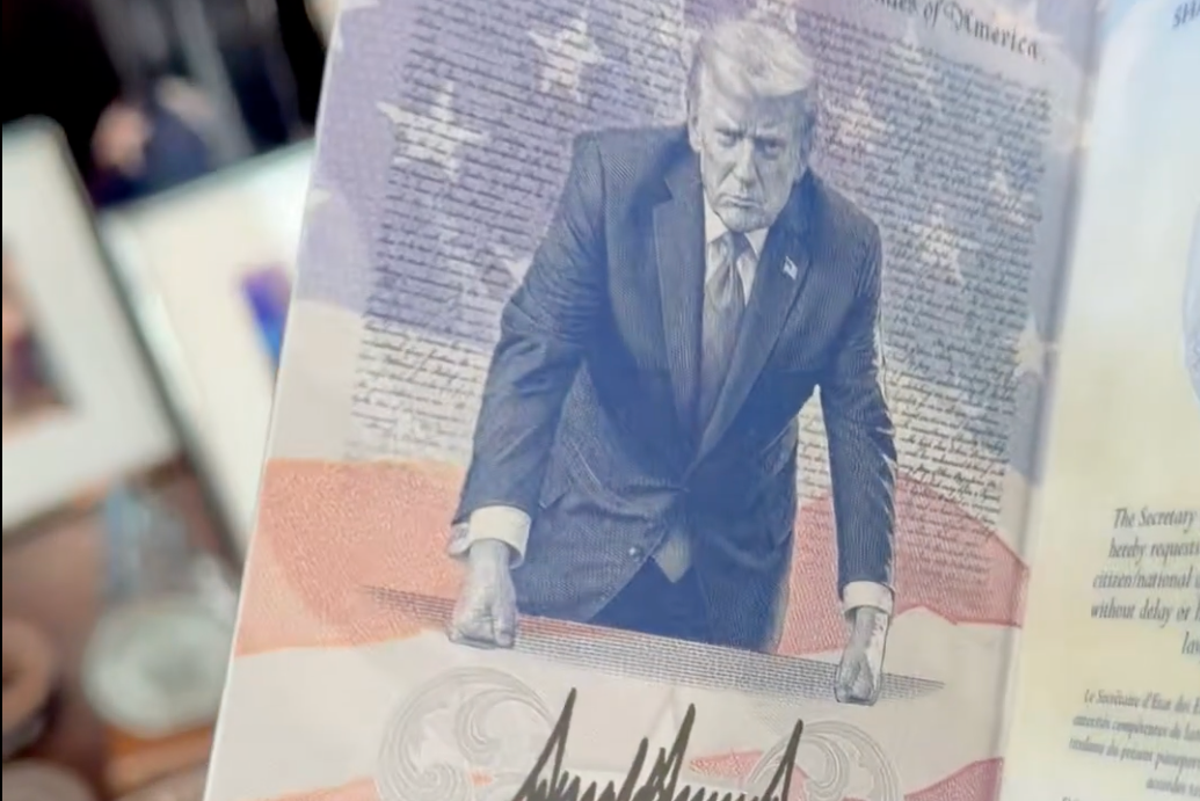
The institutional integration of a living executive into sovereign identity markers represents a structural shift in public administration branding. When the Department of State introduced the limited-edition commemorative travel document featuring a portrait of President Donald Trump alongside the text of the Declaration of Independence, public discourse largely reduced the event to partisan theater. Viral media coverage focused primarily on online commentary and individual social media posts by figures like Eric Trump, who displayed the document publicly. This framing obscures the underlying mechanism: the deliberate fusion of personal political capital with permanent state instruments during a major national milestone, specifically the nation's semiquincentennial.
Examining this phenomenon requires moving past superficial reactions to evaluate the administrative pathways, institutional precedents, and communicative strategies that govern modern state artifacts. Official documentation of this scale operates under strict bureaucratic parameters, yet it simultaneously serves as a primary vehicle for political signaling. You might also find this similar story insightful: Inside the Arctic Ship Seizure That Shatters Moscow Financial Immunity.
The Mechanics of Commemorative Bureaucracy
State-issued identification documents function as neutral instruments of legal verification and international transit. Altering their internal layout involves complex bureaucratic clearances governed by federal design standards. The integration of the semiquincentennial stamp, marked with the number 250, alongside historical iconography such as the founding figures, provides a contextual wrapper for the inclusion of the sitting executive.
The operational friction required to obtain these documents acts as an intentional filter. Because standard passport renewals follow automated or centralized mail-in pathways, requiring applicants to schedule dedicated in-person appointments at regional passport agencies creates a high-barrier tiered system. This structural constraint transforms a routine administrative product into an exclusive opt-in asset for a specific political demographic. As extensively documented in detailed coverage by The Washington Post, the results are notable.
- Administrative Segmentation: Standard renewals remain isolated from specialized commemorative editions.
- Friction Pricing: Requiring physical agency visits filters out casual applicants in favor of highly motivated constituents.
- Visual Hierarchies: Superimposing modern political portraits over historical text alters the traditional semiotics of official government paper.
Signaling Value and Polarization Matrices
The public reaction to the release of these specialized documents follows a predictable polarization matrix. Critics argue that incorporating a living leader into foundational state documents breaches long-standing norms of institutional neutrality, which historically reserved such placement for deceased historical figures or allegorical symbols. Proponents view the design as an effective assertion of nationalist branding tied directly to an administration's populist mandate.
This dynamic exposes a fundamental divergence in how different segments of the electorate interpret state symbolism. For the administration's base, official artifacts carrying distinct personal branding validate an anti-establishment narrative by permanently embedding current leadership into the physical fabric of government. For opponents, the same artifacts signal an erosion of institutional boundaries between partisan identity and the neutral apparatus of the state.
The resulting discourse generates asymmetric political returns. While critics amplify the perceived overreach through institutional pushback and viral counter-messaging, the administration leverages the controversy to reinforce brand loyalty among core supporters who prioritize direct, unfiltered identification with executive authority.
Resource Allocation and Public Attention Opportunity Costs
Public policy debates surrounding these branding initiatives invariably center on the allocation of administrative bandwidth. When government agencies dedicate resources to marketing specialized commemorative items—such as the expansion to hundreds of thousands of copies due to reported demand—legislative critics point to opportunity costs.
- Administrative Overhead: Processing specialized in-person applications diverts personnel from standard passport backlog reduction.
- Legislative Friction: Lawmakers focused on macroeconomic pressures, such as housing affordability and cost-of-living metrics, frame aesthetic state branding as a diversion from core governance.
- Institutional Precedent: Each instance of living-leader branding sets a new baseline for future executive administrations, potentially accelerating the politicization of civil service outputs.
The structural tension lies in the contrast between tangible economic concerns managed by the state and the symbolic utility of cultural branding. While citizens experience governance primarily through economic indicators, administrative agencies maintain discretionary authority over public messaging, commemorations, and visual identity systems.
Evaluate upcoming state artifact rollouts by monitoring the specific bureaucratic pathways utilized for distribution rather than focusing on episodic social media amplification. Track whether physical agency requirements remain mandatory or if distribution expands to automated channels, as this indicates the administration's priority shift between broad distribution and targeted base consolidation.