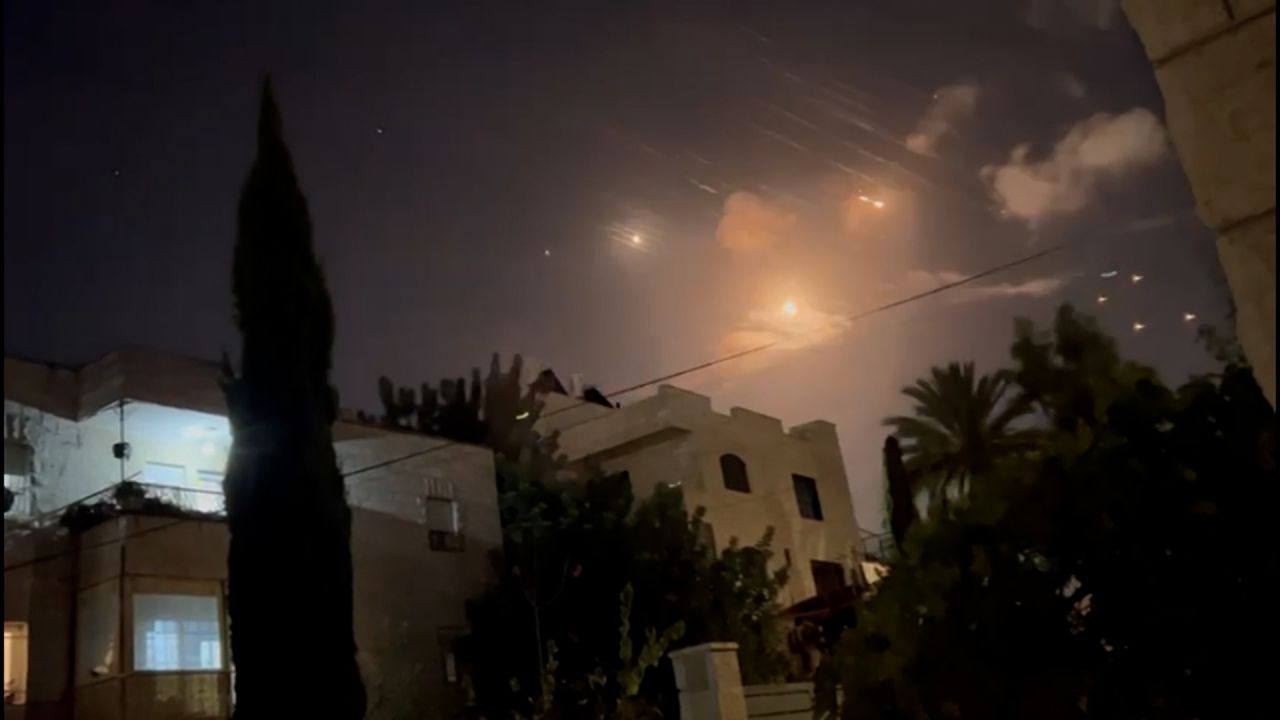
The sight of a ballistic missile streaking over the golden Dome of the Rock isn't just a terrifying military visual. It's a moment that shatters decades of unspoken red lines in the Middle East. On Saturday, March 21, 2026, as the region marked the end of Ramadan, an Iranian missile reportedly struck Jerusalem, landing just a few hundred meters from the Al-Aqsa Mosque compound.
This isn't just another headline about "heightened tensions." It’s a direct hit to the religious and symbolic heart of the world. While the Israeli Foreign Ministry quickly pointed to the event as proof of the "true face" of the Tehran regime, the reality on the ground is even more chaotic. For the first time in nearly 60 years, Muslim worshippers were barred from entering the mosque for Eid al-Fitr prayers. The streets that should have been filled with celebration were instead lined with police cordons and the jagged remains of high-tech weaponry.
The moment the sky fell on the Old City
Around 11:00 AM local time, the air raid sirens didn't just signal a drill. They signaled a direct threat to one of the most densely packed and holiest square kilometers on Earth. Footage shared by Israeli authorities appears to show a projectile descending rapidly toward the Old City before a massive explosion sends a plume of grey smoke into the air.
Reports from the Israel Defense Forces (IDF) and local police confirm that debris from an intercepted ballistic missile fell in the Jewish Quarter, roughly 400 meters from both the Western Wall and the Al-Aqsa complex. This isn't "close enough" in military terms—it’s a hair’s breadth away from a global catastrophe. If that warhead had drifted even slightly or if the interception had happened a second later, we’d be talking about the destruction of a site sacred to billions.
Where the debris actually landed
- The Jewish Quarter: Significant fragments caused property damage near a public playground.
- Church of the Holy Sepulchre: Shrapnel was recovered from roofs adjacent to the site where Christians believe Jesus was crucified.
- Al-Aqsa Plaza: Small fragments were found strewn across the floor of the compound, near the Dome of the Rock.
A broken tradition and a locked gate
You have to understand the gravity of closing Al-Aqsa on Eid. Since 1967, even during some of the worst periods of conflict, the mosque has generally remained open for the major holiday prayers. This year, the gates were slammed shut.
Israeli authorities cited "life-saving guidelines" and the risk of mass casualties from ongoing missile barrages. It sounds logical on paper, but for the thousands of Palestinians who showed up with prayer mats under their arms, it felt like a targeted erasure of their religious life. Instead of the usual 100,000-plus crowd inside the compound, you had smaller, tense groups praying on Salah al-Din Street and near security barriers, watched closely by armed police.
I’ve seen plenty of "security closures," but this one feels different. It’s an admission that the iron-clad protection people assume these holy sites have—either through divine intervention or diplomatic "off-limits" status—is gone.
The technology behind the terror
We’re not talking about crude Qassam rockets here. The projectiles being fired are sophisticated ballistic missiles. In previous attacks, Iran has used the Fattah-1 and Kheibar Shekan, missiles capable of reaching Israel from Iran in about 12 minutes.
The challenge for Israel's defense systems, specifically the Arrow 2 and Arrow 3, is that intercepting a ballistic missile over a city as old and tightly packed as Jerusalem is a nightmare. Even a "successful" interception, as we saw on Saturday, results in hundreds of pounds of hot metal falling at terminal velocity onto ancient stone buildings and residential neighborhoods.
What this means for the region
Tehran’s strategy has shifted. They’re no longer just operating through proxies like Hezbollah or the Houthis in a "shadow war." This is direct, state-on-state violence that doesn't seem to care about collateral damage to Islamic holy sites. By launching these salvos during Eid, the Iranian leadership is sending a message: no place is a sanctuary.
But there’s a massive risk for Iran here, too. If an Iranian missile actually destroyed the Al-Aqsa Mosque, the "Axis of Resistance" would lose its primary symbolic justification. The backlash from the wider Muslim world would be unprecedented. Yet, they keep firing.
What you need to know now
If you’re following this, don't just look at the maps. Look at the shift in policy. The closure of holy sites isn't a one-off event; it’s a sign that the "status quo" in Jerusalem is effectively dead.
Keep an eye on the following:
- Official IDF updates: They’re the first to confirm the type of missile used.
- The Waqf’s response: The Islamic trust that manages the site will likely take a hard line against further closures.
- Regional airspace: If Jordan or other neighbors stop intercepting over their own territory, the debris field in Jerusalem will only get worse.
Stay off the streets in the Old City during sirens. Shrapnel from a "successful" interception is just as deadly as a direct hit when you're standing in an open plaza.