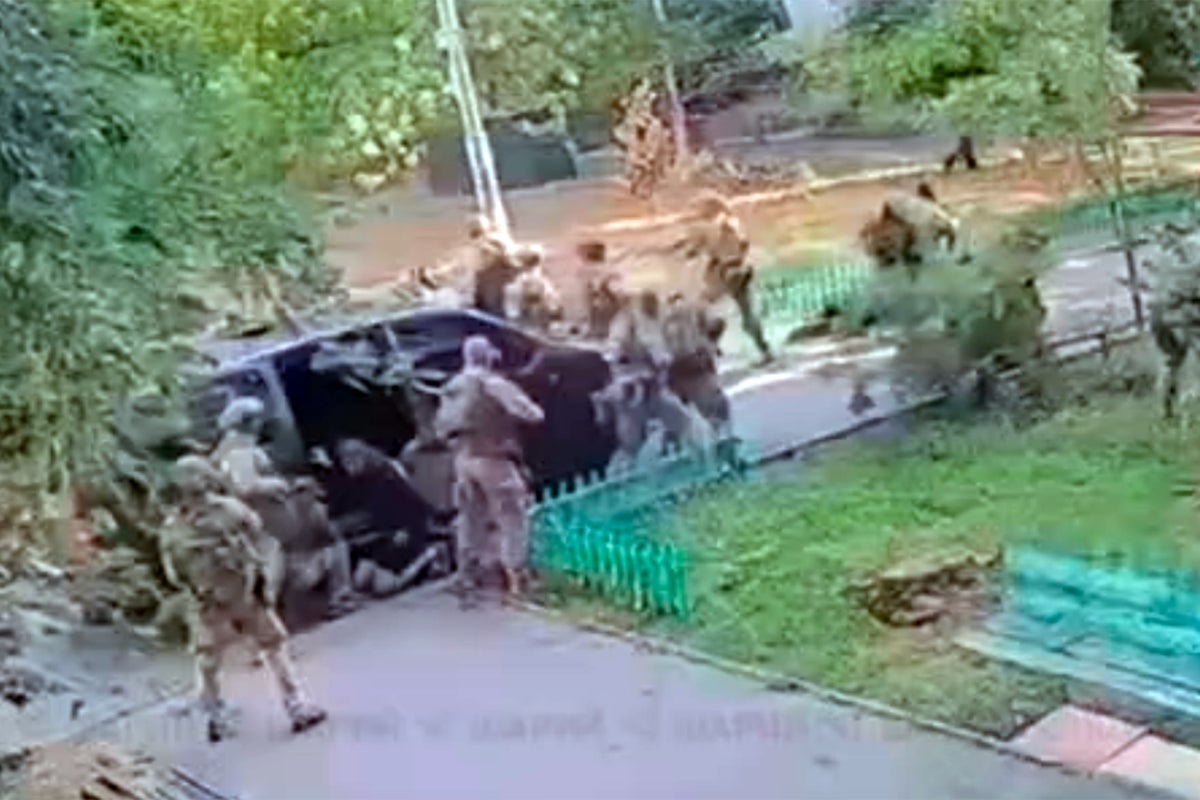
In a quiet residential courtyard on Yurii Shumskyi Street in Kyiv's Berezniaky neighborhood, the illusion of wartime administrative harmony shattered when operatives from Ukraine's two primary security agencies opened fire on each other.
The midday shootout on September 2, 2026, left three military intelligence fighters wounded, multiple individuals detained, and a sprawling institutional crisis laid bare for the capital to witness. On one side stood the Security Service of Ukraine, known as the SBU. On the other stood the Main Directorate of Intelligence, universally referred to as the HUR. Both structures share a nominal existential enemy in Moscow, yet their operatives traded automatic gunfire over a disputed counterintelligence sweep. This was not a confused frontline engagement under the cover of artillery smoke. It was an open turf war in a residential housing block complete with green and blue armbands, blocked vehicles, and elite Alpha special forces reinforcements.
President Volodymyr Zelenskyy immediately condemned the episode as an absolute disgrace, demanding sweeping internal accountability. Yet presidential reprimands miss the structural reality. The Berezniaky firefight is the inevitable byproduct of an uncoordinated, hyper-competitive intelligence apparatus that expanded exponentially after the 2022 full-scale invasion. When overlapping mandates meet unchecked institutional growth, jurisdictional disputes transform from bureaucratic paperwork battles into kinetic engagements.
The Anatomy of an Institutional Collision
Understanding why two allied agencies exchanged lead requires unpacking the contested timeline of the days leading up to the gunfire.
According to representatives and legal counsel for the HUR, the friction began in late August when SBU operatives allegedly detained Stepan Kaplunov, the deputy commander of the Russian Volunteer Corps—a military formation of Russian nationals fighting for Ukraine that operates under HUR oversight. For roughly a week, Kaplunov’s whereabouts remained obscure to his unit. Then, on September 1, SBU officers brought Kaplunov back to a Kyiv apartment utilized by HUR fighters to execute a search.
Military intelligence personnel caught wind of the operation, interpreted the move as a hostile seizure of their personnel, and mobilized to recover their comrade. What started as a localized confrontation escalated rapidly. Warning shots gave way to direct fire as additional HUR personnel arrived. By morning, the SBU deployed its elite Alpha counter-terrorism unit to reinforce its positions, resulting in a second, heavier burst of gunfire that wounded three intelligence officers.
The SBU's official narrative paints an entirely different picture. The domestic security agency maintains that the operation was part of a legitimate, urgent counterintelligence effort to thwart a Russian Federal Security Service plot. According to this version, Kaplunov had been recruited by Moscow to orchestrate the assassination of a prominent Russian opposition figure visiting Ukraine for Independence Day, alongside targeting other members of the Ukrainian armed forces. The SBU asserts that Kaplunov cooperated, providing critical intelligence, but when investigators attempted to execute follow-up searches and secure evidence, a group of armed individuals—identified as HUR-affiliated fighters—blocked their path with vehicles and launched an armed attack.
The State Bureau of Investigation and the Prosecutor General's Office stepped in to untangle these conflicting accounts. Both agencies are now tasked with determining who fired first in a courtyard designed for children's playgrounds, not tactical ambushes.
The Structural Roots of Inter-Agency Rivalry
Institutional friction between the SBU and the HUR is not a novel phenomenon born of this single autumn morning. It is a structural flaw hardwired into Ukraine's security architecture.
During peacetime, intelligence jurisdictions are neatly drawn on paper. The SBU handles domestic counterintelligence, counterterrorism, and the protection of state secrets, inheriting much of its structural DNA from the Soviet-era KGB. The HUR functions as an arm of the Ministry of Defense, explicitly designed for foreign military intelligence, strategic reconnaissance, and external special operations.
Total war obliterated those tidy boundaries.
The SBU transformed from a bloated, corruption-plagued domestic agency into a dynamic fighting force operating long-range sea drones, cyber warfare units, and frontline sabotage groups. Simultaneously, the HUR expanded its footprint far beyond traditional military reconnaissance, cultivating domestic networks, running independent paramilitary units composed of foreign and Russian volunteers, and executing high-profile operations inside both occupied territories and Russia proper.
When both agencies possess expansive domestic assets, independent special forces, and immense wartime budgets, operational overlap becomes constant. Turf wars cease to be metaphorical. In a system where success is measured by operational audacity and proximity to power, sharing intelligence is often viewed as ceding influence.
This rivalry has turned lethal before. In March 2022, during the chaotic opening weeks of the Russian onslaught, SBU counterintelligence officers shot and killed Denys Kireyev, a member of Ukraine's initial negotiation team with Russia, in central Kyiv. It was later revealed by military intelligence leadership that Kireyev was a valuable HUR asset who had provided critical warnings regarding the invasion timeline. The SBU never offered a comprehensive public accounting of that killing. No high-ranking officials faced public trial for gunning down a man carrying state intelligence credentials. Impunity breeds repetition. What happened as an opaque execution in 2022 metastasized into an open, filmed gunfight in broad daylight by 2026.
The Cost of Operational Anarchy
The immediate fallout extends far beyond political embarrassment for the presidential administration. Kyiv is currently enduring historic, sustained waves of Russian drone strikes designed to paralyze urban economic life and exhaust air defense networks. Citizens navigating air-raid sirens do not expect to hear automatic gunfire originating from competing factions of their own government.
For international partners supplying billions in military and financial aid, scenes of intelligence officers exchanging fire in residential districts feed into existing narratives concerning governance vulnerabilities and internal disarray. Transparency and institutional control are not secondary concerns; they are prerequisites for sustaining long-term external support.
President Zelenskyy's demand for thorough internal investigations and personnel changes—including the dismissal of select security officials—is a necessary baseline. Yet firing mid-level supervisors or reprimanding department heads treats the symptom while leaving the disease untouched.
As long as Ukraine's intelligence architecture encourages parallel structures with redundant capabilities and minimal institutional friction-reduction mechanisms, operational collisions will recur. A state fighting for its survival against a vastly larger neighbor cannot sustain a shadow war fought within its own command structure. The Berezniaky courtyard standoff serves as an unambiguous warning: if the boundaries between allied intelligence services are not defined by strict legal protocols and enforced command chains, the next friendly-fire incident may not end with mere injuries.
Kyiv shootout between SBU and HUR
This video provides a detailed news report and breakdown regarding the unprecedented armed clash and political fallout between Ukraine's SBU and HUR intelligence agencies in Kyiv.
http://googleusercontent.com/youtube_content/1