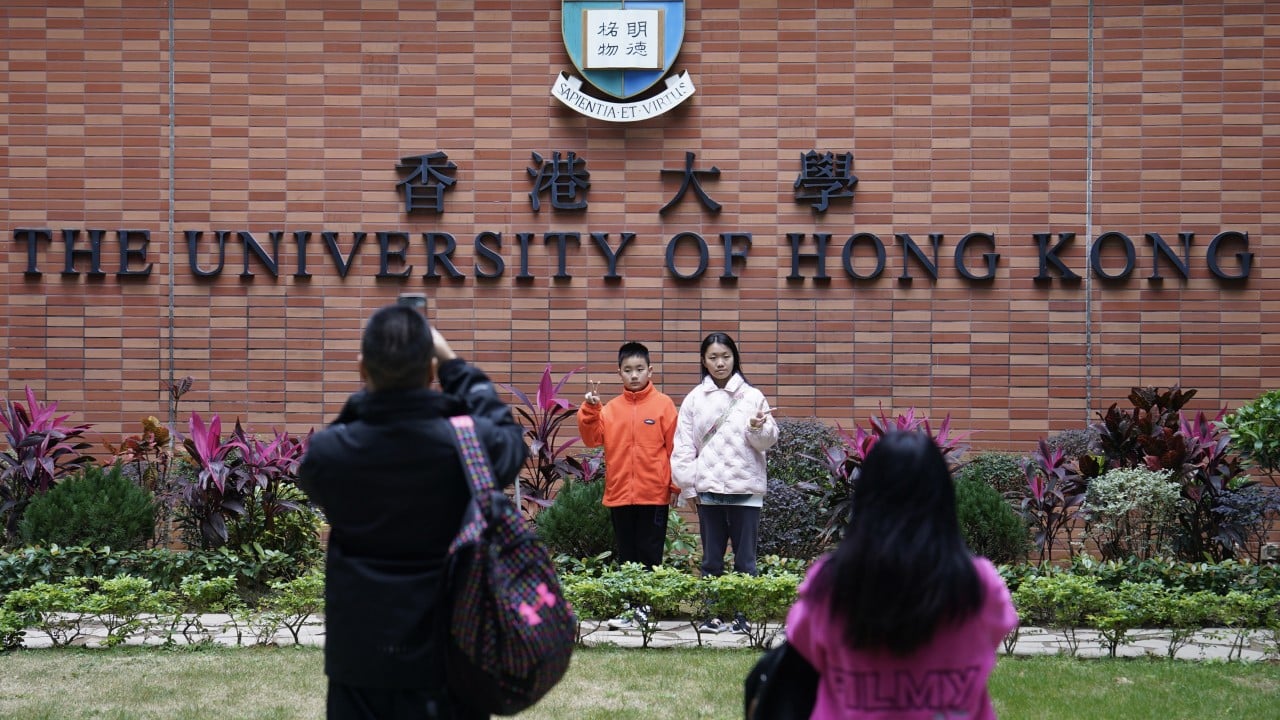
The traditional dream of a Western Ivy League education is hitting a cold, hard wall of geopolitical reality. For decades, the path for China’s academic elite was clear: dominate the gaokao, secure a high-scoring English proficiency certificate, and board a flight to London or Boston. That conveyor belt has stalled. A volatile mix of tightening US visa restrictions, rising anti-Asian sentiment in the West, and a staggering youth unemployment rate at home has forced a massive strategic retreat. Mainland students are not giving up on international standards; they are simply moving the destination closer to home. Hong Kong, once viewed as a secondary fallback, has emerged as the premier hedge against a fractured world.
The numbers tell a story of desperation and calculation. Applications from mainland China to Hong Kong’s top-tier universities—the "Big Three" of HKU, CUHK, and HKUST—have surged by double digits year-on-year. This isn't just about proximity. It is a sophisticated arbitrage play. Students are trading the uncertainty of a hostile American political climate for a "best of both worlds" scenario: a Western-style curriculum and English-language instruction, but with the safety of Chinese soil and a direct pipeline into the Greater Bay Area’s massive economy.
The Visa Weapon and the Death of the American Dream
For a Chinese STEM student, the US border has become a place of high anxiety. Under Presidential Proclamation 10043, thousands of graduates from specific Chinese universities are effectively banned from entering the United States for graduate study. This isn't a minor administrative hurdle. It is a systemic lockout. Students who have spent years preparing for careers in robotics, AI, or semiconductors now find their aspirations treated as national security threats.
The psychological impact of these denials ripples through the mainland’s middle class. Parents who have invested their life savings into their children’s education are no longer willing to gamble on a visa interview that might end in a summary rejection. The risk-reward ratio for a US degree has flipped. Why spend $300,000 on an education that might not even allow you to stay for a three-year OPT period? Hong Kong offers a degree that carries global prestige without the threat of deportation or the fear of being caught in a geopolitical crossfire.
Gaokao Fatigue and the Search for a Safety Valve
The internal pressure within the Chinese domestic system is the other half of the pincer movement. The gaokao remains one of the most grueling academic hurdles on the planet. With over 13 million students sitting for the exam in 2024, the competition for a spot at a "C9 League" university—China’s equivalent of the Ivy League—is statistically soul-crushing.
Hong Kong universities have positioned themselves as the ultimate safety valve. By accepting both gaokao scores and international curricula like the IB or A-Levels, they provide a multi-channel entry point. For the "middle-upper" tier of mainland students—those who are brilliant but perhaps not in the top 0.01% required for Tsinghua—Hong Kong provides a way to maintain elite status without the binary "pass-fail" trauma of the domestic system.
The Professional Pivot to the Greater Bay Area
Education is an investment, and the dividends are jobs. The current mainland job market is brutal. Youth unemployment figures have been so sensitive that the government temporarily halted their publication to recalibrate the data. In this environment, a degree is only as good as the network it provides.
Hong Kong is reinventing itself as the central hub of the Greater Bay Area (GBA). This regional integration project, linking Hong Kong and Macau with nine cities in Guangdong province, is designed to be a high-tech rival to Silicon Valley. Mainland students realize that a degree from a Hong Kong institution provides a unique "dual-literacy." They understand the international markets, but they are also physically and culturally integrated into the GBA.
The introduction of the Top Talent Pass Scheme (TTPS) by the Hong Kong government has acted as a massive magnet. This policy allows graduates from the world’s top 100 universities—which includes many of Hong Kong’s own institutions—to obtain a two-year work visa with almost no strings attached. It is a direct counter to the narrowing pathways in the US and UK.
The Cultural Comfort Zone
The safety factor cannot be overstated. Following the pandemic and the rise of populist politics in the West, reports of discrimination against Chinese students in Western cities have become staples of Chinese social media. Apps like Xiaohongshu are filled with "survival guides" for students abroad, detailing how to avoid street crime and racial vitriol.
Hong Kong offers a familiar cultural environment. The food, the language (even with the Mandarin-Cantonese divide), and the geographic proximity allow students to remain connected to their families. During the pandemic, the ability to take a high-speed train back to Shenzhen in 15 minutes became a luxury that no student in London could afford. This proximity has shifted from a convenience to a strategic necessity for families who feel the world is becoming increasingly unstable.
The High Cost of Quality
While Hong Kong is cheaper than New York or London, it is significantly more expensive than mainland China. Tuition fees for non-local students have been rising. Accommodation is a notorious bottleneck. Hong Kong’s housing market is the least affordable in the world, and university dorms are at breaking capacity.
This creates a socio-economic filter. The students moving to Hong Kong are often from the wealthy urban elite of Shanghai, Beijing, and Shenzhen. We are seeing a concentration of talent and capital that further widens the gap between the haves and the have-nots within the mainland system. Hong Kong is not just absorbing students; it is absorbing the next generation of China’s leadership class.
Institutional Stress and the Quality Control Challenge
The sudden influx of mainland applications is a double-edged sword for Hong Kong’s universities. On one hand, it drives up their entrance requirements and global rankings. On the other, it creates an atmosphere of "mainlandization" that some fear could erode the very international character that makes these schools attractive in the first place.
The challenge for administrators is maintaining a diverse, international student body while the primary "market" is overwhelmingly from across the border. If a classroom in Hong Kong becomes 90% mainland students, does it still offer the "international experience" that parents are paying for? This is the delicate balance that will determine if Hong Kong remains a global hub or becomes a regional branch office.
The Faculty Factor
Elite universities are built on faculty, not just students. Hong Kong has been aggressively recruiting top-tier researchers from Western institutions, often offering higher salaries and better research funding than their counterparts in the US or Europe. Many of these recruits are "sea turtles"—ethnic Chinese academics who are leaving Western tenured positions due to the "China Initiative" and other political pressures in the US. This "reverse brain drain" is fueling the rise of Hong Kong’s research output.
Economic Realism vs Academic Idealism
The shift toward Hong Kong marks the end of an era of academic globalization. We are moving toward a bipolar world where educational spheres of influence are being drawn along ideological lines. For the mainland student, Hong Kong is the only territory that sits on the fence.
It is a pragmatic choice made in a world that has stopped being pragmatic. The belief that education could be separated from politics has died. Students are now choosing their university based on where they will be allowed to work, where they will be physically safe, and where their passport won't be a liability. Hong Kong, for now, is the only place that checks every box.
The migration of talent is the most reliable leading indicator of future economic power. If the brightest minds of the mainland are looking south rather than west, the long-term impact on Western innovation will be profound. The "American Century" was built on the back of imported talent. By closing its doors, the US is inadvertently building the prestige of its competitors.
Hong Kong’s universities are the primary beneficiaries of this strategic blunder. They are no longer just schools; they are lifeboats for a generation of high-achievers who have been told they are no longer welcome in the West. The flow of talent has changed direction, and it is unlikely to reverse anytime soon.
Verify your eligibility for the Top Talent Pass Scheme and evaluate the ROI of a Hong Kong degree compared to a domestic "Double First Class" institution. The window for easy entry is closing as competition intensifies.