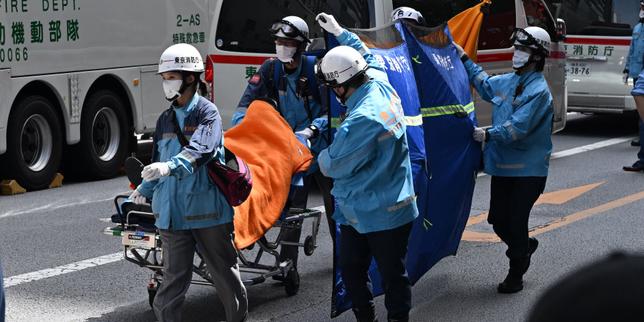
The recent incident in a Tokyo shopping center—where approximately 20 individuals required hospitalization following the intentional release of an unidentified airborne substance—exposes a critical vulnerability in the architecture of modern urban commerce. While mass media focuses on the sensationalism of the "attack," a rigorous analysis reveals this as a failure of environmental control systems and a demonstration of how high-density human bottlenecks amplify the efficacy of low-tech disruptions. The event underscores three distinct operational failures: sensory-based detection lag, the bottleneck effect of evacuation pathways, and the systemic strain on localized emergency medical infrastructure.
The Physics of Indoor Chemical Dispersion
The efficacy of an airborne irritant in a confined space is dictated by the interaction between the source strength, the spatial volume, and the Air Exchange Rate (AER) of the building's HVAC (Heating, Ventilation, and Air Conditioning) system. In the Tokyo incident, the rapid onset of symptoms across twenty individuals suggests a high-concentration release within a localized "dead zone" of the ventilation grid.
Airflow Dynamics and Concentration Gradients
Indoor environments are rarely uniform. Airflow is governed by mechanical forced air and "stack effects" caused by temperature differentials. When a substance is sprayed, it follows a predictable decay model:
- The Initial Plume Phase: High concentration, low volume. Immediate incapacitation of those in the 1-3 meter radius.
- The Dilution Phase: As the substance travels, concentration decreases while the "threat volume" increases. This is where the majority of the twenty victims were likely compromised.
- The Persistence Phase: The substance enters the HVAC return vents, potentially recirculating through other floors unless the system is equipped with high-efficiency particulate air (HEPA) filters or activated carbon scrubbers capable of gas-phase filtration.
Most commercial centers prioritize energy efficiency, which often involves recirculating up to 80% of indoor air. In a chemical release scenario, this efficiency becomes a threat vector, transforming a localized incident into a building-wide contamination event.
Human Factors and the Bottleneck Constraint
The hospitalization of twenty people is not merely a medical outcome; it is a mathematical function of pedestrian density and egress velocity. In high-traffic Tokyo hubs, the "Crowd State" often fluctuates between Stable and Unstable flow.
The Perception-Reaction Gap
There is a measurable delay between the moment of release and the moment of evacuation. This gap is comprised of:
- Sensory Recognition: The time required for victims to identify that coughing or eye irritation is an external threat rather than a personal ailment or environmental fluke (e.g., dust).
- Social Proofing: A behavioral phenomenon where individuals hesitate to flee until they observe others doing the same. This delay increases the "Dose-Response" duration, leading to more severe medical symptoms.
Throughput Limitations
When the "substance" was identified, the immediate reaction of the crowd created a surge toward exits. In architectural safety, this is analyzed via the Effective Width of corridors and stairwells. If the inflow of fleeing people exceeds the discharge capacity of the exits, a "crush point" forms. In this specific case, the physical symptoms caused by the spray (shortness of breath, dizziness) effectively lowered the walking speed ($v$) of the crowd, reducing the total outflow ($Q = \rho \cdot v \cdot w$, where $\rho$ is density and $w$ is width). This stalled movement kept more people in the contaminated zone for a longer duration.
Categorizing the Medical Load
The clinical response to an unknown substance in an urban center follows a triage hierarchy designed to prevent hospital saturation. Based on the reports from Tokyo, the victims likely fell into three categories of the Injury Matrix:
Primary Respiratory Distress
Victims closest to the source who inhaled the highest concentration. The physiological response involves bronchospasms and potential pulmonary edema. These individuals represent the "Immediate" priority in triage.
Secondary Ocular and Dermal Irritation
The majority of the twenty transported individuals likely suffered from mucous membrane irritation. While painful and incapacitating, these symptoms are often transient. However, in a high-density urban environment, the sheer volume of "Minor" cases can paralyze a Level 1 Trauma Center, diverting resources from life-threatening emergencies.
Psychogenic Mass Effect
In any chemical event, a portion of the hospitalized individuals may exhibit symptoms driven by acute stress response rather than chemical exposure. This is a recognized variable in disaster management. The challenge for responders is that the physical manifestations (tachycardia, hyperventilation) are indistinguishable from certain chemical exposures without rapid tox-screening.
The Cost of Information Asymmetry
The delay in identifying the specific substance released in the Tokyo mall creates a "Decision Vacuum." For the strategy consultant, this is a failure of real-time data acquisition.
Modern smart buildings are equipped with sensors for $CO_2$, humidity, and temperature, yet they are almost universally blind to Volatile Organic Compounds (VOCs) or particulate spikes associated with aerosolized irritants. This asymmetry means that the "First Responders" are effectively the victims themselves. By the time the Fire Department arrives to perform atmospheric monitoring, the plume has likely shifted, or the perpetrator has exited the radius.
The Economic Ripple Effect
Beyond the immediate medical costs, these incidents impose a "Security Tax" on urban commerce.
- Operational Downtime: The mall closure results in lost revenue for hundreds of tenants.
- Brand Erosion: High-end retail centers rely on the perception of a "controlled environment." An incident like this shatters the illusion of safety, leading to a long-term decay in foot traffic.
- Insurance Premiums: Future risk assessments for the property manager will now include "Malicious Chemical Release" as a high-probability, high-impact variable, directly hitting the bottom line.
Structural Recommendations for Urban Resilience
To mitigate the impact of future chemical dispersals in high-density zones, the following strategic shifts are required:
- Dynamic HVAC Zoning: Implementing "Automated Isolation Modes" where sensors (VOC or particulate) can instantly trigger a 100% outdoor air purge or shut down recirculation in the affected zone. This prevents the building from acting as a delivery mechanism for the substance.
- Visual Egress Signaling: Replacing standard "Exit" signs with dynamic lighting that can steer crowds away from the contaminated area and toward the safest exit based on real-time sensor data.
- Point-of-Care Tox-Screening: Equipping urban emergency units with portable mass spectrometry or advanced reagent kits to identify common irritants (pepper spray, mace, CS gas) on-site. This allows for immediate "Treat and Release" protocols, preventing the unnecessary clogging of hospital emergency departments.
The Tokyo incident was a small-scale demonstration of a massive systemic vulnerability. As urban centers become denser and more technologically integrated, the "Soft Target" profile of a shopping mall evolves. The defense is not more security guards, but a more intelligent building that can breathe, sense, and react faster than the people inside it.
The immediate strategic play for property developers is the integration of high-fidelity environmental sensors into the existing Building Management System (BMS). Investing in air-quality monitoring is no longer a "wellness" feature for LEED certification; it is a fundamental component of life safety and risk mitigation in a volatile urban landscape.