If you walk through the streets of Belgrade, Sarajevo, or Zagreb today, you'll see a world that looks remarkably European, polished, and—on the surface—settled. But talk to anyone over the age of fifty for more than ten minutes, and the conversation inevitably drifts toward a ghost. That ghost is a country that no longer exists. Understanding Yugoslavia before and after isn't just a history lesson; it’s about figuring out how a place that felt like the future for so many people ended up as a cautionary tale for the rest of the world.
History is messy.
Most people think of Yugoslavia as just another Soviet satellite. Honestly? That’s wrong. It was never behind the Iron Curtain. Josip Broz Tito, the man who held the whole thing together with charisma and a very firm hand, told Stalin to buzz off back in 1948. This created a "Third Way." It was a weird, fascinating hybrid of socialism and a market economy where you could actually buy Levi’s jeans and listen to Western rock music while still living in a worker-managed state.
Yugoslavia Before and After: The Golden Era vs. The Hard Truth
Before the collapse, the Yugoslav passport was basically gold.
Seriously. Because the country was "Non-Aligned," its citizens could travel to both the West and the East without much hassle. It was a unique privilege. People in Poland or Czechoslovakia looked at Yugoslavs with genuine envy. You had "Socialism with a human face." There was a middle class that took annual vacations to the Adriatic coast, drove small Zastava cars, and lived in brutalist apartment blocks that—back then—represented modern progress rather than urban decay.
The economy wasn't perfect, though. Let’s be real. By the late 1970s, the cracks were showing. The country was staying afloat on massive Western loans. When Tito died in 1980, the glue started to melt. Inflation didn't just go up; it exploded. We're talking about people running to the store to buy bread because the price would literally change by the time they walked home.
Then came the 1990s.
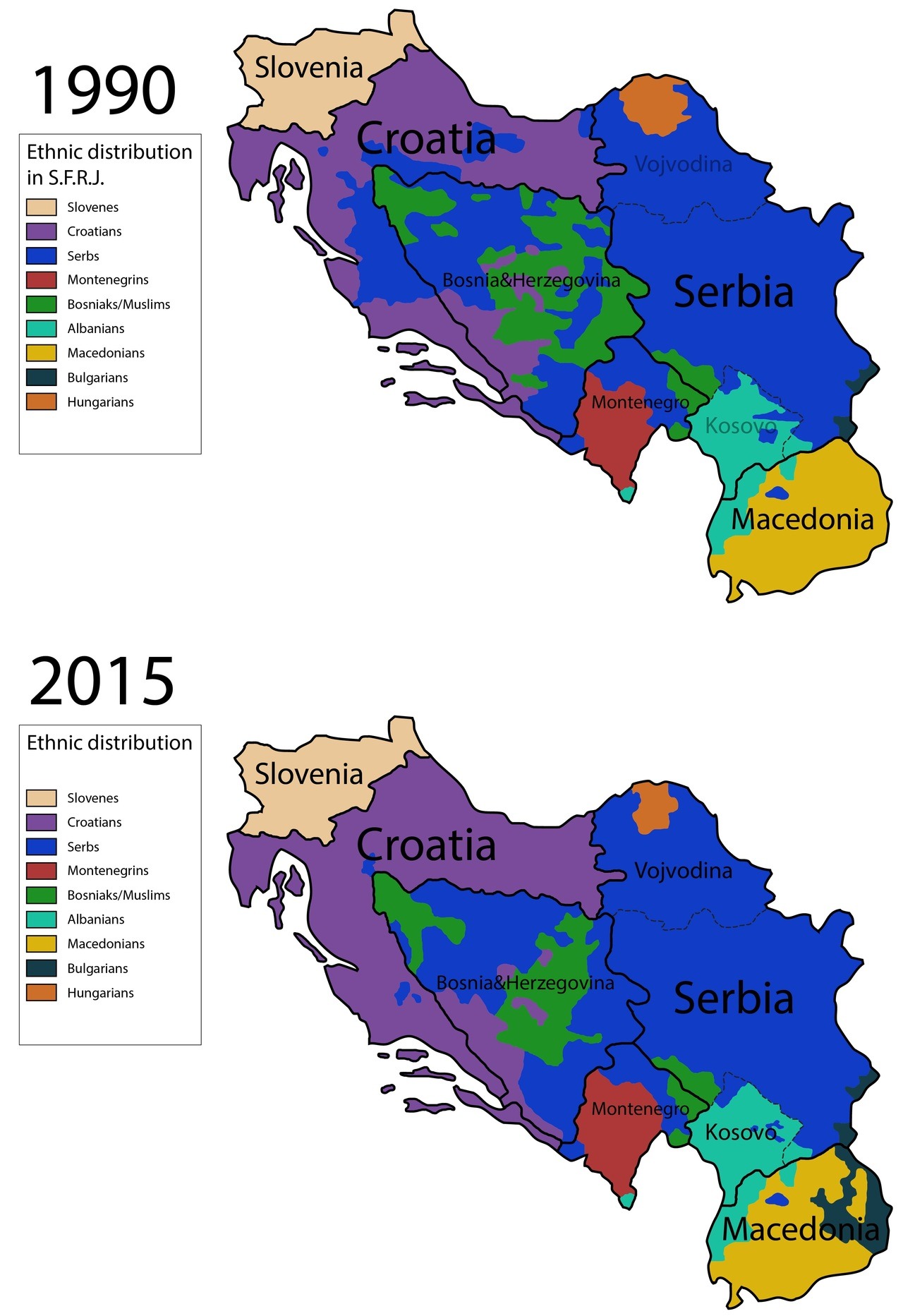
The "after" part of this story is usually what people know from the news—the Siege of Sarajevo, the Srebrenica massacre, the NATO bombings. The transition wasn't a transition; it was a violent amputation. Seven new countries eventually emerged: Slovenia, Croatia, Bosnia and Herzegovina, Serbia, Montenegro, North Macedonia, and Kosovo (though the last one’s status is still a geopolitical headache).
The Economic Shock of Independence
When the borders went up, the supply chains died. A factory in Serbia might have made the engines for a tractor, but the tires came from Croatia and the electronics from Slovenia. Suddenly, you needed a customs stamp to move a part fifty miles.
Slovenia and Croatia managed to pivot toward the European Union relatively quickly. They had the coastline and the proximity to Austria and Italy. But if you look at the "after" in places like Kosovo or parts of rural Bosnia, the economic stagnation is heavy. Unemployment spiked. Brain drain became the new national pastime. Basically, the smartest kids in the Balkans started moving to Germany or Ireland, and they haven't stopped since.
Why the "Yugo-nostalgia" Won't Go Away
You might wonder why anyone would miss a period of one-party rule. It's a valid question.
For many, it's not about the politics; it's about the security. In the "before" times, you had a job for life. You had a healthcare system that worked. You could sleep on a park bench and nobody would bother you. There’s a specific word for this feeling in the region: Yugonostalgija.
It’s fueled by the contrast of the "after." Today, the Balkan states are plagued by "stabilitocracy"—a term political scientists use to describe regimes that are technically democratic but feel pretty authoritarian because they prioritize stability over actual reform. Corruption is, frankly, exhausting for the locals.
- Slovenia: The overachiever. Joined the EU in 2004. High GDP, very "Alpine," feels more like Austria than the Balkans.
- Croatia: The tourism powerhouse. They adopted the Euro recently, which made the locals complain about prices but solidified their place in the West.
- Serbia: The complicated heart. It’s caught between wanting EU membership and keeping its traditional ties to Russia.
- Bosnia and Herzegovina: Still governed by the Dayton Agreement, which stopped the war but created one of the most complicated (and some say, dysfunctional) political systems on the planet.
The Cultural Landscape: What Changed?
The music survived. That’s the one thing that actually crossed the borders during the war and stayed there. "Turbo-folk" became the soundtrack of the 90s—a weird mix of traditional Balkan melodies and aggressive electronic beats. Even when the armies were shooting at each other, people on all sides were listening to the same singers.
Religion also made a massive comeback.
In Yugoslavia, the state was officially atheist. After the breakup, religious identity became a shorthand for ethnic identity. If you were Catholic, you were Croat. If you were Orthodox, you were Serb. If you were Muslim, you were Bosniak. This shift changed the physical landscape too. Thousands of new churches and mosques were built where community centers used to stand.
Practical Insights for the Modern Traveler or Researcher
If you're trying to understand Yugoslavia before and after by visiting the region today, don't just look at the monuments.
Look at the Spomeniks. These are massive, abstract, futuristic war memorials commissioned by Tito. They look like something out of a sci-fi movie. Many are crumbling now, scattered across mountainsides in the middle of nowhere. They are the perfect metaphor for the country: ambitious, confusing, and slowly being reclaimed by the earth.
What you should do if you want to see the "Before": Go to the Museum of Yugoslavia in Belgrade. They have the "House of Flowers," which is Tito’s mausoleum. It’s a strange, quiet place that still gets thousands of visitors who leave flowers on his grave. It’s not just old people either; you’ll see kids who weren't even born when the country collapsed.
What you should do to understand the "After": Visit the "Tunnel of Hope" in Sarajevo. It's a small section of the underground tunnel that kept the city alive during the siege. It’s a visceral reminder that the transition from a unified state to independent ones came at a staggering human cost.
The transition is still happening.
North Macedonia recently had to change its name just to appease Greece and keep its hopes of joining the EU alive. The borders are still tense in places. But there’s also a new generation that is tired of the old grudges. They are building tech startups in Sofia (which isn't Yugoslavia, but part of the broader Balkan boom) and Belgrade. They are making award-winning films.
Moving Forward: Actionable Insights
If you are researching the region or planning a trip to see the history for yourself, keep these things in mind:
- Check your history at the border. People are generally very friendly, but don't walk into a bar in Zagreb and start praising Serbian politics, or vice versa. The wounds are "old" in history years but "yesterday" in human years.
- Look for the "Yugo-tours." There are specific guided tours in almost every major Balkan city that focus on the socialist era. They use old Yugo cars to drive you around. It's a bit kitschy, but the guides are often history students who give you the nuanced version of the story.
- Read the literature. If you want the "soul" of the before and after, read Ivo Andrić (The Bridge on the Drina) or Slavenka Drakulić. They capture the psychology of the region better than any textbook.
- Acknowledge the complexity. Avoid the trap of "ancient ethnic hatreds." That’s a lazy Western narrative. The breakup was driven by specific political actors, economic collapse, and the opportunism of the late 80s.
Yugoslavia was a bold experiment. Whether it was a "noble failure" or a "doomed project" depends entirely on who you ask. What is certain is that the map of the Balkans is finally starting to feel permanent again, even if the memories of the old map are still being argued over in every smoky kafana from the Adriatic to the Danube.