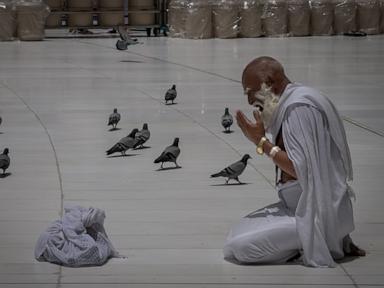
The heat does not merely sit in the air; it presses against the chest like a physical weight. On the plains of Arafat, the thermometer edges past 115 degrees Fahrenheit, but numbers fail to capture the sensory reality. The reality is the smell of asphalt softening under foot. It is the blinding glare of the sun reflecting off two million white cotton garments. It is the rhythmic, collective gasp of a sea of humanity breathing in air that feels like the exhaust of an engine.
Every year, the Hajj pilgrimage draws millions to the holy sites of Saudi Arabia. It is one of the five pillars of Islam, a duty to be fulfilled at least once in a lifetime by every able-bodied Muslim who can afford it. To the casual observer tracking the news, it looks like a massive logistical statistic. A headline about crowd control, infrastructure, or meteorological warnings.
But look closer.
Watch the elderly woman from Jakarta, her frail shoulders wrapped in the simple, unstitched ihram cloth. She has spent thirty years saving coins from a meager market stall just to buy her plane ticket. Her knees ache. Her throat is parched. Beside her walks a young tech executive from London, weeping openly, his bare feet callousing on the scorching gravel. Here, status is stripped away. The billionaire and the laborer stand identical, baked by the same sun, dust settling into the creases of their skin.
To understand the Hajj, you must understand that it is not a vacation, nor is it a mere ritual. It is a grueling, deliberate confrontation with one’s own mortality.
This year, however, the spiritual weight of the pilgrimage is compounded by a suffocating worldly anxiety. As millions gather to circle the Kaaba—the black cube that serves as the focal point of Islamic prayer—the geographical reality of the Middle East hangs heavily over the gathering. A few hundred miles to the northwest, the Gaza Strip remains engulfed in a devastating conflict. The ripples of that war vibrate through the crowds.
The Saudi authorities strictly prohibit political chanting or demonstrations during the Hajj. The focus, by law and by spiritual decree, must remain entirely on God. Yet, the human heart does not compartmentalize so easily. You see it in the quiet moments. In the corners of the Grand Mosque, pilgrims sink to their knees, tears streaming down their faces, whispering prayers not just for their own families, but for the children of Gaza, for peace in Yemen, for stability in Sudan. The silence of these prayers is louder than any protest march.
Consider a hypothetical pilgrim named Tariq. He is a schoolteacher from Algeria. He spent five years waiting for his name to be drawn in his country’s Hajj lottery. Now that he is finally here, standing where the Prophet Muhammad delivered his final sermon, Tariq finds his mind drifting between the divine and the deeply human.
"You feel a profound sense of privilege to be here," Tariq might tell you, his voice cracking from the dry air. "But you also feel a heavy ache. We are one body as Muslims. When one part of the body hurts, the whole body suffers from sleeplessness and fever. How can I pray for my own prosperity without begging for the lives of those under fire?"
This emotional duality is the invisible undercurrent of this year's pilgrimage. The contrast between the internal search for peace and the external reality of geopolitical fracture is stark.
Meanwhile, the physical trial escalates by the hour. The climate of the Arabian Peninsula has always been harsh, but recent years have pushed the region into uncharted territory. Climate data shows that the temperatures during the summer Hajj cycle are rising at an alarming rate. The Saudi government has responded with massive technological interventions. Giant misting fans line the pedestrian paths, spraying fine vapor to cool the air. Mobile clinics patrol the routes, their staff loaded with ice packs and rehydration salts. Volunteers hand out millions of bottles of cold water, which are emptied within seconds.
But technology has its limits against the raw power of the desert. Heatstroke is a silent predator. It begins with dizziness, a sudden cessation of sweat, a disorientation that makes the vast crowds look like a blur. For the young and fit, it is a severe challenge; for the elderly and infirm, it can be fatal.
Yet, the march continues.
Why do they keep walking? Why do millions willingly step into a furnace, carrying the emotional weight of a turbulent world on their shoulders?
The answer lies in the concept of Sabr—an Arabic word often translated as patience, but which truly means beautiful, steadfast endurance. To the pilgrim, the heat is not an administrative failure or a mere environmental hazard; it is part of the purification. The physical discomfort is a tool that breaks down the ego. When your throat is dry and your muscles are screaming, the superficial distractions of modern life burn away. You are left with nothing but your core essence, standing naked before your Creator.
The journey peaks at Mount Arafat, a granite hill rising from the plain. Here, pilgrims spend an entire afternoon standing in intense contemplation. This is the emotional crescendo of the Hajj. It is a dress rehearsal for Judgment Day, a space where time seems to fracture. Millions of voices rise in a low, resonant drone, reciting the Talbiyah: "Here I am, O Allah, here I am."
In this moment, the war concerns and the sweltering heat melt into something larger. The geopolitical boundaries that divide the map outside the sanctuary walls feel artificial. For a few hours, the global community of believers becomes a tangible, living reality. They are bound together by shared exhaustion, shared faith, and a shared yearning for a world that mirrors the peace they find in their prayers.
As the sun begins to dip below the horizon, casting long, purple shadows across the desert, the temperature drops by a fraction of a degree. A faint breeze sweeps across the plains. Two million people prepare to move to the next station of their journey, their white garments stained with dust and sweat, their bodies pushed to the absolute brink.
They will return to their home countries transformed. They will carry back the titles of Hajji and Hajja, marks of spiritual honor. But more than that, they will carry the memory of having stood shoulder-to-shoulder with strangers from every corner of the earth, proving that even in a world fractured by violence and scorched by a rising sun, humanity can still find a way to walk together in peace.