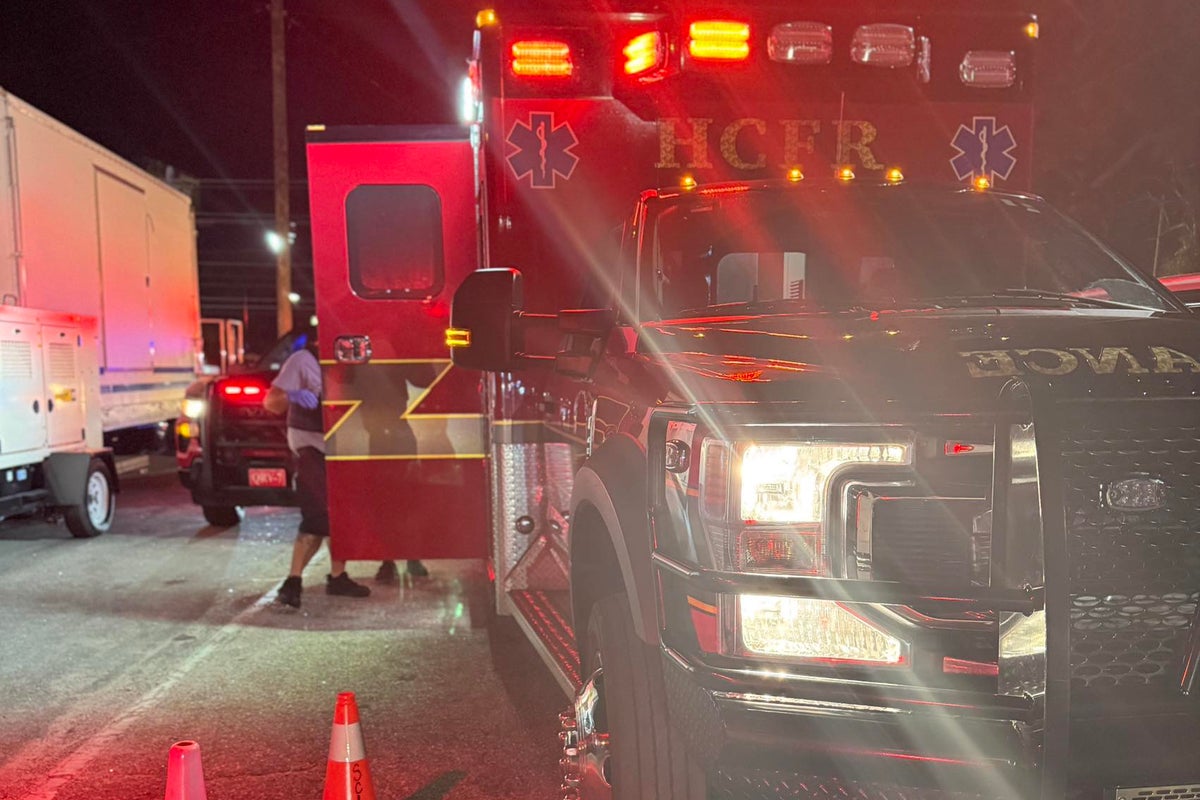
A sudden surge of panic ripped through the crowd at the annual Black Pearl Cultural Heritage and Bike Festival in Atlantic Beach, South Carolina, leaving 19 people injured in a frantic, multi-second stampede. The incident, which occurred just after 1 a.m. at a main stage area during the historic Memorial Day weekend gathering, triggered an immediate response from Horry County Fire Rescue and local law enforcement. Investigators later confirmed that the entire chaos was sparked not by gunfire, weapons, or an active threat, but by a single individual who started running, causing a catastrophic domino effect through the dense crowd.
While three people were hospitalized with non-life-threatening injuries, the incident serves as a stark reminder of a growing systemic issue in modern event management. We are treating crowd safety as a policing problem rather than a psychological and architectural challenge.
Every year, massive festivals draw hundreds of thousands of attendees into tightly confined municipal footprints. When anxiety running beneath the surface meets poor spatial layout, the results are predictably volatile. To understand why a crowd of 300,000 people can be destabilized in a matter of seconds, we have to look past the immediate headlines and examine the invisible mechanisms of crowd mechanics.
The Anatomy of a Phantom Threat
Crowd surges are rarely born out of malice. They are the physical manifestation of collective anxiety. In the case of the Atlantic Beach stampede, multiple law enforcement agencies, including the South Carolina Law Enforcement Division, verified that no actual threat to public safety existed. There were no shots fired, no brandished weapons, and no structural failures.
Instead, a single person ran. In a hyper-dense environment, running is interpreted by the human brain as an evolutionary alarm bell. If someone else is fleeing, your primitive survival instinct commands you to do the same, even if you cannot see what they are running from.
[Dense, Static Crowd]
       │
       ▼
[Single Individual Runs] (Trigger Event)
       │
       ▼
[Visual Alarm Signal Cascades to Neighbors]
       │
       ▼
[Phantom Threat Assumption] (Collective Panic)
       │
       ▼
[Physical Surge/Stampede] (Domino Effect)
This chain reaction takes less than five seconds to mature. By the time the third or fourth tier of the crowd receives the signal, the movement has amplified from a quick step into a desperate shove. The tragedy of the modern mass gathering is that our communal spaces are built to contain people, not to guide their psychology. When a crowd assumes a threat exists, containment structures like barricades and single-point exits become the very hazards that cause injury.
The Myth of the Unruly Festivity
Local officials are quick to defend their preparation, and in many ways, their tactical response was swift. Officers took to the stage to broadcast clear information, neutralizing the panic and allowing the festival to resume. Yet, the pre-emptive measures taken prior to the stampede tell a different story of structural strain.
Traffic into Atlantic Beach had already been suspended on consecutive nights due to safety concerns. One of the main performance stages was shut down early specifically to maintain crowd control. These actions are often framed as prudent administrative decisions, but they are actually symptoms of an infrastructure operating at its absolute limit.
When a municipality restricts movement and closes venues prematurely, it compresses the remaining crowd into a smaller number of active zones. Higher density directly correlates with an increased velocity of panic. If you crowd more bodies into fewer square feet, any ripple of motion becomes an immediate physical impact.
Why Modern Event Management is Failing
The traditional playbook for large-scale events relies heavily on an overt security presence to deter bad behavior. This strategy completely misdiagnoses the risk matrix of a modern festival.
Security guards and police officers are trained to look for active bad actors, such as shoplifters, fights, or armed individuals. They are not trained, nor are they positioned, to monitor fluid dynamics or psychological pressure points within a mass of humanity.
| Traditional Event Management | Advanced Crowd Dynamics Management |
|---|---|
| Focuses on law enforcement and threat deterrence | Focuses on spatial architecture and behavior |
| Uses rigid physical barriers to restrict movement | Uses dynamic routing to distribute crowd density |
| Relies on reactive announcement systems | Utilizes real-time density mapping and sightline clarity |
| Measures success by the absence of criminal acts | Measures success by the preservation of personal space bubbles |
When a crowd reaches a critical density threshold, individual agency disappears. People stop moving as independent actors and begin behaving like a liquid pool. If the fluid is compressed by barricades or restricted by narrow streets, any sudden disruption creates a shockwave.
The Blueprint for Predictive Safety
Fixing the systemic vulnerability of mass gatherings requires a shift from reactive policing to predictive spatial engineering. We must accept that human beings will panic under the right conditions, and we must design environments that dampen that panic rather than accelerate it.
Sightline Transparency and the Illusion of Safety
Panics accelerate because people cannot see why the crowd around them is moving. If a person sees someone running but can also clearly see fifty feet ahead that the path is clear, their brain registers the runner as an anomaly rather than a warning.
Event layouts must prioritize wide, unbroken sightlines. Stages should not be tucked into tight corners or dead-end streets. When attendees can visually verify their surroundings, the likelihood of a phantom threat taking root drops significantly.
Structural Venting
In engineering, high-pressure systems use relief valves to prevent catastrophic failure. Crowds require the exact same philosophy.
Instead of trapping a crowd inside a continuous perimeter of steel bike racks, boundaries must feature micro-escapes. These are one-way, easily displaced barrier segments designed to give way under a specific amount of outward physical pressure. If a surge occurs, the crowd naturally vents into adjacent empty spaces, resetting the density level before a crush can occur.
[Crowd Surge Area] ──> [Pressure-Sensitive Micro-Escape Barrier] ──> [Safe Empty Zone]
Real Time Density Telemetry
Waiting for a stampede to occur before taking action is a failure of modern logistics. Today's event organizers have access to real-time data that is rarely utilized for active safety routing.
By tracking automated Wi-Fi handshakes and using overhead cameras equipped with basic density-mapping software, safety directors can see exactly when a zone is approaching a critical state. If a specific intersection begins to bottleneck, ambient lighting and digital signage can automatically shift to guide incoming foot traffic away from the congestion point long before the crowd feels the squeeze.
The Cost of Inaction
The organizers of the Black Pearl Festival noted that this forty-year tradition shouldn't be defined by a single, isolated moment of panic. They are correct. The cultural footprint of an event that draws hundreds of thousands of visitors is a vital piece of heritage and local commerce.
The vulnerability observed in South Carolina is not unique to Atlantic Beach. It is present at every major music festival, sporting event, and parade across the country. We are continuing to host 21st-century crowds within mid-20th-century spatial designs, relying on luck and the quick reflexes of first responders to prevent tragedy.
Relying on a quick response after a crowd panics is no longer an acceptable standard of care. True safety lies in preventing the dominoes from being stacked closely enough to fall in the first place.