Rain hits the slate roofs of Belfast differently than it hits the granite of Aberdeen or the damp stone of Cardiff. Cold. Persistent. Familiar.
I have stood under that same gray drizzle in all three places, watching people fold umbrellas and step into doorways as if the weather were a language they had spoken since childhood. You learn early, walking those streets, that a single passport does not erase a thousand years of friction. Yet people still share pharmacies, pension systems, shipping lanes, and family WhatsApp groups where nobody ever quite agrees on who paid for dinner last time.
Now ask yourself a question that usually gets buried under constitutional jargon and late-night panel shows: what happens if Scotland, Wales, and Northern Ireland stop negotiating with Westminster one by one and start talking to one another?
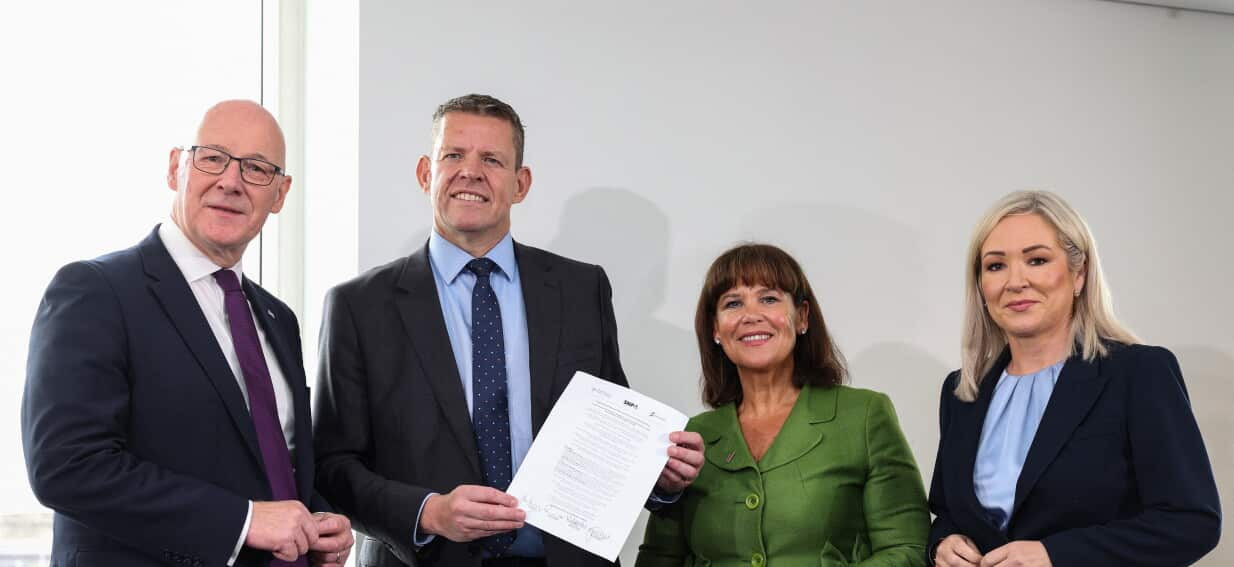
Not a formal treaty signed in mahogany-paneled rooms with cameras flashing. Nothing quite so tidy. Think smaller, sharper, and far harder to reverse—a quiet alignment of grievances, legal strategies, and bargaining habits across Edinburgh, Cardiff, and Belfast. A three-way solidarity pact, informal at first, then impossible to ignore.
Would that threaten United Kingdom unity?
The honest answer is uncomfortable: it does not need to shatter the union overnight to hollow it out from the inside.
The Myth of the Single Room
For decades, British constitutional politics treated devolution like a set of separate hallways branching off a main corridor. London sat at the end of the hall, holding the keys to the treasury, defense, and foreign affairs. Scotland had its parliament in Holyrood, Wales had its Senedd in Cardiff Bay, and Northern Ireland had its power-sharing assembly at Stormont. Whenever tension flared, Westminster dealt with each room on its own terms—offering a fiscal tweak here, a delayed legislative consent motion there, a warm speech about precious bonds.
That architecture assumed the rooms stayed soundproof.
They never were.
Consider a hypothetical scenario—a composite sketch built from real political currents rather than a single leaked memo. Picture three mid-level civil servants and policy advisers meeting off the record in a neutral city, perhaps Dublin or Edinburgh, during a tense winter of budget standoffs with Whitehall. None of them has authority to bind a government. Yet each carries the same bruised notebook of vetoes, delayed funding formulas, and court disputes over post-Brexit powers. Over coffee that goes cold before anyone finishes it, they realize their separate complaints rhyme.
Wait. Stop and look at what happens if that rhyme turns into a chorus.
In constitutional law, the UK relies heavily on conventions—unwritten rules about how ministers behave, how devolved legislatures are consulted, and how power is shared without a single codified constitution. Conventions work best when everyone agrees on the polite fiction holding them together. The moment three of the four nations decide that bilateral bargaining with London is a losing game, the polite fiction starts to fray.
I admit freely that mapping this future makes me uneasy. Constitutional shifts sound dry until you realize they decide who gets emergency hospital funding, which ports face customs checks, and whether a teenager in Derry or Swansea feels like a full partner or an afterthought. Even seasoned legal scholars argue over how far intergovernmental bodies can bend before breaking.
Why England Changes the Math
You cannot talk about British unity without reckoning with scale. England holds roughly eighty-four percent of the UK population. Scotland accounts for roughly eight percent, Wales around five percent, and Northern Ireland just over three percent.
Numbers like those shape instincts long before anyone opens a constitutional textbook.
In Westminster, a government can win a comfortable majority while barely winning seats in Scotland or Wales, and with only a handful of constituencies in Northern Ireland. That arithmetic is legal. It is also deeply frustrating for politicians and voters in the smaller nations who watch policies designed around English housing markets, English health trusts, or English energy grids roll out across the whole island anyway.
To understand the emotional weight of this, picture a metaphor: a four-person family sharing a kitchen where one person cooks eighty-four percent of the meals, buys most of the groceries, and insists everyone eat at the same hour—while the other three take turns complaining that the salt shaker is always out of reach. You can argue endlessly about who pays the mortgage. What lingers is the feeling of being managed rather than heard.
Now imagine the three smaller cooks comparing notes.
Even without a formal alliance, Scotland, Wales, and Northern Ireland already share structural realities that distinguish them from England. Each has a devolved legislature with its own political party ecosystem. Each has wrestled with the Internal Market Act, which allows goods and services meeting standards in one part of the UK to circulate in others, a mechanism critics in Edinburgh and Cardiff argue can undercut devolved standards in agriculture, environment, and public health. Each has watched debates over competence and consent play out in courts and committees.
A pact among the three would not need to demand immediate independence for all of them. Think about how much more dangerous—and politically clever—a softer coordination would be.
Suppose Edinburgh, Cardiff, and Belfast begin synchronizing their demands on intergovernmental councils. Suppose they coordinate legal challenges, share economic modeling on trade barriers, or present joint positions on green energy transmission charges. Suddenly, London is no longer negotiating with one smaller nation at a time. It faces a bloc representing roughly sixteen percent of the population, speaking with overlapping arguments about fairness, asymmetric devolution, and democratic consent.
Three Distinct Fault Lines, One Shared Leverage
Yet a three-way pact is not automatic. In fact, the differences between Scotland, Wales, and Northern Ireland are often just as sharp as their shared frustrations with Whitehall.
Let us look at the human stakes inside each nation, because abstractions dissolve the second you picture a kitchen table.
Take Claire, a hypothetical logistics coordinator in Larne, Northern Ireland. Her job depends on frictionless movement across the Irish Sea and smooth supply chains reaching both Dublin and Glasgow. Since Brexit and the Windsor Framework arrangements, Northern Ireland has occupied a unique constitutional space—part of the UK customs territory while following specific EU single-market rules for goods to avoid a hard land border with Ireland. For Claire, constitutional theory is not an evening debate; it is paperwork, port delays, and whether her employer keeps an evening shift.
Now shift to Gareth, a hypothetical wind-turbine technician living near Newtown in mid-Wales. Around him, hills that once pulsed with coal and slate history are increasingly lined with blades turning against low Atlantic clouds. Wales generates vast amounts of renewable power, yet residents often ask why grid charges and infrastructure decisions feel tilted toward London and the southeast of England. Gareth does not wake up chanting constitutional slogans. He notices when local schools struggle with budgets while energy wealth leaves the valley.
Move north again to Fiona, a hypothetical nurse in Dundee. Her mother’s care package, her own wage negotiations, and her brother’s decision to take a job in Manchester all sit at the intersection of Holyrood budgets and Treasury block grants. In Scotland, the independence question has been a living fault line for over a decade, splitting neighborhoods and dinner tables even when constitutional talk recedes from front pages.
Claire, Gareth, and Fiona do not live identical lives. Northern Ireland has a peace settlement and cross-border constitutional dynamics with the Republic of Ireland that have no parallel in Great Britain. Scotland has a deep-rooted independence movement and distinct legal and educational traditions. Wales has a reviving language, a younger devolved institution, and a growing sense of national confidence without a majority for leaving the UK.
So why would a pact even be on the table?
Because shared leverage does not require identical goals.
In politics, strange coalitions form whenever three players realize they lose separately what they might win together. Scotland wants maximum autonomy or independence. Wales wants stronger fiscal powers, fairer infrastructure funding, and recognition as an equal partner rather than a junior branch. Northern Ireland wants stability, protection for its unique trade position, and respect for the Good Friday Agreement framework.
If Edinburgh, Cardiff, and Belfast quietly align around a single principle—that Westminster cannot unilaterally reshape shared rules without genuine multilateral consent—each capital gets something useful without surrendering its own red lines.
How a Union Actually Unravels
People tend to imagine the end of a union as a dramatic midnight ceremony: flags lowered, speeches given, borders redrawn on a Tuesday morning.
History rarely works like a movie script.
Unions usually weaken through erosion. A convention ignored once becomes a precedent twice. A dispute over funding turns into a dispute over legitimacy. Citizens start treating national institutions as foreign bureaucracies, and politicians discover that picking fights with London polls better at home than compromising.
I remember talking years ago with someone who had lived through a bitter regional autonomy dispute in another European country. What struck me was not the anger in the streets—it was the exhaustion. People grew tired of explaining their daily realities to capitals hundreds of miles away. Once trust sinks below a certain waterline, every technical disagreement looks like malice.
A Scottish, Welsh, and Northern Irish pact would test the UK’s trust waterline directly.
Consider what happens to the United Kingdom’s self-image if three of its four nations treat the center as an adversary to be managed collectively. Even if Scotland stays in the UK, even if Wales votes down independence in any hypothetical poll, even if Northern Ireland remains within the union under existing agreements, the political center of gravity shifts.
The UK is not merely a territory. It is an idea: that four nations can pool sovereignty, share risks, and belong to a larger story without erasing who they are. Strip away that shared story, and what remains is a balance sheet and a set of statutes. Balance sheets hold coalitions together in boom times. They rarely survive prolonged stagnation, housing crises, or constitutional resentment.
What London Gets Wrong—and What It Can Still Fix
When commentators ask whether a devolved pact threatens UK unity, they often frame it as a security threat or a constitutional crisis waiting to happen. That framing misses the human reality.
Most people in Scotland, Wales, and Northern Ireland are not waking up hoping for chaos. Claire wants steady freight schedules. Gareth wants fair bills and good local jobs. Fiona wants a health service that does not buckle every winter. Political alliances among the devolved nations gain oxygen precisely when ordinary people feel that solo pleading with Westminster produces polite letters and zero movement.
If London treats a three-way devolved pact purely as disloyalty, it will pour fuel on the fire. Heavy-handed centralism—bypassing devolved institutions, shrinking shared decision-making bodies, or treating intergovernmental forums as rubber stamps—is the fastest way to turn cautious coordination into permanent bloc politics.
Conversely, what would genuine renewal look like?
It would mean taking intergovernmental relations out of the shadows. Real joint decision-making on shared infrastructure, fiscal fairness, and trade rules—where Edinburgh, Cardiff, and Belfast are not merely briefed after decisions are made, but heard before they lock in. It would mean acknowledging that asymmetric devolution is not a temporary glitch to be smoothed over, but the permanent reality of a multinational state.
I cannot promise that better machinery alone would quiet every nationalist argument. Some people believe the UK has run its course, and no reform will persuade them otherwise. Still, there is a vast middle ground of persuadable, pragmatic citizens who care far more about competence and fairness than constitutional purity.
That middle ground is where the real battle for UK unity lives.
The Quiet Test Ahead
Look again at those three rainy cities—Belfast, Cardiff, Aberdeen.
No secret treaty is required for a pact to begin. It can start with a shared briefing paper on energy grids, a coordinated push on regional rail funding, or a joint complaint when a bill touches devolved powers without consent. Small moves. Quiet moves. The kind that barely make the top of the news until you step back five years later and realize the center no longer sets the agenda alone.
A Scottish, Welsh, and Northern Irish pact might not break the United Kingdom tomorrow. Yet it would expose a truth Britain has spent generations dodging: unity is not enforced by ink on parchment. It is renewed, or lost, in how fairly four nations treat one another when the rain is falling and nobody wants to share the last umbrella.