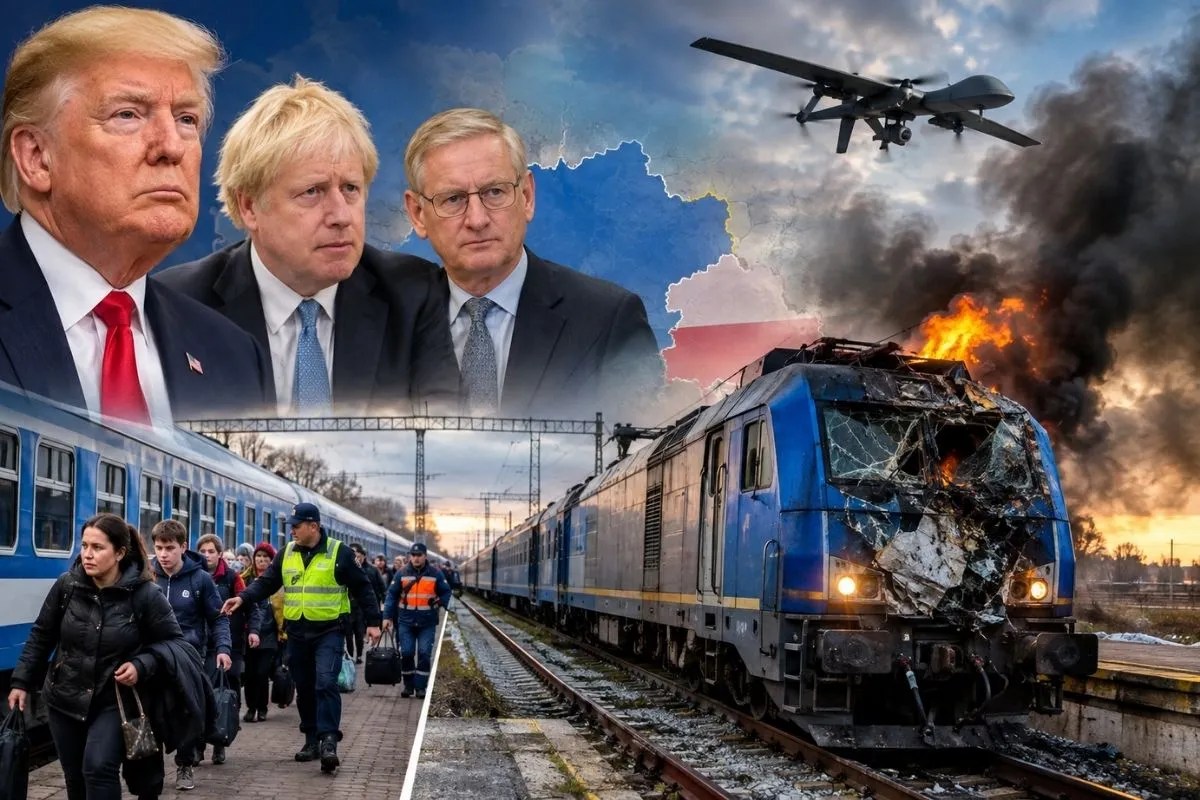
The iron arteries running through western Ukraine are the last dependable lifeline of a nation under siege. When a Russian drone strike slammed into a locomotive near the Polish border, interrupting a corridor used by former British Prime Minister Boris Johnson and high-profile European delegations, international headlines fixated on the narrow margins of survival. Two hundred and six passengers faced sudden evacuation as air raid alarms pierced the predawn chill just kilometers from NATO territory.
Yet focusing solely on the celebrity names aboard misses the structural reality of the conflict's expansion. This was not a random stray munition or an errant guidance system. It represents a deliberate, calculated escalation targeting the logistical choke points that sustain both civilian survival and allied diplomatic transit.
The Geography of Vulnerability
Western Ukraine has long functioned as the logistical backbone for everything entering the country, from humanitarian aid to high-level diplomatic missions. Rail lines like the Yahodyn crossing corridor handle traffic that cannot fly through closed airspace. Because civilian air travel remains grounded, rail transport is the primary vector for foreign leaders, intelligence chiefs, and international observers visiting Kyiv.
When long-range munitions strike these specific rail hubs, the message from Moscow transcends tactical sabotage. It is an operational stress test against Western resolve. Russian military planners understand the precise schedules and movement patterns of these corridors far better than public disclosures admit. Targeting infrastructure within artillery and drone range of the Polish border signals an explicit willingness to push kinetic actions to the absolute doorstep of the European Union and NATO.
The mechanics of these strikes rely on loitering munitions designed to exploit gaps in regional air defense blankets. While major cities like Kyiv or Lviv retain prioritized anti-air architectures, secondary logistics routes often operate with thinner coverage. Moscow has systematically exploited this delta. By hitting locomotives and switching stations near border checkpoints, the objective is to create operational paralysis. If foreign dignitaries can be pinned down or forced into field evacuations, the psychological deterrent grows exponentially.
The Intelligence Failure and Protocol Realities
Behind closed doors in European security capitals, the incident triggered immediate post-mortems regarding operational security leaks. High-level travel into a combat zone inherently carries acute risk, but compartmentalization is supposed to mitigate it. When a special transport carrying senior political figures is intercepted or forced to halt due to active kinetic strikes on the same line, it points to persistent vulnerabilities in signal security and movement observation.
Intelligence analysts tracking Russian electronic warfare capabilities note that tracking high-value passenger trains requires minimal sophistication. Commercial rail monitoring, combined with localized spotters and persistent satellite reconnaissance, allows command centers in Russia to map transit windows with high fidelity. The evacuation protocol—while executed efficiently by Ukrainian railway personnel—exposed the fragility of moving VIPs across a combat theater where air superiority belongs to no single power.
The immediate political fallout saw foreign ministries trading sharp rhetoric. Ukrainian officials reiterated that every strike near the western frontier is a direct provocation aimed at the alliance. Conversely, Western capitals are forced to recalibrate how much risk they are willing to absorb for face-to-face diplomacy. Every time a former premier or a security advisor has to scramble off a halted train into a roadside shelter, the cost-benefit calculus of physical presence in Kyiv shifts.
The Broader Logistical Squeeze
To view this event purely through the lens of political drama is to misunderstand the broader campaign. The attack on the border rail infrastructure runs parallel to sustained operations against energy grids, fuel depots, and transport nodes across Ukraine. Moscow is attempting to compress the operational space available to the Ukrainian state, forcing a choice between military resupply and civilian transit continuity.
As winter approaches, the strain on these transit vectors multiplies. Damaged locomotives cannot easily be replaced, and specialized repair parts take time to source from European partners. Every successful strike on a border hub ripples outward, creating cascading delays in freight movement and passenger mobility.
The near-miss involving international delegations served as a stark, unavoidable reminder that the geographic firewall separating the war from Western territory is razor-thin. The structural pressure on these transit corridors will only intensify as long-range attrition remains the dominant mode of engagement. The smoke clearing near the Polish border has left behind a permanent alteration in how European security architects view the safety of the iron road.
The border is no longer a spectator to the conflict. It is the frontline.


