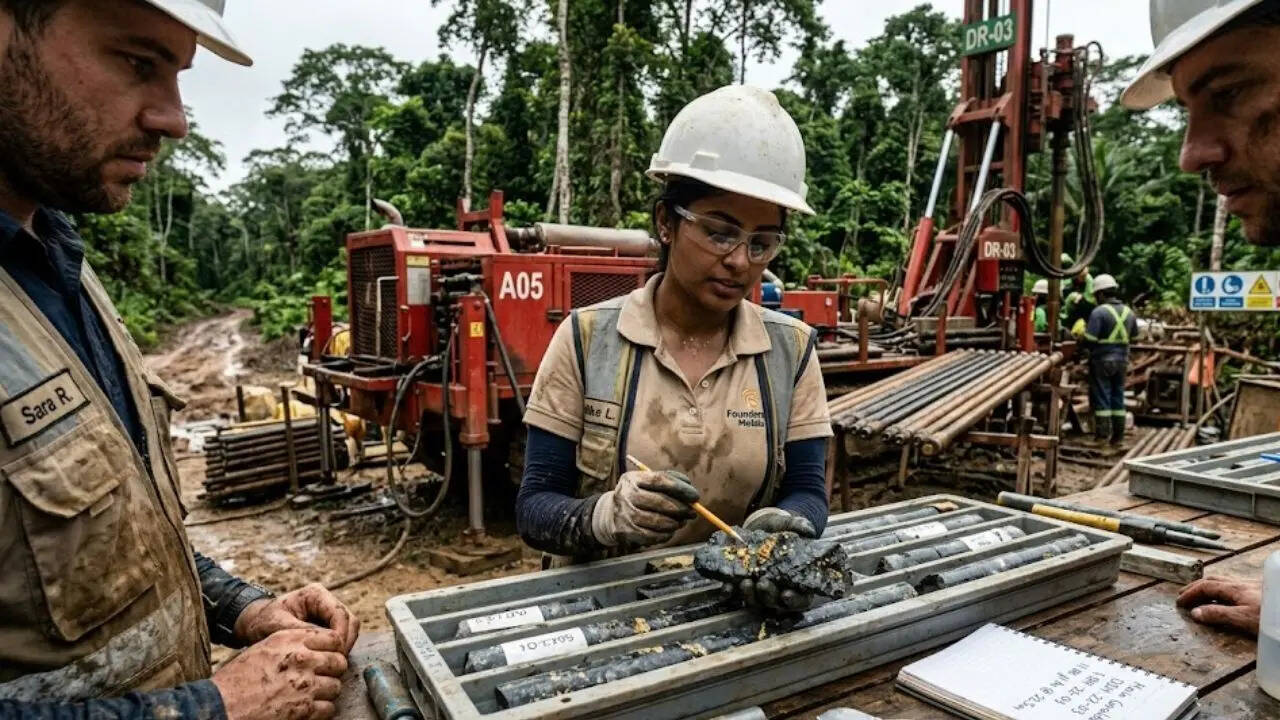
Suriname is sitting on a geological anomaly that defies the standard logic of the Guiana Shield. While the world’s mining giants focus on established plays in neighboring Guyana or the deep jungles of French Guiana, a specific patch of ground known as Maria Geralda has yielded assay results that make seasoned exploration geologists nervous. We aren't talking about the typical low-grade, high-volume deposits that dominate modern mining. This is something else entirely. The numbers coming out of recent drilling programs suggest a concentration of gold that looks more like a mistake in the lab than a natural occurrence. But it isn't a mistake. It is a fundamental shift in how we understand the mineral wealth of South America’s smallest independent nation.
The sheer density of the gold found in these samples has sent a shockwave through the junior mining sector. Usually, an exploration company is thrilled to find three or four grams of gold per ton of rock. At Maria Geralda, the grades have frequently spiked into the double and even triple digits. This isn't just "good" dirt. It is high-grade mineralization that suggests a massive, underlying hydrothermal system that hasn't been properly mapped until now.
The Secret Geometry of the Guiana Shield
To understand why Maria Geralda matters, you have to look at the bones of the continent. The Guiana Shield is a vast, ancient rock formation that has been shedding gold into South American rivers for millions of years. For decades, the narrative was simple: the easy gold was in the riverbeds, and the hard gold was trapped in massive, low-grade deposits that required billions of dollars in infrastructure to extract.
Maria Geralda breaks that narrative. The geological structures here are tighter, more pressurized, and significantly more enriched. Geologists are finding that the gold isn't just scattered; it is concentrated in quartz vein networks that appear to have acted as a high-pressure plumbing system for molten precious metals during the Earth's formative years.
Most analysts missed this because they were looking for the next "Rosebel," a massive open-pit mine nearby. They were looking for scale. They forgot about intensity. The Maria Geralda discovery proves that small footprints can hold massive value if the "plumbing" is right. This changes the economics of the entire region. Suddenly, you don't need a five-billion-dollar processing plant to make a profit. You need precision.
Why the Market is Misreading the Risk
The biggest mistake an investor or analyst can make right now is treating Suriname like a frontier wasteland. It is a country with a long, albeit messy, mining history. The infrastructure is there, the expertise is on the ground, and the government is desperate for formal revenue to stabilize its economy.
However, the "shocks" reported by the media regarding these high grades ignore a brutal reality of mining. High grades are a double-edged sword. While they offer incredible margins, they also imply nugget effect—a phenomenon where gold is distributed unevenly. You might hit a pocket of pure wealth in one drill hole and find nothing but grey stone ten feet away.
This is the tension at the heart of the Maria Geralda project. The headline numbers are spectacular, but the work of proving "continuity" is where the real battle lies. If the veins are continuous, this is the discovery of the decade. If they are isolated pockets, it is a geological curiosity. The current data leans heavily toward the former, as magnetic surveys show these structures stretching for kilometers across the concession.
The Infrastructure Advantage Nobody Mentions
Geography is destiny in the mining world. You can find a mountain of gold in the high Andes, but if you can't get a bulldozer to it, it might as well be on the moon. Maria Geralda sits in a logistical sweet spot. It isn't buried in an inaccessible mountain range. It is located in a region where the tracks are already beaten down.
- Proximity to Power: The project is within striking distance of existing power grids.
- Water Access: Mining is a thirsty business, and Suriname’s interior is crisscrossed by waterways that, while requiring strict environmental management, provide the necessary industrial baseline.
- Labor Pool: Local communities have been mining this ground informally for generations. They know the rock better than the PhDs in London or Toronto.
The transition from "informal" mining to a high-tech industrial operation is where the friction occurs. The high grades at Maria Geralda have historically attracted "garimpeiros" or artisanal miners. These men work with picks, shovels, and mercury. They follow the color. The fact that they have been active in the area for years was the first clue that the big companies were missing something. The "discovery" isn't that gold is there; the discovery is that the gold goes much, much deeper than the artisanal pits ever reached.
The Geopolitical Gamble
Suriname is at a crossroads. The country has struggled with inflation and political shifts, but the mineral sector is its lifeblood. For a project like Maria Geralda to succeed, it needs more than just high-grade assays. It needs a stable legal framework.
Recent shifts in Surinamese policy suggest a move toward transparency. The government knows that the "shocking" grades at Maria Geralda are a beacon for foreign direct investment. They are cleaned up the act because they have to. Gold represents over 70 percent of the country's export earnings. When a project like this shows potential for significant, high-margin production, it isn't just a business story. It is a national security story.
If the high-grade zones at Maria Geralda are as extensive as the initial drilling suggests, Suriname could leapfrog its neighbors in terms of production efficiency. They wouldn't be competing on volume alone; they would be competing on cost per ounce. This is the metric that keeps mining CEOs awake at night.
The Technical Reality of 100 Grams Per Ton
Let's talk about what "unusually high grades" actually look like on a spreadsheet. In most of the world, 1.5 grams per ton is considered "ore." At Maria Geralda, we are seeing intervals of 50, 80, or even 150 grams per ton.
Imagine a block of stone the size of a small car. In a standard mine, the gold inside would be the size of a grain of sand. At Maria Geralda, it’s the size of a golf ball. This reduces the amount of rock you have to crush, the amount of chemicals you have to use, and the amount of waste you have to store. It is, in every sense, a "cleaner" way to mine if managed correctly.
But the geology is complex. The gold is hosted in deformed volcanic rocks and shear zones. These aren't neat, straight lines. They twist. They pinch and swell. To map this, you need more than just luck; you need advanced 3D modeling and directional drilling. The companies on the ground are currently deploying these tools, and the results are confirming that the high-grade "shoots" are plunging deep into the earth, well beyond the reach of any historical exploration.
Environmental and Social Scrutiny
You cannot talk about gold in Suriname without talking about the jungle. The Maria Geralda discovery sits in a delicate ecosystem. The "shock" of the discovery will inevitably be followed by the "scrutiny" of international watchdogs.
The era of digging a hole and walking away is over. For Maria Geralda to become a producing mine, the operators must prove they can handle the tailings without poisoning the river systems. The high-grade nature of the deposit actually helps here. Because you are processing less rock for more gold, your environmental footprint is naturally smaller than a massive low-grade operation. This is a point the industry analysts often overlook. Profitability and sustainability are actually aligned when the grades are this high.
The Competition for the Ground
As the grades become public, the "land grab" phase begins. Large-cap miners are watching Maria Geralda like hawks. They don't want to do the risky work of exploration; they want to buy the result. We are seeing a pattern where the junior explorers do the heavy lifting, prove the resource, and then get swallowed by the giants.
The tension in Paramaribo is palpable. Every new drill result published by the project owners increases the buyout price. For the analysts sitting in New York or Vancouver, the "shock" is about the geology. For the people on the ground in Suriname, the shock is about the sudden realization that they are standing on one of the most valuable pieces of real estate in the Western Hemisphere.
Deciphering the Assay Sheets
When you look at the recent data sets, pay attention to the "intercept width." A high grade is meaningless if it’s only across ten centimeters of rock. At Maria Geralda, the high grades are appearing across widths of five to ten meters. That is a "mineable width." It means a machine can get in there and extract the ore without taking too much "waste rock" with it.
This is why the geologists are genuinely surprised. It is rare to see this level of concentration maintained over significant distances. It suggests a "perfect storm" of geological events: the right temperature, the right pressure, and a rock type that was brittle enough to shatter and allow the gold-bearing fluids to fill the gaps.
The Long Road to Production
Despite the excitement, a discovery is not a mine. The road from a "shocker" drill hole to a poured gold bar is long and paved with permit applications.
- Resource Estimation: Turning drill hits into a mathematical model of the earth.
- Feasibility Studies: Proving that the gold can be extracted for less than it costs to sell.
- Permitting: Navigating the Surinamese bureaucracy.
- Financing: Raising the hundreds of millions required for construction.
The high grades at Maria Geralda shorten this timeline because the "payback period"—the time it takes to earn back the investment—is drastically reduced. In a world where gold prices are volatile, a high-grade project is a safety net. It can survive a price drop that would kill a lower-grade competitor.
The End of the Beginning
The story of Maria Geralda is no longer about whether there is gold in the ground. That question has been answered with a definitive "yes." The new story is about the scale of the system and the speed at which it can be brought to market. The Guiana Shield has finally given up one of its most concentrated secrets, and the global mining industry is scrambling to react.
We are moving out of the exploration phase and into the definition phase. The geologists have had their shock. Now, it is time for the engineers and the financiers to take over. The dirt at Maria Geralda is rich, the structures are deep, and the implications for Suriname’s economy are staggering. This isn't just another mine; it is a reminder that the earth still holds pockets of extreme wealth that defy our existing models. Watch the drill bit. It’s the only thing that doesn't lie.
The next series of deep-hole results will likely determine if Maria Geralda is a singular phenomenon or the start of a new high-grade trend that redefines the entire Surinamese gold belt. All signs currently point toward the latter. The map of South American mining is being redrawn, and the center of gravity has shifted to a patch of jungle that everyone thought they already knew.