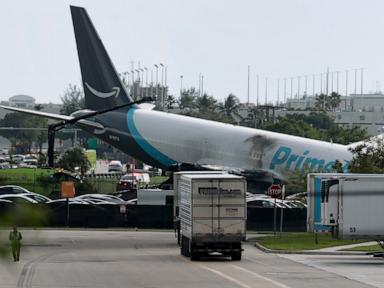
A Boeing 767-300 operating as an Amazon Prime Air cargo flight overran the runway at Miami International Airport, breaching the airport boundary, striking ground vehicles on an adjacent roadway, and resulting in five fatalities and five injuries. The incident, which involved a 32-year-old aircraft converted from passenger configuration and operated by third-party carrier 21 Air after departing San Juan, Puerto Rico, forces a rigorous evaluation of runway safety areas, kinetic energy management during landing overruns, and the risks associated with urban-adjacent airport perimeters.
When a widebody commercial aircraft experiences a runway excursion, the event is governed by the principles of kinetic energy dissipation, braking coefficient limits, and structural deceleration constraints. Understanding why a routine landing transforms into a catastrophic boundary breach requires examining the mechanical variables that control stopping distance.
The Physics of Stopping Distance and Runway Margins
The stopping distance of a landing aircraft is a function of initial touchdown speed, aircraft mass, aerodynamic drag, reverse thrust efficiency, and wheel braking friction. When an aircraft touches down downfield due to floating or high approach speeds, the remaining runway length decreases non-linearly relative to the safety margins required to bring a multi-ton airframe to a complete stop.
For a Boeing 767-300 landing under heavy cargo payloads, the kinetic energy equation dictates that velocity squared heavily dictates stopping requirements.
$$\text{Kinetic Energy} = \frac{1}{2} m v^2$$
If touchdown occurs with excess ground speed or on a wet surface with a reduced friction coefficient, the braking system's ability to convert kinetic energy into thermal energy through friction is quickly saturated.
Runway Safety Areas are engineered to provide a graded buffer zone beyond the paved surface to safely decelerate aircraft that undershoot or overrun. However, when urban infrastructure, public roadways, or perimeter fencing abut the operational boundary of a constrained hub like Miami International Airport, the physical buffer is eliminated. In this event, the aircraft transitioned from the paved overrun directly onto public thoroughfares, resulting in vehicle impacts.
Operational Dynamics of Third-Party Air Cargo Networks
Amazon Air relies on a hybridized operational model utilizing contracted third-party carriers such as 21 Air rather than maintaining a unified, wholly owned airline structure. This model introduces complex lines of operational oversight, training harmonization, and maintenance variance.
Cargo operations frequently involve older aircraft frames that have transitioned from passenger service into freight configurations—in this case, a 32-year-old airframe built in the 1990s. Converted freighters often operate with altered center-of-gravity profiles and high cycle counts. While regulatory bodies mandate rigorous inspection cycles under structural integrity programs, the integration of aging hulls into high-frequency logistics networks places continuous demands on mechanical systems, including anti-skid braking components, spoiler deployment mechanisms, and thrust reverser actuators.
The operational cadence of e-commerce logistics creates tight turnaround windows. While flight crews adhere to mandatory Crew Resource Management and duty-time regulations, systemic pressures within the freight sector highlight the operational tension between speed-to-delivery metrics and margin-of-error tolerances in adverse weather or sub-optimal braking conditions.
Systemic Airport Perimeter Risks
The interaction between heavy commercial aviation and perimeter public roads represents a long-standing vulnerability in global airport design. Legacy airports built decades before modern traffic expansion often feature runways terminating close to perimeter fences, municipal streets, or industrial zones.
When a runway excursion occurs in these environments, the consequence shifts rapidly from a localized aviation incident to a multi-agency urban mass casualty event. Mitigation strategies rely on two primary engineering controls:
- Engineered Materials Arrestor Systems: Beds of crushable lightweight concrete installed at runway ends designed to deform under an aircraft's weight, systematically absorbing kinetic energy without relying solely on wheel brakes.
- Perimeter Zoning Buffers: Mandatory clear zones preventing public vehicular traffic from operating within the direct trajectory of runway extended centerlines.
The absence or spatial limitation of these buffers at high-density urban airports leaves a narrow margin between minor runway excursions and catastrophic structural breaches.
Strategic Infrastructure and Regulatory Adjustments
Addressing the systemic vulnerabilities exposed by the Miami International Airport incident requires a shift in how aviation safety regulators evaluate terminal-area risk. The integration of high-tempo cargo flights into constraints traditionally designed for lower-density passenger hubs demands three structural modifications.
First, regulatory oversight of third-party wet-lease and ACMI operators must align precisely with the safety management systems of major logistics principals. Accountability for operational safety cannot be diluted by subcontracting structures.
Second, federal funding prioritization must shift toward retrofitting urban-adjacent runways with arresting technology where physical geographic expansion is impossible.
Third, municipal zoning boards and airport authorities must enforce stricter spatial separation between perimeter access roads and runway safety areas. Removing public roadways from immediate alignment with runway thresholds eliminates the secondary impact hazard that transformed a runway overrun into a fatal ground collision. The focus moving forward rests entirely on enforcing these structural boundaries before operational tempo outpaces engineering safety margins.