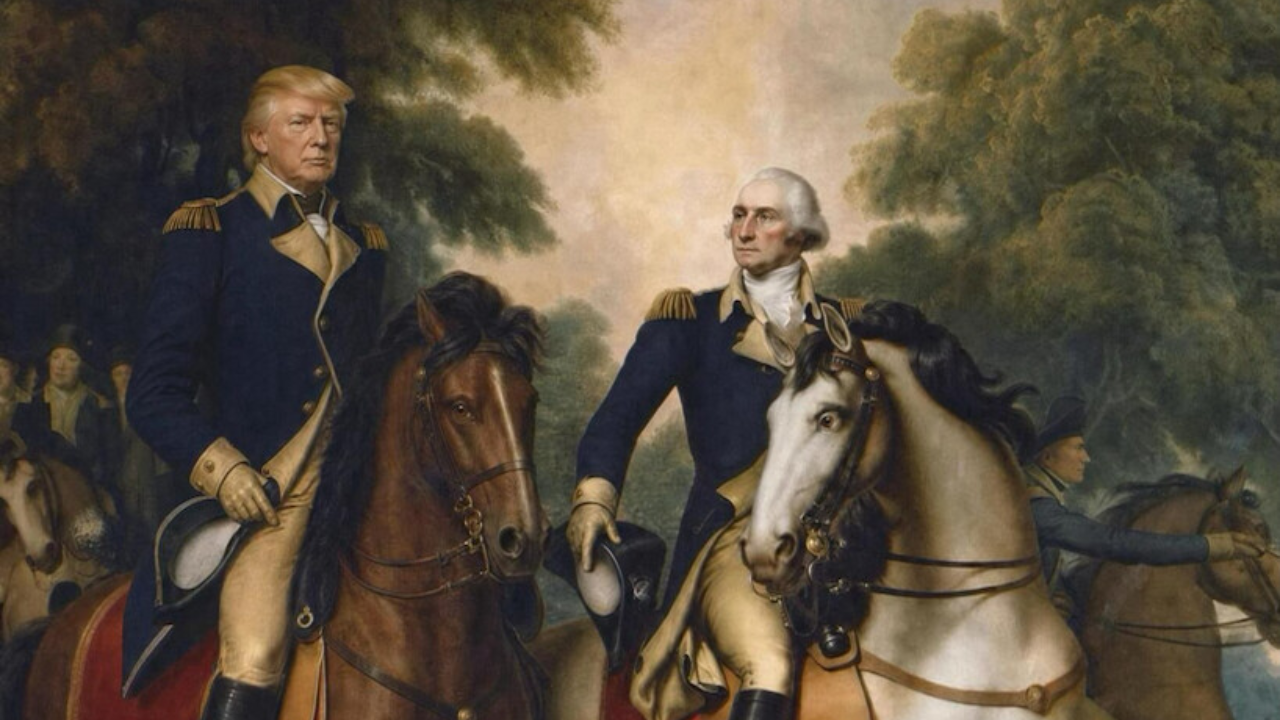
Donald Trump recently flooded his Truth Social feed with a bizarre cascade of artificial intelligence-generated fantasies, featuring everything from equestrian rides alongside George Washington to an altered map renaming New Mexico as New America. While mainstream coverage treats these surreal digital creations as mere internet curiosities or eccentric presidential daydreams, dismissing them as harmless fun misses the underlying mechanics of modern political warfare. This continuous stream of synthetic media represents a calculated shift in how political messaging bypasses traditional journalistic gatekeepers, turning post-truth absurdity into an active weapon of engagement.
When an elected official shares fabricated imagery showing George Washington sitting in a contemporary cabinet meeting alongside Vice President JD Vance, or depicts longtime critic Robert De Niro wearing a pro-Trump shirt, the objective is not to deceive anyone into thinking these events actually happened. Nobody believes George Washington survived into the twenty-first century. The true function of this synthetic media is emotional provocation and narrative saturation. By occupying the digital space with hyper-personalized, algorithmically optimized fiction, political actors force every conversation onto their own turf.
For decades, political communication relied on spin, selective statistics, and carefully massaged press releases. Today, generative models have lowered the barrier to producing entirely fictional alternate realities on demand. A user scrolling through social media is no longer confronted with arguments about policy or governance. Instead, they encounter a digital universe where boundaries between historical fact, celebrity culture, and executive wish-fulfillment dissolve entirely. When Trump posts an image claiming sovereignty over the Moon or reshaping the map of the Middle East into his own facial profile, these absurdities function as attention magnets. They guarantee algorithmic amplification across platforms that reward sheer volume and emotional friction.
The broader implications extend far beyond a single social media bender. We are witnessing the normalization of a post-reality political environment where truth is secondary to emotional resonance. When political figures routinely post fabricated representations of themselves as medical professionals curing opponents, muscular action heroes, or historical commanders, they train their base to consume information through a lens of total disbelief toward objective reality. Every institution—from journalism to historical record—is painted as an obstacle to be overridden by the raw, unfiltered imagination of the leader.
Consider the economic backdrop accompanying these digital distractions. Alongside images of colonial-era joyrides and lunar flags, the same feed featured fabricated financial tickers showing massive stock gains, blending policy declarations with personal asset performance. This mingling of state power, personal myth-making, and synthetic imagery creates a dizzying environment designed to exhaust critical inquiry. When the sheer volume of fabricated content becomes overwhelming, the public stops asking whether a specific claim is true and instead judges it solely by whether it aligns with their tribal loyalties.
Journalists and analysts who continue to treat these posts as isolated eccentricities are missing the entire architecture of twenty-first-century propaganda. This is not about failing technology or poor taste. It is an intentional strategy of saturation. By drowning the public square in synthetic marvels and grievances, political leaders ensure that reality itself becomes just another negotiable variable.
The threshold has been crossed. We no longer inhabit an era where political communication defends a disputed version of facts; we live in a landscape where facts are discarded altogether in favor of custom-built, AI-driven mythologies that demand absolute submission or total exhaustion.