Suburban Florida at midnight smells like damp St. Augustine grass, cooling asphalt, and night-blooming jasmine. It is a sensory blanket designed to lull you into total complacency. You walk out your front door in flip-flops, holding a retractable leash in one hand and your phone in the other, thinking about tomorrow’s dentist appointment or whether you remembered to lock the side gate. You are safe. You are in a neighborhood with streetlights, trimmed hedges, and homeowner association rules about mailbox paint colors.
Then your dog stops. Learn more on a similar topic: this related article.
He doesn't bark. Barking is for mailmen, squirrels, and the neighbor's golden retriever. When a dog encounters something ancient and fundamentally wrong, the hair along his spine lifts in a silent, rigid ridge, and his breath catches in his throat.
Look down at the edge of the beam from the streetlamp. That is not a fallen palm frond. It is not a discarded black garden hose. Further analysis by TIME explores similar perspectives on this issue.
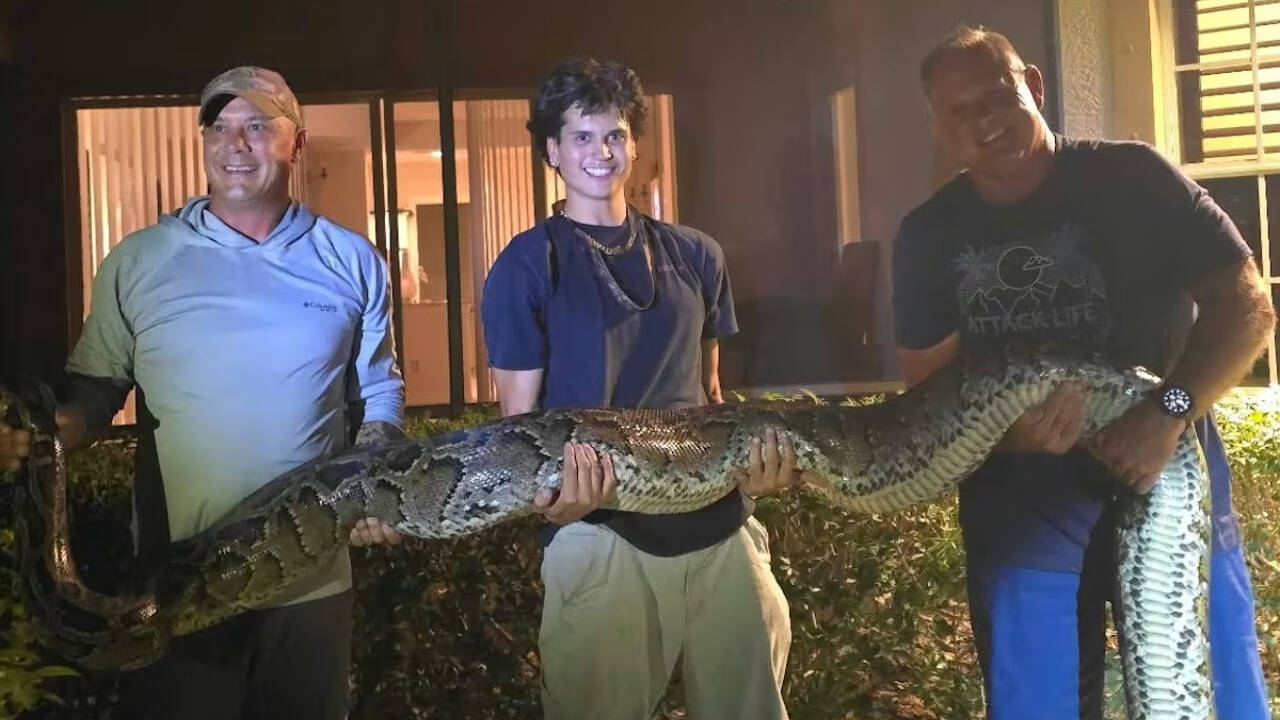
It is fifteen feet of solid, patterned muscle, weighing one hundred and thirty-four pounds, sliding silently across the concrete where your kids ride their bicycles at four in the afternoon.
For one Florida couple, this exact scene ceased to be a late-night horror story and became a Tuesday night reality. Out for a routine, quiet walk with their dog, they stumbled across a Burmese python of staggering proportions—a fifteen-foot, 134-pound apex predator cruising through a residential area like it owned the deed to the cul-de-sac.
Cold. Heavy. Real.
Most news reports give you those numbers and move on. Fifteen feet. One hundred and thirty-four pounds. Removed by wildlife officials. Have a nice day. Those dry summaries miss the point entirely, because the real story isn't just that a giant snake was found near a house. The real story is what that snake represents about the fragile illusion of the boundary we draw between human comfort and untamed nature.
The Architecture of an Ambush
To understand why finding a 134-pound python during a dog walk sends a visceral shockwave through a community, you have to understand what that animal actually is. People hear "snake" and picture a six-foot black racer darting away into the bushes when you start the lawnmower.
A Burmese python is not that.
Think of a standard six-foot couch in your living room. Now double it, add three feet, and fill the entire length with dense, braided steel cables wrapped in mottled brown and tan camouflage. A snake of this size doesn't flee from footsteps. At 134 pounds, it sits comfortably at the top of the local food chain, completely indifferent to suburban traffic, porch lights, or human schedules.
I have spent years walking the edge habitats of South Florida—those jagged, uneasy borders where manicured lawns abruptly surrender to sawgrass marshes and drainage canals. When you spend enough time in those liminal spaces, you learn quickly that your eyes are trained to look for movement, and the Burmese python is an evolutionary master of stillness. You can stand three feet away from a twelve-foot specimen coiled in dry brush and stare right at it for thirty seconds before your brain finally untangles the geometric blotches on its skin from the dappled shadows of the leaves.
That camouflage is why late-night walks carry a specific, quiet dread for anyone who lives near the Everglades watershed. During the blistering heat of the Florida afternoon, pythons stay submerged in cool canal water or tucked deep inside limestone crevices and thick brush. When the sun drops and the asphalt retains the day’s warmth, they move. They use paved roads and concrete sidewalks as thermal highways, soaking up the residual heat from the ground while hunting under the cover of darkness.
When that couple stepped out with their dog, they weren't intruding into the deep wilderness. They were simply walking along the exact strip of warm concrete a massive predator had chosen for its evening commute.
The Invisible Stakes on the Other End of the Leash
Consider what happens next in that split second on the sidewalk.
A forty-pound dog sees a strange shape in the dim light and steps forward to sniff. A Burmese python does not possess venom, so it does not strike and retreat. It strikes to anchor. Its mouth is lined with backward-curving teeth designed like surgical fishhooks—the harder a victim pulls away, the deeper those teeth sink into flesh. Within less than two seconds, the snake throws two or three massive coils around the animal’s chest.
Every time the dog exhales, the python tightens its grip by an inch. It isn't crushing bones, despite the old campfire myths; it is cutting off blood flow to the brain and preventing the lungs from expanding. Against 134 pounds of pure muscular constriction, a panicked dog owner has almost zero leverage. You cannot pry open jaws locked by backward-facing teeth with your bare hands, and you cannot unwrap coils thicker than a grown man's thigh while the animal is actively flexing.
Let’s step into a hypothetical scenario for a moment to grasp the sheer physics of the encounter. Imagine trying to wrestle a wet, muscular firehose filled with concrete that has one end anchored to a tree and the other wrapped around something you love. Even trained wildlife biologists—people who capture these animals for a living—follow a strict rule of thumb: you need one experienced handler for every four to five feet of snake. A fifteen-foot python requires a three-person team just to safely control the head and keep the body from binding someone’s legs.
One person holding a dog leash and a flashlight isn't equipped for a battle. They are equipped for a tragedy.
That is the invisible weight hanging over that late-night news item. The couple and their dog walked away unharmed, mostly because they spotted the snake before the distance closed into strike range. A few steps further in darker shadow, or an off-leash sprint toward the bushes, and the headline changes from an astonishing wildlife encounter to a devastating loss.
How a Pet Trade Mistake Swallowed a State
Whenever a monster like this surfaces in a neighborhood, the immediate question from people outside Florida is always the same: How on earth did a snake native to Southeast Asia end up in a suburban driveway?
The answer is a masterclass in human short-sightedness.
Decades ago, particularly through the 1980s and 1990s, exotic pet dealers imported tens of thousands of baby Burmese pythons into Miami. At hatchling size, they are barely twenty inches long, brightly patterned, and docile—an easy impulse buy for an enthusiast wanting an exotic pet. Nobody thinks about the math when the snake fits inside a ten-gallon glass aquarium.
The math, however, is relentless. Fed regularly on rats and rabbits, a Burmese python grows fast. Within three to four years, that manageable pet becomes a ten-foot, eighty-pound giant requiring specialized enclosures, heavy-duty locks, and massive frozen prey. Overwhelmed owners, unwilling to euthanize an animal they raised, drove out to the edge of the Everglades, opened their car trunks, and let the snakes go, telling themselves the animals would simply find a happy home in the swamp.
Then came August 1992. Hurricane Andrew tore through South Florida with 165-mile-per-hour winds, obliterating a major reptile breeding facility near the edge of the wetlands and releasing hundreds more pythons directly into the wild.
The Everglades turned out to be an accidental paradise for them. Subtropical humidity, endless waterways, mild winters, and a native ecosystem where no animal had ever evolved to recognize a giant constrictor as a threat. In Southeast Asia, pythons face tigers, king cobras, and diseases that keep their numbers in check. In Florida, they found an all-you-can-eat buffet of naive prey.
By the time state officials realized the snakes weren't just surviving—they were breeding prolifically—the population had exploded past the point of easy eradication. A single mature female Burmese python, especially one reaching the massive bulk of 134 pounds, can lay anywhere from fifty to one hundred eggs in a single clutch.
The Silence in the Sawgrass
If you want to feel the true cost of this invasion, don't look at the snake. Look at what is missing around it.
Twenty-five years ago, driving along the Tamiami Trail or walking the levees near the Everglades at dusk meant seeing life everywhere. Raccoons rummaging along the water's edge. Opossums crossing the gravel. Marsh rabbits darting into the palmettos. Bobcats slipping through the cypress trees.
Today, vast stretches of that same territory are eerily, profoundly silent.
Peer-reviewed ecological studies conducted across Everglades National Park revealed numbers that read like a biological obituary. In areas where pythons have been established the longest, populations of raccoons dropped by 99.3 percent. Opossum sightings plummeted by 98.9 percent. Bobcats declined by more than 87 percent. Marsh rabbits, cottontail rabbits, and foxes essentially vanished from the landscape entirely.
Think about that scale of erasure. Nearly every medium-sized mammal across hundreds of thousands of acres was systematically consumed, converted into snake muscle.
And when the marshes run low on rabbits and raccoons, a 134-pound predator doesn't politely starve to death. It follows the water. South Florida is stitched together by thousands of miles of interconnected flood-control canals that run directly from the wild sawgrass straight behind suburban neighborhoods, golf courses, and elementary schools. To a python, a canal is a sheltered, predator-free interstate leading directly to new food sources: Muscovy ducks, stray cats, backyard chickens, and family pets.
Every time a massive python is pulled off a neighborhood street, we aren't seeing a freak anomaly. We are seeing the inevitable overflow of an ecosystem pushed completely out of balance.
Confessions from the Edge of the Map
I used to think this was strictly a wilderness problem—something reserved for airboat captains, park rangers, and weekend hunters wading through thigh-deep muck in the middle of the night. You read the annual headlines about the Florida Python Challenge, see photos of smiling bounty hunters holding up eighteen-foot trophies on dirt roads, and assume the battle lines are safely drawn miles away from civilization.
That comfort evaporates the first time you spot fresh drag marks in the mud ten yards behind a suburban strip mall.
A python leaves a signature trail—a wide, smooth, unmistakable trough flattened through the grass, distinct from the narrow, winding wiggle of a smaller native snake. Seeing that track near a place where people walk their dogs and unload groceries rearranges your sense of geography. You realize the map isn't divided into "nature" and "city" anymore. Nature is just waiting until dark to reclaim the concrete.
What makes the situation genuinely unsettling—even for people who study reptiles for a living—is how impossible it is to measure the true scale of the problem. Wildlife agencies estimate there are tens of thousands, possibly over a hundred thousand, Burmese pythons living across South Florida. Nobody knows the exact number because their detection rate in the wild is notoriously low, often estimated at less than one percent.
For every 134-pound giant spotted under a streetlamp during a late-night dog walk, dozens more are lying motionless in the dark water twenty feet away, completely unseen.
Living With Eyes Open
So what do you actually do when the wild moves into your zip code? You don't panic, and you don't lock yourself indoors, because living in Florida has always meant sharing space with creatures that demand respect. You simply trade suburban complacency for deliberate awareness.
If you live anywhere near canals, retention ponds, or marshland borders in South or Central Florida, that awareness starts the moment you clip on a leash after sunset:
- Ditch the retractable leash at night. A twenty-foot cord lets your dog explore dark shrubbery and canal banks long before your flashlight beam reaches them. Keep your dog within four to six feet of your side on a fixed lead.
- Carry a real light, not a phone screen. A smartphone flashlight illuminates ten feet of ground in a weak, diffused wash. A dedicated 1,000-lumen pocket flashlight cuts through shadows along hedges and ditches, catching the distinct glossy sheen of scales before you step within reach.
- Keep your distance and call the professionals. If you ever confront a large constrictor, never try to be a hero with a shovel or a broom. Step back slowly, keep your eyes on the animal so you can track where it moves, and immediately call the Florida Fish and Wildlife Conservation Commission’s Exotic Species Hotline at 1-888-IVE-GOT1 (1-888-483-4681). Snap a photo from a safe distance if you can—visual confirmation helps dispatchers send the right removal team immediately.
That couple walking their dog did the most important thing right: they paid attention. They broke out of the autopilot trance of a routine neighborhood stroll, recognized something out of place in the dark, and kept their distance until trained hands could remove a 134-pound predator from the street.
Tonight, across thousands of quiet neighborhoods bordering the wetlands, porch lights will flicker on, front doors will latch shut, and people will step out onto warm concrete sidewalks with their dogs trotting happily ahead. Most of them will walk past manicured hedges and dark drainage ditches without a second thought, comforted by the hum of air conditioners and the glow of streetlamps.
Just remember that out in the dark grass beside the curb, something ancient, silent, and remarkably patient is watching the sidewalk too.


