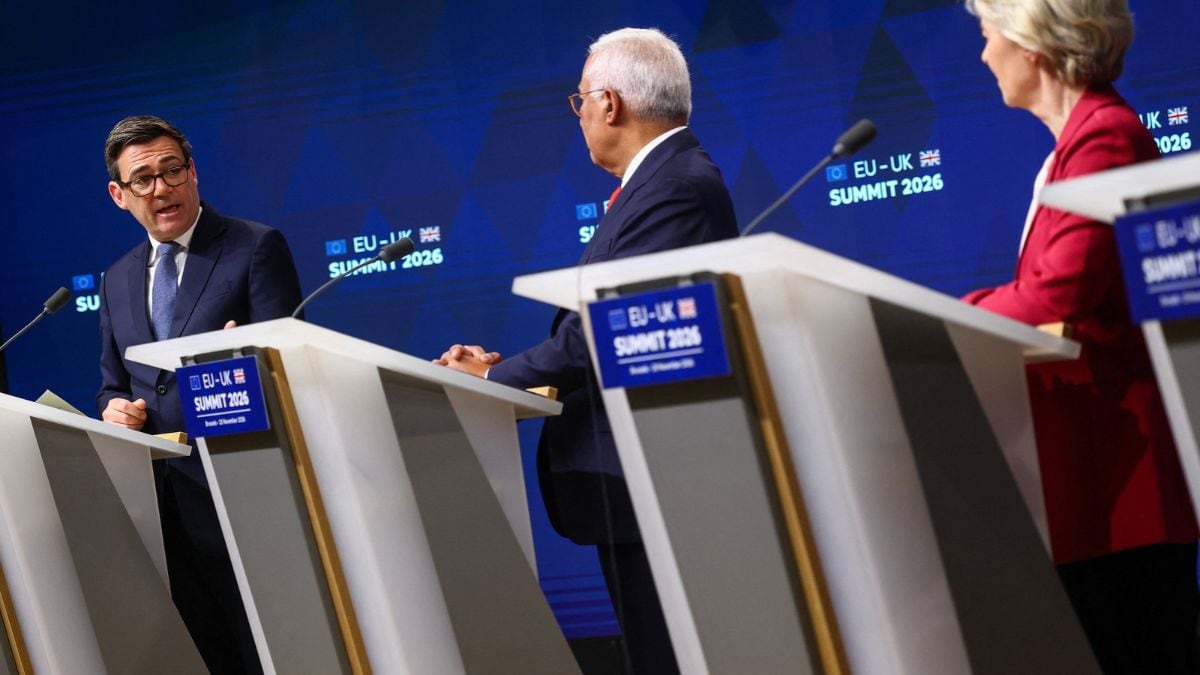
Ten years after the 2016 referendum tore the British political establishment apart, London and Brussels have finally signed a comprehensive UK EU reset deal. On paper, the agreement promises to strip away border red tape, align agricultural standards, and bind the two sides into a formal defense pact. In reality, it represents a quiet, pragmatic surrender of the purest ideological fantasies of Brexit in exchange for cold economic survival. Neither side wants to call it a reversal. Both sides know the old post-Brexit settlement was slowly suffocating British growth while leaving European security dangerously exposed.
The math finally broke the ideology. For a decade, successive British governments treated divergence from European rules as an end in itself, even when diverging meant paying billions in extra customs fees to sell goods to their closest neighbor. This new agreement reverses that logic across critical sectors, trading regulatory independence for friction-free access. For another perspective, see: this related article.
Why the Original Trade Deal Failed
To understand why this reset happened now, you have to look at the structural flaw baked into the 2020 Trade and Cooperation Agreement. That original deal eliminated tariffs and quotas on goods, which allowed politicians in London to claim they had secured tariff-free trade. What they glossed over was the return of non-tariff barriers.
Tariffs are just taxes at the border. Non-tariff barriers are the paperwork, safety inspections, veterinary checks, and regulatory certifications required to prove a product is legal to sell in another market. When Britain left the European Single Market and the Customs Union, it voluntarily erected those barriers between itself and its largest trading partner. Further insight on the subject has been provided by The Washington Post.
Consider a hypothetical example of a mid-sized British food exporter selling artisanal cheddar to distributors in France. Under the 2020 rules, that exporter suddenly needed an Export Health Certificate signed by a qualified vet for every single shipment, alongside customs declarations and rules-of-origin paperwork. A lorry carrying mixed loads of food could be delayed for hours at Dover or Calais if a single form had a typo. For smaller firms, the administrative cost exceeded the profit margin, so they simply stopped exporting to the continent.
Macroeconomic data consistently reflected this friction. While global trade recovered after the pandemic, UK goods exports to the European Union stagnated in real terms compared to pre-pandemic baselines. Business investment flatlined for years because companies could not predict whether London would diverge from Brussels on chemical safety, product labeling, or carbon pricing. Capital hates uncertainty, and the post-Brexit framework institutionalized it.
What the Reset Actually Changes
The diplomatic language surrounding the new accord is deliberately muted, designed to avoid triggering domestic political backlashes in Westminster. Yet the operational mechanics of the agreement target the exact bottlenecks that have choked trade since 2021.
Veterinary and Plant Health Alignment
The centerpiece of the trade chapter is a new Sanitary and Phytosanitary (SPS) agreement. In plain terms, Britain has agreed to align its food, plant, and animal health standards with European Union rules.
This eliminates the need for routine physical checks and veterinary certificates on agrifood products moving between Great Britain and the EU. It also resolves the lingering political headache over trade between Great Britain and Northern Ireland, which had remained inside the EU single market for goods under the Windsor Framework. By matching EU rules across the entire United Kingdom, the notorious border down the Irish Sea largely evaporates for food and agricultural products.
The catch is obvious. Britain becomes a rule-taker in agrifoods. If Brussels bans a specific pesticide or alters food labeling requirements next year, London must follow suit or risk voiding the friction-free access. Critics argue this surrenders sovereignty. Exporters counter that sovereignty meant very little when British shellfish could not legally enter European ports without expensive purification processing.
A Formal Security and Defense Pact
Trade was only half the equation. War on the eastern flank of Europe and shifting American strategic priorities forced both London and Brussels to confront an uncomfortable truth. You cannot build a credible European defense architecture while excluding one of the continent's two nuclear-armed powers.
The new UK EU security pact establishes structured dialogue on foreign policy, joint military procurement, intelligence sharing, and defense industrial cooperation. Previously, British defense contractors faced steep hurdles when bidding for projects funded by European Union defense initiatives, despite deep historical ties between British and continental aerospace firms.
Under the reset, British defense companies gain smoother pathways to participate in joint European procurement programs, while British troops can more easily deploy alongside EU-led missions. Foreign ministers will now hold regular, institutionalized summits rather than relying on ad-hoc phone calls during crises.
Youth Mobility and Professional Recognition
Brussels entered the negotiations with a clear priority of its own. European capitals wanted a structured youth mobility scheme allowing citizens aged 18 to 30 to live, study, and work across the Channel for a fixed period.
London initially resisted, terrified that any deal involving visas would be weaponized by anti-immigration populists as a return to free movement. The final compromise creates a capped, time-limited exchange program with strict visa requirements, health surcharges, and zero access to public welfare funds. It mirrors existing arrangements Britain already operates with countries like Australia, Canada, and Japan.
Alongside this, the deal establishes a formal framework for the mutual recognition of professional qualifications. Architects, engineers, accountants, and lawyers will no longer have to re-qualify from scratch to practice across borders, reversing a quiet brain drain that hurt London's dominant services sector.
The Hidden Trade-Offs Nobody Wants to Admit
Every diplomatic victory requires concessions that negotiators bury in the footnotes. This agreement is no exception. While ministers celebrate smoother trade, three major compromises sit at the heart of the deal.
First, Britain has accepted a dynamic alignment mechanism in specific sectors, overseen by joint arbitration panels. If a dispute arises over whether British rules match European standards, European law remains the ultimate benchmark for interpreting those standards. For years, eliminating the indirect jurisdiction of the European Court of Justice was a sacred red line for British conservatives. That red line has been quietly blurred in exchange for market access.
Second, European fishing fleets retained long-term access to British waters on terms far more generous than coastal communities were promised in 2016. Fishing accounts for a tiny fraction of the British economy, smaller than the lawnmower industry, yet it carries immense symbolic weight. Brussels knew this and used fisheries access as an immovable condition for granting agrifood concessions. London blinked.
Third, the agreement locks Britain into closer alignment with the EU Emissions Trading System. Linking the UK and EU carbon markets prevents British steel, cement, and fertilizer exporters from being hammered by Europe's Carbon Border Adjustment Mechanism, a green tariff designed to penalize imports from countries with looser climate rules. However, it also restricts the ability of future British governments to unilaterally lower energy taxes or alter domestic industrial carbon pricing without Brussels signing off.
| Sector | Post-2020 Baseline | New Reset Framework | The Core Trade-Off |
|---|---|---|---|
| Agrifood & Plants | Full border checks, vet certificates | Dynamic SPS alignment, minimal checks | UK follows EU food rules without a vote |
| Defense & Security | Ad-hoc coordination, procurement barriers | Formal pact, joint industrial access | Shared strategic commitments, joint funding rules |
| Carbon & Energy | Separate markets, risk of EU border tariffs | Linked emissions trading schemes | Loss of unilateral UK carbon tax flexibility |
| Labor & Services | Case-by-case visas, unrecognized degrees | Capped youth mobility, degree recognition | Political sensitivity over migration numbers |
| Fisheries | Temporary quota adjustments | Multi-year guaranteed EU fleet access | Domestic backlash from UK coastal towns |
Why Brussels Agreed to Open the Door
A common misconception in British commentary is that the European Union relishes punishing Britain to deter other member states from leaving. That narrative might have held some truth in 2017 when nationalist movements across Europe were flirting with exit referendums. By 2026, the political reality in Europe looks completely different.
Hard-right parties in France, Italy, and the Netherlands largely abandoned calls to leave the Eurozone or the EU after watching the economic chaos that engulfed Westminster between 2016 and 2022. Brexit ceased to be a contagious threat and became a cautionary tale. Brussels no longer needed to make an example of London.
Instead, European leaders faced pressing internal crises. Industrial competitiveness across Germany and France had weakened due to high energy costs and fierce competition from subsidized Chinese manufacturing. Washington's unpredictable posture toward NATO forced European capitals to take responsibility for their own territorial defense. In that environment, keeping a major G7 economy and military power locked outside the room out of bureaucratic spite became a luxury Europe could no longer afford.
The Political Trap Waiting for Westminster
Signing the treaty is the easy part. Surviving its implementation over the next five years will test the resilience of British politics.
The reset relies on a delicate illusion. British ministers must convince voters that they are merely fixing broken plumbing to boost economic growth, while convincing European partners that Britain will faithfully implement rules made in Brussels without constant friction.
That balancing act will fracture the moment the European Union passes a controversial new regulation affecting food, chemicals, or carbon pricing. Imagine a scenario where Brussels introduces strict new agricultural runoff rules that raise costs for British farmers, or bans a food additive popular in British supermarkets. The British government will face a binary choice. It can enforce the European rule domestically, handing opposition politicians an easy soundbite about foreign dictation. Or it can refuse to comply, triggering retaliatory tariffs and border checks from Brussels that unravel the entire agreement.
Moreover, the deal stops well short of rejoining the Single Market or the Customs Union. British manufacturers of cars, pharmaceuticals, and electronics still face rules-of-origin audits and separate regulatory approvals if they choose to diverge from EU technical standards. The reset removes the sharpest thorns from the relationship, yet it leaves the fundamental architecture of separation intact.
What Comes Next for British Business
For corporate boards in London, Manchester, and Edinburgh, the geopolitical theatrics matter far less than the compliance spreadsheets. The immediate takeaway is clear. The era of speculative regulatory divergence is dead.
Over the past decade, some British businesses delayed upgrading machinery or kept dual supply chains running in anticipation that Westminster might slash red tape and create a deregulated Singapore-on-Thames model. That experiment never materialized because British voters consistently favored high consumer, environmental, and labor protections, and British exporters refused to abandon their largest market.
Companies now have a predictable medium-term horizon. Supply chains between the UK and continental Europe will gradually smooth out as electronic customs corridors and aligned veterinary protocols come online over the next eighteen months. Logistics costs will drop, particularly for perishable goods and precision components that cross the Channel multiple times during assembly.
Yet the deeper lesson of this decade-long detour remains sobering. Geography is stubborn. You can rewrite treaties, redraw customs borders, and invent new slogans about global reach, but gravity still governs trade. Neighbors trade most with neighbors, and the price of frictionless commerce is always shared rules. Britain spent ten years trying to outrun that basic economic law before quietly signing a deal to live with it again.