Two in the morning is the hour when houses tell lies.
The floorboards settle with a sharp crack that sounds distinctly like a boot heel on oak. A branch scrapes against the siding, mimicking the slow, deliberate drag of a crowbar. You lie awake, staring at the ceiling fan, your heart hammering against your ribs while your brain tries to calculate the distance between your bed and the locked front door. For decades, the solution to that midnight dread was simple, if flawed. You bought a dog, you installed heavy deadbolts, or you mounted a static plastic eye above your porch and hoped the intruder stood directly inside its narrow, ninety-degree cone of vision.
Then came the hum.
Picture a hypothetical Tuesday night in a quiet suburban cul-de-sac. Let us call the homeowner Elena. She is three hundred miles away in a sterile hotel room, staring at her phone screen because an alert just chimed. In the old days—meaning two years ago—that alert would show her a grainy, static frame of her front hallway. If the noise came from the back mudroom, or if someone left a side window unlatched behind the curtains, Elena was blind. She would have to call a neighbor, wake them up, and ask them to walk into a potentially dangerous situation.
Instead, Elena taps a button on her screen.
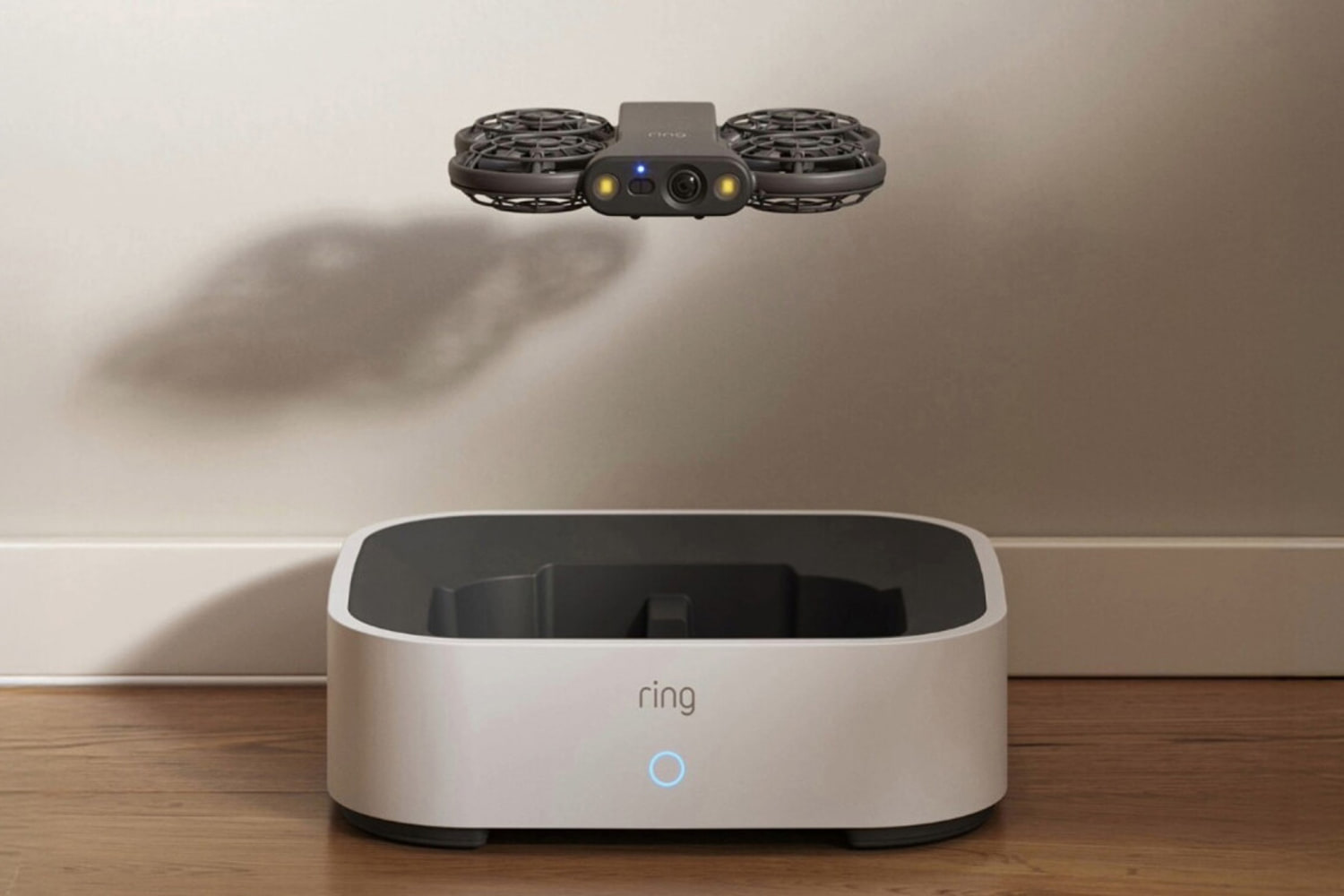
Down in her living room, a small, white docking station clicks open. A miniature, lightweight quadcopter lifts off with a soft, insect-like whir. It glides down the hallway, turns smoothly into the kitchen, hovers over the island to check the back sliding door, and beams a crisp, live video feed directly to Elena’s palm. Satisfied that the noise was just a fallen stack of mail, she taps another icon. The machine drifts back to its dock, slots itself in, and goes dark.
Silence.
This is not science fiction. When Amazon’s Ring unveiled its autonomous indoor flying drone—the Always Home Cam—alongside a suite of roving, wheeled security robots for homes and commercial warehouses, the tech press largely treated it like a novelty gadget. They listed the specs. They noted the $250 price tag for the flying camera, the caged propellers designed to bounce harmlessly off drywall, and the fact that it only records when airborne, physically blocking its own lens when docked. They mentioned Astro, the wheeled home robot on periscope-like legs, and the commercial autonomous security bots meant to patrol empty office parks and construction sites after hours.
They missed the point entirely.
When a trillion-dollar company puts wings on a surveillance camera and wheels under an artificial intelligence, they are not just selling hardware. They are renegotiating the oldest human contract we have: the boundary between the sanctuary of the home and the watchful eye of the outside world.
The Architecture of Paranoia
To understand why a flying indoor camera feels simultaneously comforting and deeply unsettling, you have to look at how we got here. Humans have always built walls to keep the dark out. First it was stone and timber. Then came alarm systems—dumb wires strung across window frames that screamed when broken.
In 2013, Jamie Siminoff walked onto the television show Shark Tank with a Wi-Fi-enabled video doorbell called DoorBot. The investors passed. Five years later, Amazon bought that company, renamed Ring, for roughly one billion dollars.
I remember the first time I installed one on my own front porch. The setup took fifteen minutes. Suddenly, my phone buzzed every time a delivery driver dropped a box, every time a stray cat crossed the welcome mat, and every time the wind blew a stray leaf across the concrete. At first, it felt like a superpower. You are never truly away from home when your home lives in your pocket.
Over time, though, a strange psychological shift occurs. You stop looking at the camera to verify that things are safe, and you start looking at it to hunt for threats. You join the neighborhood digital watch groups. You watch pixelated videos of strangers walking down the sidewalk at dusk, and your brain fills in the blanks with malice. Security technology feeds on the very anxiety it promises to cure. The more you see, the more you realize you can’t see. A camera on the porch leaves the backyard blind. A camera in the living room leaves the upstairs hallway dark.
Ring’s engineers looked at that blind spot and saw a market inefficiency. Why sell a customer six static cameras to cover a two-thousand-square-foot house when you can sell them one camera that flies?
Consider the mechanics of the Always Home Cam. It does not fly freely like a hobbyist drone you might pilot at a local park; there is no joystick on your phone. Instead, it acts like a Roomba for the air. During setup, you walk the device through your house, mapping out specific waypoints. You tell it: Here is the kitchen. Here is the front door. Here is the downstairs bathroom window. When an alarm triggers, or when you request a check-in, the drone launches, follows its pre-programmed flight path using obstacle-avoidance sensors, checks the designated zone, and returns to base.
On paper, it is brilliant engineering. It solves the multi-camera cost problem while bypassing the creepy permanence of a lens staring at your couch while you watch movies in your pajamas. Because the camera lens is physically recessed inside the charging dock until the propellers spin up, and because the rotors make a distinct, audible hum in flight, Ring argues that privacy is built into the physics of the machine. You cannot be spied on secretly by a device that sounds like an angry bumblebee every time it opens its eyes.
The Invisible Shift in Commercial Space
While the flying living-room drone captured the headlines, the quieter—and far more consequential—revolution is happening in warehouses, car dealerships, and corporate campuses.
Think about the traditional night watchman. For centuries, securing a commercial property meant paying a human being to walk a predictable route with a flashlight and a punch clock. It is dull, exhausting, and occasionally perilous work. Most of a guard’s shift consists of fighting off sleep in a freezing booth; the remaining one percent consists of confronting intruders alone in the dark.
Amazon’s entry into autonomous commercial patrols—through Ring’s business security ecosystem and partnerships with autonomous robotics firms—changes the math completely. Instead of one guard walking a perimeter once an hour, a fleet of weather-resistant, wheeled robots rolls silently across the asphalt. Equipped with thermal imaging, LiDAR, and high-definition optical zoom, these machines do not get tired, they do not check their phones, and they do not blink.
When a sensor trips at a remote solar farm or a sprawling logistics hub, a drone can launch from a weatherproof rooftop box, reach the fence line in forty seconds, and beam live telemetry to a remote human operator sitting in a brightly lit control room three states away. That operator can then use the drone’s onboard speaker to warn the trespasser off the property before dispatching local police with exact GPS coordinates.
It is efficient. It is cost-effective. It reduces liability.
And yet, pause for a moment and consider what happens when the boundary between commercial surveillance and domestic space blurs. Technology rarely stays neatly inside its original lane. The thermal sensors perfected for spotting copper thieves at an industrial yard eventually shrink down to fit inside a consumer doorbell. The facial recognition algorithms built to secure corporate data centers eventually get pitched as a convenient way to unlock your front door when your hands are full of groceries.
The Weight of the Lens
Let us return to a hypothetical scenario, because the real friction of this technology does not live in circuit boards—it lives in human relationships.
Imagine a household with four people: two parents, a teenager, and an elderly grandparent recovering from surgery. The drone was bought for security, pure and simple. Nobody wants a break-in.
Three months in, the novelty wears off, and the tool becomes a habit. A parent stuck in traffic wonders if the teenager actually came home from school on time. A quick tap on the app, a thirty-second flight down the upstairs hall, and the question is answered. Later that evening, the same parent launches the drone to check if the grandparent took their evening medication on the kitchen counter, rather than calling and risking waking them up.
Nothing malicious happened here. Every single action came from a place of care, responsibility, or mild parental impatience. Yet, the atmosphere inside the house changes subtly. The walls are no longer solid. Privacy inside the home ceases to be an inherent right and becomes a temporary state granted only while the dock stays closed.
Psychologists have long studied the Hawthorne effect—the phenomenon where human beings alter their behavior the moment they know they are being observed. When you introduce an autonomous, mobile eye into a domestic sanctuary, you introduce a low-grade, permanent tension. You start dressing differently when walking from the shower to the bedroom, just in case. You lower your voice during an argument, glancing toward the corner of the room where the white plastic dock sits waiting.
I am not immune to the appeal of these devices. Living alone in a ground-floor apartment years ago, I woke up to the sound of someone trying to jimmy my bedroom window at three in the morning. By the time I threw on clothes and grabbed a heavy flashlight, the shadows outside were empty, leaving me shaking with adrenaline and wondering if they were still hiding behind the bushes. Had I owned a button that could have sent a flying spotlight out into the yard to sweep the perimeter while I stayed behind a locked door, I would have pressed it without a second thought.
That is the trap. The desire for safety is visceral, ancient, and entirely rational. Corporations understand that fear is the most reliable motivator on earth. When you are scared, you do not read the forty-page terms of service regarding cloud storage, data sharing with law enforcement, or encryption protocols. You just want the dark to have lights.
What We Trade for Certainty
Skeptics often ask the wrong questions about autonomous home robots. They worry about hackers seizing control of the drone and flying it around their living room—a valid technical concern, though one that multi-factor authentication and end-to-end encryption largely mitigate if a user actually bothers to turn them on.
The deeper, harder question is not about malicious hackers breaking in. It is about what we willingly invite inside.
Every sensor added to a home is another thread tying your private life to a massive, centralized data infrastructure. Even if a flying camera never shares a single frame of video with an outside party, the metadata alone tells a remarkably intimate story. It logs when you wake up, when you leave, how often you check on your kids, how many guests you entertain, and the exact architectural layout of the rooms where you are most vulnerable.
We have spent the last twenty years digitizing our public lives—our thoughts, our friendships, our purchases, our movements across cities. Our living rooms were the last analog holdout. They were the one place where you could drop the mask, leave the dishes in the sink, cry without an audience, and exist entirely off the grid.
Putting wings on a camera and wheels under a microphone changes that equation permanently. It turns the home from a refuge into a monitored perimeter. It trains us to view our own bedrooms through the cold, objective lens of a security feed.
Perhaps, a decade from now, a small drone buzzing quietly past the kitchen cabinets at midnight will seem as unremarkable as a refrigerator humming in the dark. We are endlessly adaptable creatures; we normalize the extraordinary faster than we care to admit.
Still, the next time you lie awake listening to the house settle at two in the morning, ask yourself what you are really hoping to hear in the quiet—the reassuring click of a deadbolt you locked with your own hands, or the soft, rising whir of rotors spinning up in the hall.