Two o'clock in the morning sounds different when you live alone.
Every house settles. Pipes groan, floorboards contract against the midnight chill, and a stray branch scrapes against the siding like a fingernail. For decades, the ritual of investigating that noise remained unchanged. You threw back the covers, grabbed a heavy flashlight—or maybe a baseball bat kept behind the bedroom door—and crept down the hallway in your socks, heart hammering against your ribs, hoping you were about to confront a raccoon and not a stranger.
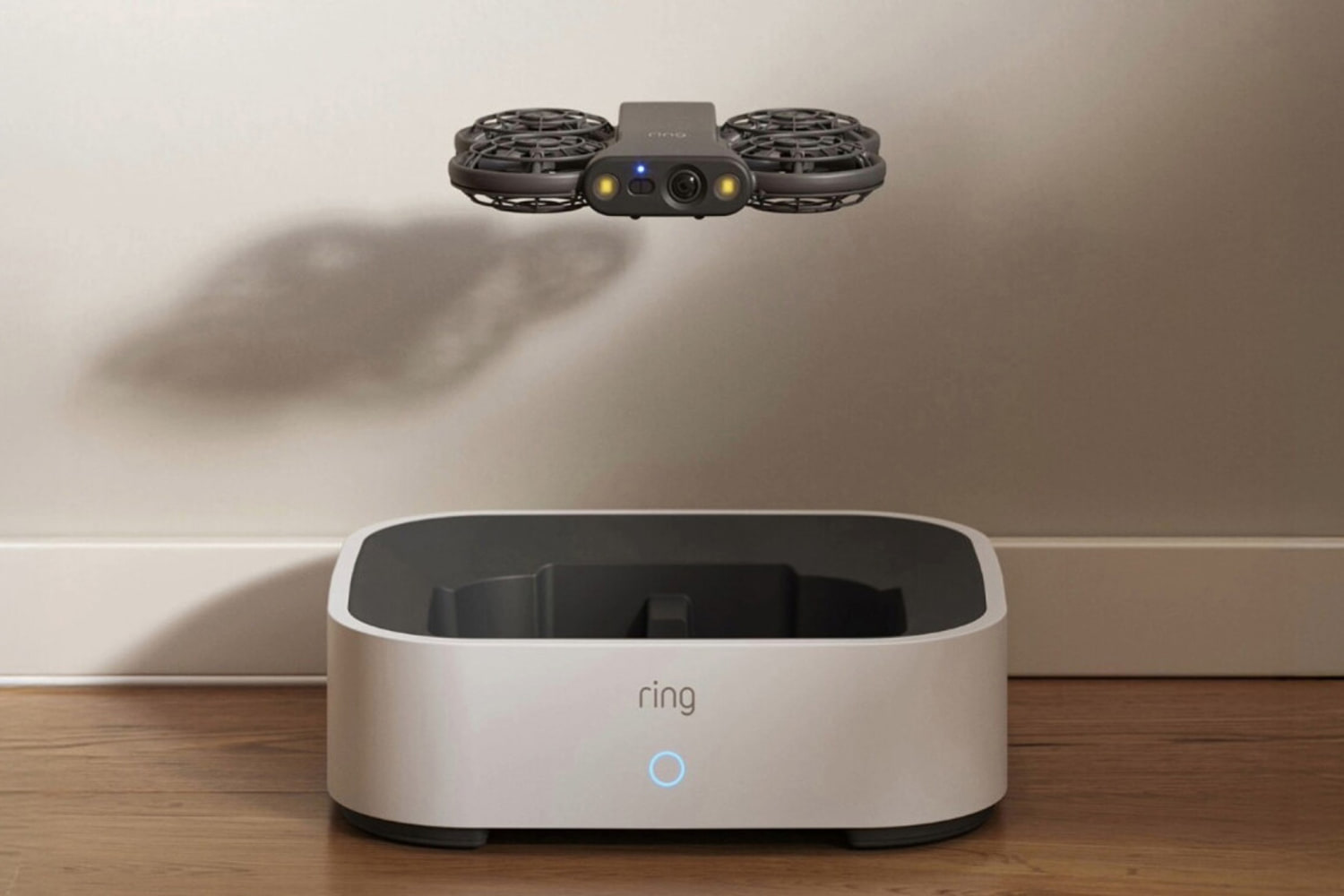
Now, picture a different version of that night. Let us invent a homeowner named Elena, living in a quiet suburban split-level while her partner travels for work. At 2:14 a.m., a downstairs window sensor trips. Elena does not leave her bed. She does not even turn on the lamp. Instead, from a sleek charging dock in the hallway, a tiny, whirring hum breaks the silence. Four shrouded propellers spin up. A miniature autonomous camera lifts into the air, glides effortlessly through the dark living room along a pre-mapped flight path, hovers in front of the kitchen window to stream live HD video straight to Elena’s phone, and—finding nothing more menacing than a neighborhood cat perched on the sill—quietly returns to its base.
Science fiction? Hardly. That exact machine is the Ring Always Home Cam, and its arrival alongside Amazon’s broader push into autonomous home security robotics marks the moment our domestic sanctuaries crossed a threshold we can never uncross.
When Amazon first pulled back the curtain on its indoor security drone—and followed up with rolling household sentinels like the Astro robot—the tech press treated it largely as a clever hardware gimmick. A flying Ring camera. A Roomba with a screen and a patrol schedule. Neat. Weird. Maybe a little creepy.
They missed the point entirely.
What Amazon actually debuted was not a gadget, nor even a better burglar alarm. It was the physical mobilization of the surveillance state inside the one place the Fourth Amendment and centuries of human instinct told us was completely off-limits: the interior of our own homes.
The Slow Creep from the Porch to the Hallway
To understand how we arrived at flying indoor cameras without rioting in the streets, you have to look at how gradually the walls of our homes became transparent.
Think back to 2013, when Jamie Siminoff pitched a Wi-Fi-enabled video doorbell called DoorBot on Shark Tank and walked away without a deal. Nobody thought homeowners needed to stream live video of their front porches to their smartphones. A peephole worked fine. A deadbolt worked better.
Then came the anxiety economy. Package theft turned into a nightly local news staple, complete with dramatic porch-pirate footage supplied directly by the very cameras designed to catch them. When Amazon acquired Ring in 2018 for roughly one billion dollars, the company did not just buy a hardware manufacturer. It bought a neighborhood watch network—the Neighbors app—that turned millions of front doors into an interconnected web of outward-facing lenses.
I remember the first time I installed a smart doorbell on my own house. The pitch was irresistible: peace of mind. Within a week, my phone was buzzing forty times a day. A delivery driver dropping off paper towels. A teenager walking a golden retriever. Shadows of maple leaves dancing across the concrete at sunset. I had bought the device to feel calmer, yet I found myself hyper-vigilant, checking my screen from restaurant tables and airport terminals, policing a twelve-foot square of concrete I used to ignore completely.
That psychological shift is the invisible engine behind Amazon’s security robotics. Fixed cameras have a glaring limitation: blind spots. A camera mounted over the garage cannot see if you left the stove on. A lens pointed at the front foyer cannot tell you if a basement pipe burst or if someone crawled through a back bathroom window.
To eliminate blind spots using traditional hardware, you would have to wire a camera into every single corner of every single room—an expensive, invasive, and visually oppressive proposition. Even the most security-obsessed homeowner balks at mounting a black plastic lens above their bed or their shower.
Amazon’s engineers solved that problem with a deceptively simple question: What if one camera could go anywhere?
Anatomy of a Flying Watchdog
Strip away the marketing gloss, and the engineering behind the Ring Always Home Cam is genuinely impressive. Building a drone that can fly outdoors in wide-open skies is one thing; building an autonomous aircraft capable of navigating a cluttered living room without shredding curtains, knocking over lamps, or slicing a curious toddler’s fingers is an entirely different beast.
The device operates on a strict set of physical and digital constraints designed to soothe nervous buyers:
- Enclosed Propellers: The four rotors are housed inside a lightweight plastic cage, preventing blades from striking walls, pets, or people.
- Pre-Mapped Flight Paths: You cannot pilot the drone manually like a remote-control toy. During setup, you walk the device through your house to teach it specific waypoints—say, "Check Kitchen," "Check Front Door," or "Check Basement." It flies only along those predetermined routes using obstacle-avoidance sensors.
- Audible Hum: Amazon deliberately engineered the propellers to emit a distinct, unmistakable buzzing sound in flight. The logic is straightforward: no one in the house should ever be recorded without knowing the camera is airborne.
- Physical Privacy Shutter: When docked in its charging cradle, the camera lens is physically blocked by the base itself. It is mechanically impossible for the drone to record video unless it is actively flying.
Alongside the flying camera, Amazon also introduced Astro, a wheeled household robot equipped with a periscope camera that can rise forty-two inches off the floor to peer onto countertops, patrol rooms while you are away, and integrate directly with Ring’s subscription monitoring services. Together, they represent a two-pronged strategy: eyes in the air and wheels on the floor, turning static home security into an active, roving presence.
On paper, the privacy safeguards sound reassuring. The lens is covered when docked. The buzz warns you when it is watching. It sticks to a script.
Yet anyone who has spent time studying how technology behaves once it leaves the showroom floor knows that intentions and outcomes rarely stay aligned for long.
The Architecture of Trust and the Reality of Data
Let us step away from hypothetical burglars for a moment and talk about the company holding the keys to this ecosystem.
When you place an autonomous robot inside your house, you are not merely buying hardware. You are inviting an enterprise-grade data-collection engine to build a three-dimensional spatial map of your private life.
Think about what a roving camera learns as it patrols your floor plan. It learns the exact layout of your rooms, the location of your exits, the brands of furniture you buy, the clutter on your kitchen table, when you wake up, when you leave, who visits you, and how long they stay. Even if raw video streams are encrypted or deleted after a set window, the metadata—the telemetry of your domestic existence—is pure gold for a retail and cloud computing giant whose entire business model relies on predicting human behavior before the humans themselves are aware of it.
We do not have to guess at how Ring handles user data and law enforcement relationships because the history is already written in public records.
Between 2019 and 2022, Ring forged partnerships with more than two thousand police and fire departments across the United States, creating a portal that allowed officers to request video footage directly from Ring owners without immediately obtaining a warrant. In several documented instances, Ring handed over user footage to police without the owner’s consent under "emergency" exceptions. Later, federal regulators fined the company millions of dollars after investigators revealed that employees and contractors had been given unrestricted access to customers’ private indoor camera feeds—including cameras placed in bedrooms and bathrooms—and that hackers had repeatedly hijacked accounts to harass families through two-way speakers.
Amazon has since tightened its policies, introduced end-to-end encryption options, and restricted direct police requests through the Neighbors app. Those reforms are real, and they matter.
But pause and consider the trade-off being asked of us. We are being told to trust that the same corporate infrastructure that struggled to secure stationary cameras mounted on porch walls will flawlessly govern autonomous, flying, room-mapping robots inside our bedrooms and hallways.
Trust, once fractured, does not rebuild on the strength of a plastic privacy shutter.
Why Fear Sells Better Than Peace
Why, then, do millions of people eagerly buy these devices? Why does the market for smart home security continue to climb year after year, even as privacy scandals dominate the headlines?
Because fear is one of the oldest and most reliable currencies in human history, and modern technology has perfected the art of selling us the cure for an anxiety it quietly amplifies.
Consider what happens when you live in a neighborhood saturated with Ring cameras and community alert apps. Every broken car window three miles away becomes an urgent push notification on your lock screen. Every unfamiliar delivery van idling at the curb gets flagged as "suspicious activity." Statistically, property crime in many parts of the country has fluctuated or declined over the past thirty years, yet the perception of danger has skyrocketed. When your pocket vibrates ten times a week with grainy clips of strangers walking up driveways at midnight, the world outside your deadbolt starts to feel like a siege.
A stationary camera feeds that anxiety by showing you the perimeter. An autonomous drone promises to conquer the interior.
It taps into a deeply human desire for omnipotence—the wish to be in two places at once, to hold dominion over our personal territory even when we are sitting in a hotel room three time zones away. If you are a caregiver checking on an aging parent, or a pet owner worried about a sick dog, or a frequent traveler whose house sits empty for weeks at a time, the appeal of a flying camera is not hard to understand. It feels like agency. It feels like control.
Control, however, has a funny way of reversing its polarity.
Living Under the Hum
Imagine, for a second, how a household actually changes when an autonomous security robot becomes part of the furniture.
Not the idealized household in an Amazon commercial—spotless minimalist living rooms, sunlit hardwood floors, smiling parents checking on a well-behaved golden retriever. Think about a real home. Laundry piled on the sofa. Kids arguing over a video game. A couple having a raw, whispered argument in the kitchen at midnight after a stressful week.
When a camera is bolted to a wall, you know where it is. You can step out of frame. You learn its angles, its blind spots, its boundaries. There is a clear spatial contract between the watcher and the watched.
A flying drone or a roaming robot destroys that spatial contract. Even if it only flies on command or when an alarm triggers, its very presence introduces an element of unpredictability into domestic space. The machine has legs—or wings. It occupies the same three-dimensional volume that human bodies occupy.
And what happens to the other people inside that home? A roommate who did not choose the system. A teenager growing up under the subtle, ambient awareness that the house itself can dispatch a drone to inspect a noise. A domestic worker, a babysitter, or a guest who walks into your living room and hears a mechanical buzz lift off from behind a bookshelf.
Psychologists have long studied the "chilling effect" of surveillance—the subtle ways human beings alter their posture, tone, and behavior when they believe they might be observed. We perform instead of relaxing. We edit ourselves. Home is supposed to be the backstage of human life, the one arena where you can drop the mask, walk around in tattered sweatpants, sing badly, cry freely, and exist without an audience.
When you put wings on a camera and give it the run of the hallway, you bring the stage lights backstage.
The Economics of the Invisible Subscription
There is another layer to Amazon’s security robotics push that rarely makes it into the product launch keynote: the business model underneath the rotors.
Amazon does not make its real money selling you a $250 flying camera or a $1,600 rolling robot. Hardware, for Amazon, has always been a razor-thin trojan horse. Think of the original Kindle e-reader, sold near cost to lock readers into the Kindle bookstore. Think of the Echo smart speaker, placed on millions of kitchen counters to turn voice commands into Prime orders.
Ring’s autonomous robots follow that exact playbook. Without a recurring Ring Protect subscription, a smart security device is essentially a live-view peephole that forgets everything the moment it happens. To unlock video history, person detection, automated patrol routines, and professional emergency dispatch, you pay a monthly fee—forever.
Once you map your home, set your flight paths, mount your contact sensors, and link your robots to your Alexa routines, switching ecosystems becomes excruciating. You do not just throw away a device; you have to rip out the nervous system of your house and retrain your habits from scratch.
In business strategy, this is known as high switching costs. In human terms, it means turning basic domestic peace of mind into a permanent utility bill—one where the price can be raised incrementally every few years while your home’s spatial data flows continuously upstream into Amazon Web Services.
Where the Sky Inside Ends
Technology rarely arrives wearing horns. It arrives wearing a helpful smile, promising to save us ten seconds, lower our heart rate, or keep our families safe while we sleep.
That is what makes Amazon’s debut of flying and rolling security robots so fascinating—and so worth resisting on autopilot. The engineers who built the Ring Always Home Cam solved real, thorny technical problems. For certain people with specific needs—monitoring an unoccupied vacation property, checking on mobility-impaired relatives, or verifying false alarms without risking a confrontation—an autonomous indoor camera offers undeniable utility.
Yet convenience is a terrible compass when it is the only instrument on the dashboard.
Every generation gets to decide where the boundary lies between safety and autonomy, between convenience and privacy. Our grandparents drew that line at the front porch. Our parents drew it at the landline phone and the locked filing cabinet. We are drawing it right now, one smart device at a time, often without realizing a decision is even being made.
Before you let a camera lift off from your hallway table and patrol the rooms where you sleep, eat, and love, ask yourself a simple question. Not whether the drone can avoid hitting your ceiling fan. Not whether the video stream is sharp in low light.
Ask yourself what happens to a human soul when there is nowhere left on earth where the walls are just walls, a creak in the floorboards is just a creak, and the dark at two in the morning belongs entirely to you.