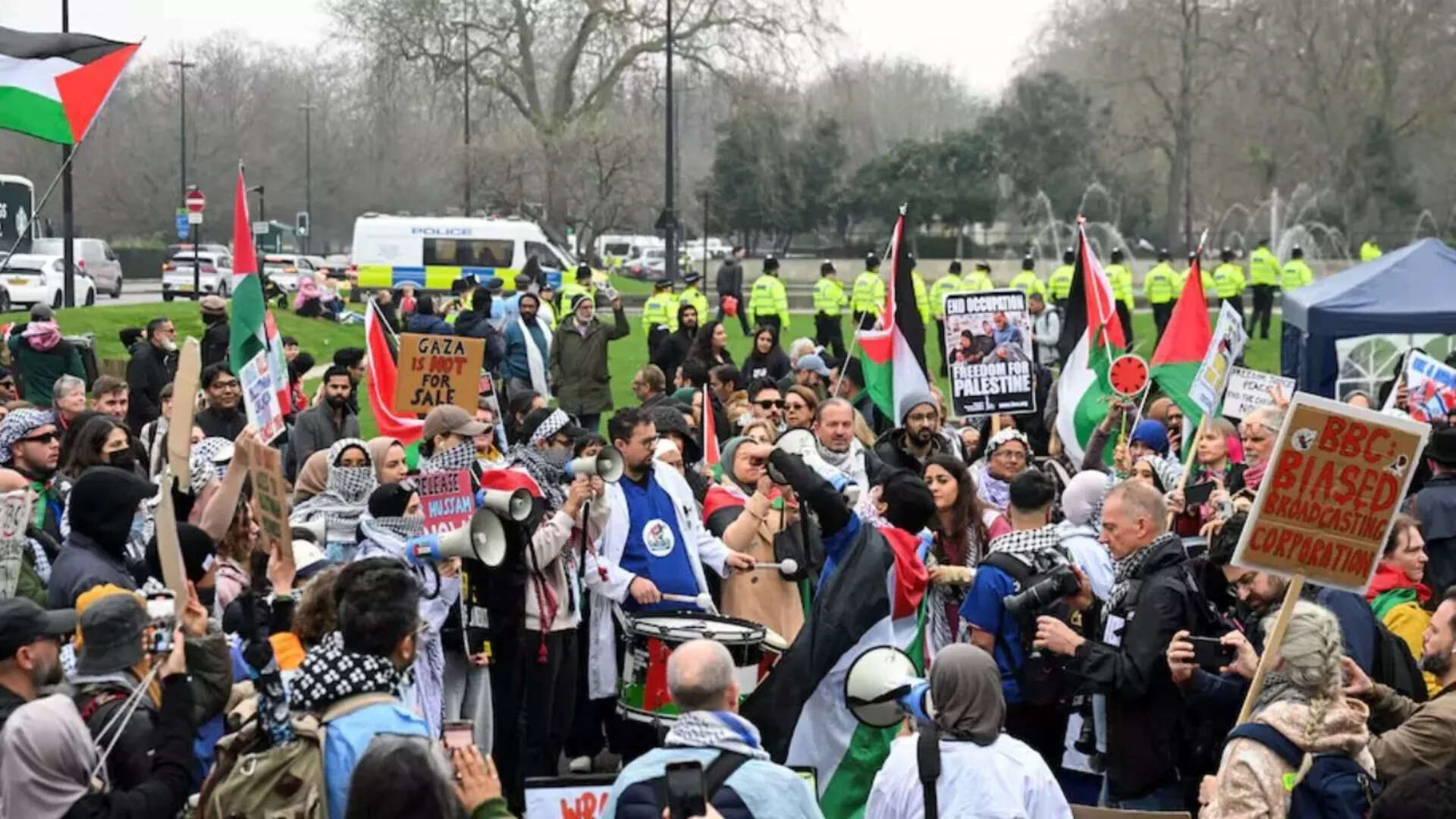
The Metropolitan Police just issued another "stern warning" for Al-Quds Day. They’ve dusted off the standard playbook: Section 14 conditions, fixed start times, and a "static" demonstration area. The media is eating it up, framing these restrictions as a win for public order and a masterful display of "firm but fair" policing.
They are lying to you. Or worse, they’re lying to themselves.
The assumption that rigid, static boundaries make a city safer is the single greatest fallacy in modern crowd management. I have spent two decades watching security budgets balloon while the actual efficacy of "kettling-lite" tactics craters. By forcing thousands of emotionally charged individuals into a high-density "pen," the police aren't preventing conflict. They are incubating it.
We need to stop pretending that a yellow line on a sidewalk is a magical barrier against geopolitical tension.
The Myth of the Controlled Perimeter
The "static" protest is a bureaucratic fantasy. It exists to satisfy a spreadsheet at Scotland Yard, not to manage the physics of human movement. When you take 10,000 people and tell them they cannot move, you create a pressure cooker.
In a fluid march, energy dissipates. People walk, they tire, and the crowd thins out naturally. By mandating a static rally, the police concentrate that energy into a singular, volatile point. It’s basic thermodynamics applied to sociology. If you increase the density without allowing for expansion, the temperature rises.
Most "clashes" reported in the news aren't spontaneous outbursts of ideology. They are the predictable result of overcrowding. When people can’t move, they get frustrated. When they get frustrated, they look for someone to blame. Usually, that’s the line of officers standing three inches from their face.
The Policing Bill You Aren't Allowed to See
Every time the Met issues one of these warnings, the taxpayer picks up a bill that would make a Fortune 500 CEO weep. We’re talking about millions of pounds in overtime, logistical staging, and "pre-event" intelligence gathering.
What do we get for that ROI?
- A gridlocked West End.
- Local businesses forced to shutter or hire private security.
- A surge in "preventative" arrests that rarely lead to meaningful convictions.
The "stern warning" is a PR shield. If violence breaks out, the police can say, "We warned them." If nothing happens, they say, "Our tactics worked." It’s a classic heads-I-win, tails-you-lose scenario for the authorities. Meanwhile, the actual underlying tensions remain completely unaddressed, festering until the next scheduled Saturday outrage.
Dismantling the People Also Ask Nonsense
If you search for protest safety, you’ll find a mountain of milquetoast advice. Let’s correct the record on the three biggest lies currently circulating.
1. "Are static protests safer for the public?"
No. They create a "soft target" environment. By pinning a crowd to a specific location for hours, you make it easier for counter-protesters to identify a front line. You also make it impossible for neutral bystanders to navigate the city without being sucked into the vacuum of the event. A moving crowd is harder to harass and easier to avoid.
2. "Do police warnings deter bad actors?"
Quite the opposite. A public, high-profile warning acts as a beacon. It signals to every agitator in the country exactly where the friction point will be. You aren't "warning" the protesters; you’re marketing the conflict to anyone looking for a fight.
3. "Is there a legal right to a quiet city?"
There is a right to passage and a right to safety, but the "business as usual" argument is dead. The current strategy of cordoning off massive chunks of the city for static rallies is the most disruptive option available. It kills foot traffic for six blocks in every direction rather than allowing a march to pass through a corridor in twenty minutes.
The "Safety" Theater of Section 14
The Public Order Act has become a crutch for lazy strategy. Section 14 allows the police to impose conditions on an assembly to prevent "serious public disorder." In practice, this has become a tool for micro-management.
I've seen commanders lose their minds over a flag pole that’s six inches too long while ignoring the fact that their own barricades have created a lethal crush hazard. The focus is on the optics of control, not the reality of safety.
When the Met announces they will be "robust" in their enforcement, they are signaling to their officers that the crowd is an enemy to be contained, rather than a group of citizens exercising a right. This shift in mindset is where the real danger lies. It leads to the "warrior cop" syndrome, where every interaction is a test of dominance.
A Scenario for Consideration
Imagine a Saturday in London where the police don't issue a "stern warning." Imagine they don't set up steel fences or define a "static" zone. Instead, they treat the event like a marathon. They facilitate movement. They keep the arteries open. They step back and only intervene if an actual crime is committed against a person or property.
In this scenario, the "spectacle" disappears. There is no line to push against. There is no cage to break out of. The media has no "face-off" photos to splash across the front page. The protest becomes what it should be: an expression of opinion, rather than a tactical exercise in urban warfare.
The Cost of the Status Quo
The real casualty here isn't "free speech" or "public order"—it's the credibility of the institutions. Every time a "static" protest turns into a chaotic mess of arrests and pepper spray, the public loses a little more faith.
We are stuck in a loop of escalating force and escalating resentment. The police feel under-supported and over-scrutinized. The protesters feel targeted and silenced. The general public just wants to buy a coffee without walking through a gauntlet of sirens.
The "contrarian" take isn't that we should ban protests or that we should let them run riot. It’s that we need to fire the people who think that more barriers equals more safety.
Real crowd management is about psychology, flow, and the de-escalation of physical presence. The current "stern warning" model is the tactical equivalent of trying to stop a flood by building a wall in the middle of the river. You don't stop the water; you just make sure that when the wall breaks, the damage is ten times worse.
Stop listening to the "experts" who tell you that the city is a battlefield. It only becomes one when you treat it like one.
Throw away the barriers. Cancel the overtime. Let the people walk.