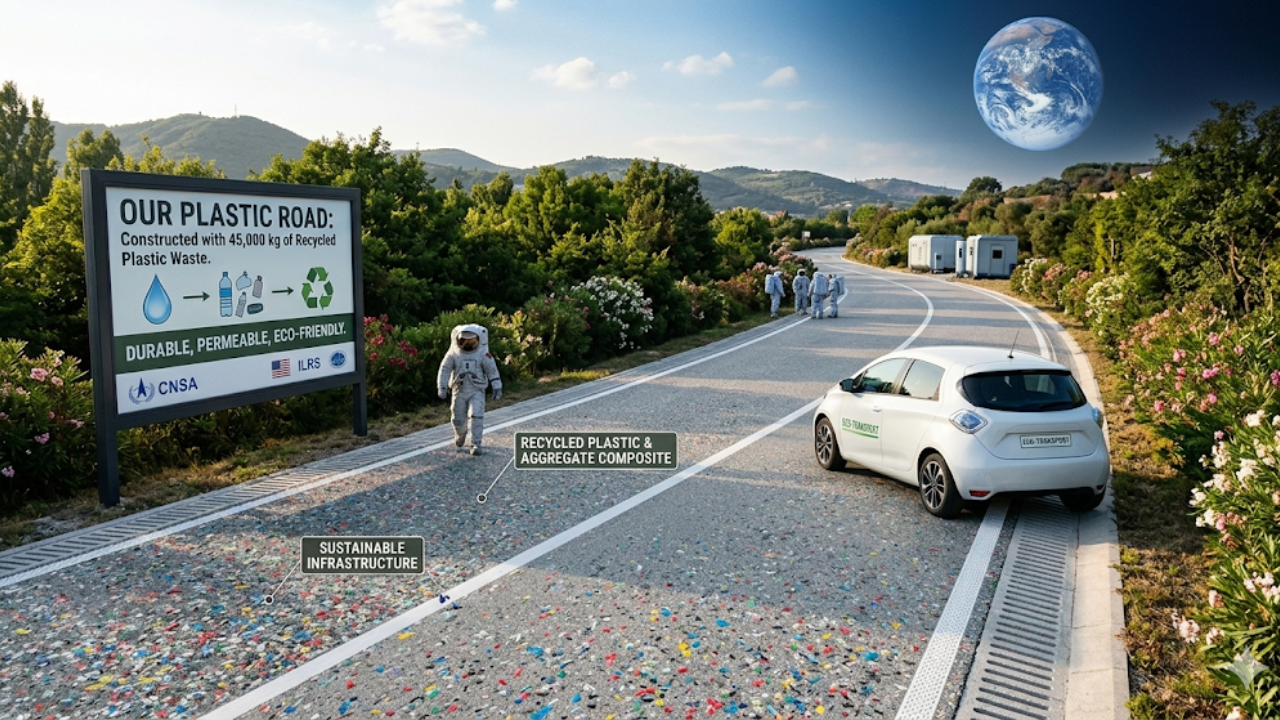
Nepal has a massive infrastructure problem. Heavy monsoon rains tear through asphalt every summer, leaving major highways looking like cratered moonscapes. At the same time, municipal authorities face an overwhelming surge of plastic pollution that clogs rivers like the Bagmati and piles up in landfill sites.
Local engineers and green entrepreneurs decided to stop treating these two massive headaches as separate issues. They started mixing shredded plastic waste into bitumen to pave streets. It turns out that plastic waste roads aren't just an eco-friendly gimmick. They actually hold up better under extreme weather than traditional asphalt.
Building plastic roads in Kathmandu and Pokhara isn't about feeling good. It's about basic survival and saving municipal budgets.
The Chemistry Behind Plastic Waste Roads
Traditional road construction relies on bitumen, a sticky black petroleum product that binds gravel together. When summer temperatures soar, bitumen softens. When heavy trucks roll over that soft surface, it ruts and cracks. Add a relentless monsoon season, and water seeps into those cracks, washing away the base layer and creating potholes.
Adding specific types of plastic waste completely changes how the binder behaves.
Engineers generally target low-density polyethylene (LDPE) and high-density polyethylene (HDPE). Think discarded shopping bags, milk sachets, and single-use packaging. Workers clean, dry, and shred this trash into tiny flakes.
When you mix these plastic flakes with hot aggregate (stones and gravel) at around 165 degrees Celsius, the plastic melts instantly. It coats the stones uniformly. Then, you add the hot bitumen. The melted plastic and bitumen fuse into a modified binder.
This process isn't just about hiding trash inside rocks. The polymer molecules from the plastic create a stronger bond. This modified mix has a higher softening point. It won't melt easily under the blazing midday sun, and it resists water penetration far better than raw bitumen. You get a tougher, more flexible road surface that handles heavy axle loads without buckling.
Real Lessons From Paving Pokhara And Kathmandu
This isn't a theoretical laboratory concept. Nepal has been testing this tech on real, high-traffic streets.
In Pokhara, municipal authorities teamed up with local tech firms to pave trial stretches using thousands of kilograms of shredded polythene bags. Pokhara gets some of the highest rainfall in the country, making it the ultimate testing ground. The early results showed a significant drop in pothole formation during the peak rainy months.
Green Road Waste Management, a pioneering local enterprise, scaled up these efforts by working directly with municipalities. They proved that utilizing local trash reduces the amount of expensive, imported bitumen required for construction by roughly 8 to 10 percent. Nepal imports all of its bitumen, meaning every kilometer of plastic road built keeps money inside the local economy while cleaning up the environment.
Municipalities found that using shredded plastic didn't require buying multi-million-dollar specialized machinery. Local crews could adapt existing asphalt plants with minor modifications. That operational simplicity matters when you're working with tight local government budgets.
The Microplastic Dilemma And What The Critics Get Wrong
Whenever someone mentions mixing plastic into infrastructure, critics immediately raise red flags about microplastics. It's a fair concern. Nobody wants roads that shed toxic particles into the groundwater every time it rains.
The actual science tells a different story.
When executed correctly, the plastic does not remain as loose fragments inside the road. Because the aggregate is heated well above the melting point of LDPE, the plastic undergoes a structural phase change. It chemically bonds with the bitumen. Once cooled, the plastic is locked within a solid, durable matrix.
Studies by institutions like the Central Road Research Institute (CRRI) in neighboring India, which has laid thousands of kilometers of plastic roads, show that these surfaces do not leach microplastics into surrounding soil or water systems during normal wear and tear. The plastic only degrades if the road is subjected to open burning, which obviously isn't part of standard road maintenance.
The real risk isn't microplastics shedding into rivers. The risk is poor quality control during construction. If a contractor gets lazy, fails to clean the plastic, or mixes in polyvinyl chloride (PVC), the chemical bond fails. PVC releases toxic chlorine gas when heated. Strict sorting protocols are mandatory. You can't just dump unwashed garbage into an asphalt mixer and hope for the best.
Why Plastic Roads Haven't Taken Over Entirely
If this technology works so well, why isn't every single road in Nepal made of plastic waste?
Supply chain fragmentation is the biggest bottleneck. Collecting plastic trash is easy; processing it into a clean, standardized, industrial-grade aggregate modifier is incredibly difficult. Nepal's waste management sector relies heavily on informal waste pickers. These workers do a phenomenal job sorting high-value materials like PET bottles, but thin plastic bags and wrappers are often left behind because they fetch a low price per kilogram.
To make plastic roads a nationwide standard, municipalities must establish centralized processing hubs. These facilities need industrial shredders, heavy-duty washing units, and strict quality control labs to filter out dangerous PVC plastics.
There's also a deep-seated institutional inertia within public works departments. Standard government bidding processes rely on decades-old engineering manuals. Upgrading national road codes to officially approve and mandate plastic-bitumen mixes takes years of bureaucratic heavy lifting. Contractors prefer sticking to what they know rather than trying a new mix design, even if the new version lasts twice as long.
How To Implement This In Your Own Community
You don't need a national mandate to start utilizing this technology in regional infrastructure projects. Change usually starts at the municipal or private level.
First, pressure your local town council or public works department to run a small-scale pilot project. A single parking lot, a walking path, or a quiet residential alley is the perfect place to start.
Second, partner with local recycling centers to secure a clean stream of LDPE and HDPE plastics. Ensure they have the capacity to wash and shred the material down to a consistent size, usually between 2mm and 4mm.
Third, connect your local university’s engineering department with municipal road contractors. Academic oversight provides the testing needed to calibrate the exact plastic-to-bitumen ratio based on your regional climate.
Stop viewing plastic waste as an intractable environmental curse. It's a high-performance building material waiting to be used. Build the collection infrastructure, upgrade the local mixing specifications, and start turning local trash into durable, weather-resistant roads.