A peaceful line of saffron robes walking along a rural roadside. A sudden roar of an engine. Splintered wood, scattered alms bowls, and nine dead bodies. What happened in the northeastern province of Mukdahan on Thursday, July 2, 2026, is a nightmare that will haunt Thailand for years. An 11-year-old boy took his parents’ pickup truck without permission, drove it for about ten kilometers, lost control, and slammed directly into a group of Buddhist monks on a sacred pilgrimage.
Five monks died right there on the hot asphalt. Four more breathed their last at the hospital. More than a dozen others are injured, some fighting for their lives.
It is easy to look at this horrifying event and call it a freak accident. It is easy to blame a single child or point fingers at negligent parents. But doing that ignores a much darker truth. This tragedy is a direct result of a broken traffic culture, toothless law enforcement, and a widespread societal blind spot regarding underage driving. Thailand has some of the deadliest roads on the planet. If slaughtering nine revered spiritual figures on a roadside doesn't force a massive overhaul of how the country manages its vehicles, nothing will.
The Brutal Reality of the Mukdahan Crash
Let's look at what actually happened on that stretch of road. A group of 35 Buddhist monks and five lay followers had just set off from a local temple. They were embarking on a grueling 260-kilometer pilgrimage walk to the neighboring province of Ubon Ratchathani. They had been walking for barely thirty minutes. They were moving in a disciplined, single-file line on the shoulder of the road, standard practice for these types of spiritual journeys.
CCTV footage captured from a nearby property reveals the terrifying swiftness of the disaster. Cars and trucks were passing by normally. Then, a pickup truck enters the frame, swerving erratically.
Survivors recall seeing the vehicle slide off the main lane. One monk, Phra Sompong, later recounted his narrow escape to local rescue workers while still in a state of shock. He was chanting a meditation mantra when he noticed the truck barreling down on them at full speed. He and another monk managed to jump into the ditch just in time. The first nine monks in the line survived. The truck struck the middle of the procession with full force, launching human bodies into the air and dragging others under the wheels.
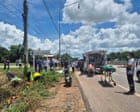
Mukdahan Governor Worayan Bunnarat confirmed the escalating death toll as the day progressed. Emergency medical teams and the Ruam Jai Mukdahan Rescue Association worked frantically at the scene, but the damage was done. The force of the impact left the roadside looking like a war zone.
The Deep Cultural Wound of Hitting a Monk Line
To understand why this specific crash has sent shockwaves across the nation, you have to understand the place monks hold in Thai society. Monks aren't just religious figures. They are the spiritual bedrock of the community. They are deeply venerated, seen as living symbols of the Buddha's teachings. Seeing them on their daily alms rounds or on long pilgrimages is a normal, sacred part of Thai life. Ordinary citizens routinely stop to offer them food, water, and deep respect.
When someone kills a monk, it isn't viewed as just another traffic statistic. It feels like a blow to the spiritual heart of the country.
The fact that these monks were killed while engaged in a pilgrimage walk makes the loss even more bitter. They were participating in a peaceful, ancient tradition meant to cultivate mindfulness and store spiritual merit. Instead, their lives were cut short by the ultimate symbol of modern negligence: a child behind the wheel of a multi-ton piece of heavy machinery.
The Myth of the Freak Accident
Public outrage has naturally centered on the driver. An 11-year-old boy. According to Mukdahan Provincial Police Chief Major General Pairoj Thaiphutsa, the child is currently in custody but was initially too traumatized to give a formal statement. Investigators are waiting for child protection officers to handle the questioning properly.
Reports indicate the boy has special needs, a detail that adds another layer of tragedy to the situation, but it also raises infuriating questions about how he got the keys in the first place. How does an 11-year-old child manage to start a massive pickup truck, back it out of a driveway, and navigate ten kilometers of public highway without anyone stopping him?
This is not a freak occurrence. Walk through any rural Thai village or provincial town and you will see children driving. You will see young pre-teens operating scooters, modified agricultural vehicles, and massive pickup trucks. It's an open secret. Parents often look the other way, or worse, encourage it because it helps with chores, farming, or running errands.
The legal driving age for cars in Thailand is 18. For small motorcycles, it's 15. Yet, these limits are treated as mere suggestions in the provinces. Local police rarely pull over underage drivers unless they cause a wreck. This complete lack of daily enforcement creates an environment where a child feels entitled to grab the family keys and take a truck for a spin.
Thailand Infamous Road Safety Failure
Governor Worayan Bunnarat stated that the province has been strict on road safety in recent years, calling this incident a harsh lesson for the entire nation. With all due respect, the country has had enough lessons. It doesn't need more warnings. It needs a total systemic cleanup.
Thailand consistently ranks near the top of global lists for traffic fatalities per capita. The World Health Organization repeatedly points out the grim numbers. Tens of thousands of people die on Thai roads every year. Speeding, drunk driving, lack of helmet use, and completely ineffective law enforcement create a deadly environment for drivers, passengers, and pedestrians alike.
The pickup truck is the undisputed king of rural Thai roads. They are affordable, practical for farming, and everywhere. But they are also heavy, powerful vehicles that require skill and maturity to handle safely. Putting an untrained, emotionally immature child behind the wheel of a high-power diesel truck is no different than handing them a loaded firearm. The outcome is entirely predictable.
The Legal and Moral Accountability of Parents
As the investigation continues, the focus must shift to parental accountability. Major General Pairoj Thaiphutsa noted that police have summoned the boy's parents to determine who was responsible for his care and to move forward with the legal process.
Under Thai law, parents can be held civilly liable for damages caused by their minor children, especially if they demonstrated negligence in supervising them. In severe cases of neglect, criminal charges can also apply.
Securing the keys to a deadly vehicle is a basic requirement of parenting. If your child can easily access your truck keys, start the vehicle, and drive onto a highway, you have failed a fundamental safety test. The legal system needs to make an example of this case. If parents face real prison time for allowing their underage children to drive, habits will change overnight.
True Solutions to Stop the Road Carnage
Grieving won't fix this. Praying won't fix this. Only aggressive, uncomfortable changes to public policy and cultural habits will stop the next procession of monks from being wiped out.
First, the country must implement immediate keys-down laws. Parents need to treat car keys like deadly weapons. Lock them away. Keep them out of reach. If an underage child takes a car and causes injury, the parents should face mandatory criminal prosecution for criminal negligence, not just financial fines.
Second, local police forces must stop ignoring underage driving in rural areas. There needs to be a zero-tolerance policy for children operating motor vehicles on public roads. Checkpoints shouldn't just look for drunk drivers during holiday festivals; they need to actively pull over children who clearly belong in a classroom rather than behind a steering wheel. Schools should also run mandatory safety programs, penalizing students who arrive at school driving vehicles illegally.
Third, infrastructure must adapt to protect vulnerable road users. Monks walking on pilgrimage routes, pedestrians, and cyclists have zero protection against massive pickup trucks. Thailand needs wider, protected shoulders on major provincial roads, especially in areas known for foot traffic and religious walks.
The tragedy in Mukdahan is a stain on the nation. It represents a complete breakdown of parental duty, community vigilance, and traffic enforcement. We cannot undo the loss of those nine monks, but we can stop pretending that this was just a sad piece of bad luck. It was the predictable result of a society that refuses to take road safety seriously. Change the laws, lock up the keys, and enforce the rules before another child turns a family vehicle into a weapon of mass destruction.