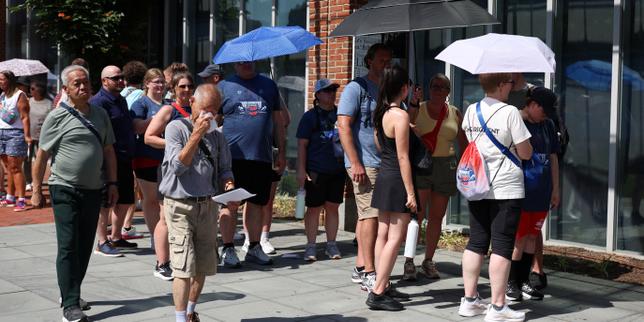
You can't hide from a heat dome when you're trapped in a canyon of concrete and steel. Right now, a massive high-pressure system is smothering the eastern half of the United States, sending temperatures skyrocketing toward 40°C ($104^\circ\text{F}$) from Washington D.C. straight through Philadelphia and New York City. Over 230 million Americans are sweating through this emergency, and the timing couldn't be worse. The historic spike lands exactly during the high-traffic Fourth of July holiday weekend.
While southern states expect blazing summers, the Northeast simply isn't built for prolonged, triple-digit exposure. The infrastructure is old. The buildings trap thermal energy. When air temperatures hover around 38°C to 40°C, high humidity pushes the real-feel heat index to a suffocating 44°C to 46°C ($112^\circ\text{F}$ to $115^\circ\text{F}$). This isn't just uncomfortable weather. It's a public health crisis masquerading as a holiday weekend.
The Deadly Physics of the Urban Heat Island
If you think your phone's weather app tells the full story, think again. Cities create their own microclimates. Materials like asphalt, brick, and steel act like massive thermal batteries. They soak up solar radiation all day and radiate it back out all night.
According to climate scientist Vijay Limaye at the Natural Resources Defense Council, urban centers trap this heat brutally. The air temperature on a tree-lined suburban street can be significantly lower than an urban block just a few miles away. This phenomenon means city residents rarely get a break.
The National Weather Service notes that nighttime lows aren't dropping below 26°C ($80^\circ\text{F}$). That lack of nighttime cooling is where the real danger lies. The human body needs lower nocturnal temperatures to recover from daytime heat strain. Without that relief, internal body temperatures stay elevated, drastically increasing the risk of heat exhaustion and heat stroke.
Why Acclimatization Matters More Than Air Conditioning
A common misconception is that because the US has high rates of air conditioning, its population is safe. That logic fails on two fronts.
First, people living in the Northeast aren't acclimatized to severe heat. Medical experts point out that the human cardiovascular system physically adapts to sustained warmth over weeks. Because cold or mild weather dominates the Northeast for most of the year, a sudden jump to 40°C shocks the system. Residents here experience heat stress at much lower thresholds than someone living in Texas or Arizona.
Second, access to cooling is highly unequal. In major metro areas, the impact tracks closely with economic lines. Data shows that historically redlined, low-income neighborhoods remain up to 3°C hotter than wealthier, greener districts. For residents in older Brooklyn apartments or Philadelphia row houses without central air, the situation becomes desperate.
The Strain on Grid Infrastructure and Public Services
Electricity operators are already sounding the alarm. The New York Independent System Operator urged residents to conserve power by bumping up thermostats and delaying the use of major appliances. When millions of air conditioners run simultaneously at maximum capacity, the localized power grid risks transformer failures and blackouts.
City governments are shifting into emergency mode to prevent casualties. New York Mayor Zohran Mamdani announced the deployment of hundreds of cooling centers, ranging from the massive Javits Center to mobile relief vans distributing water and sunscreen. Parks are extending public pool hours, and outreach teams are hitting the streets to check on vulnerable unhoused populations.
Yet, traditional emergency plans clash directly with holiday behavior. Millions of people are traveling, attending outdoor concerts, and gathering for parades. Joshua DeVincenzo from Columbia University's National Center for Disaster Preparedness warns that disaster planning usually assumes people will stay indoors near a cooling mechanism. When millions choose to stand outside for hours to watch fireworks in 40°C weather, standard emergency calculations go out the window. Major events, including festivals and outdoor races, face last-minute cancellations across the region.
Essential Protocols to Survive High Heat Index Days
When the heat index passes 43°C, standard summer advice isn't enough. You need to adjust your daily routine immediately.
- Track the Heat Index, Not the Temp: If the thermometer says 37°C but the humidity is 75%, your body feels 44°C. Trust the index. It dictates how efficiently your sweat can evaporate to cool you down.
- Pre-hydrate Before Going Out: If you wait until you feel thirsty to drink water, you're already dehydrated. Drink fluids consistently throughout the day, and skip the extra iced espresso or alcoholic holiday cocktails, which accelerate fluid loss.
- Identify the Early Warning Signs: Heat exhaustion presents as heavy sweating, a rapid pulse, dizziness, and nausea. If you or someone else experiences this, get to an air-conditioned room and apply cool, wet cloths. If confusion, fainting, or hot, dry skin sets in, that's heat stroke. Call 911 immediately. It's a medical emergency.
- Protect Your Pets: Asphalt temperatures can easily reach 60°C ($140^\circ\text{F}$) when the air is 38°C. This burns paw pads in seconds. Keep animals indoors, and never, under any circumstances, leave a pet inside a parked vehicle.
Check in on elderly neighbors or friends who live alone in older buildings. A quick phone call or knock on the door can save a life before the heat dome finally breaks next week.