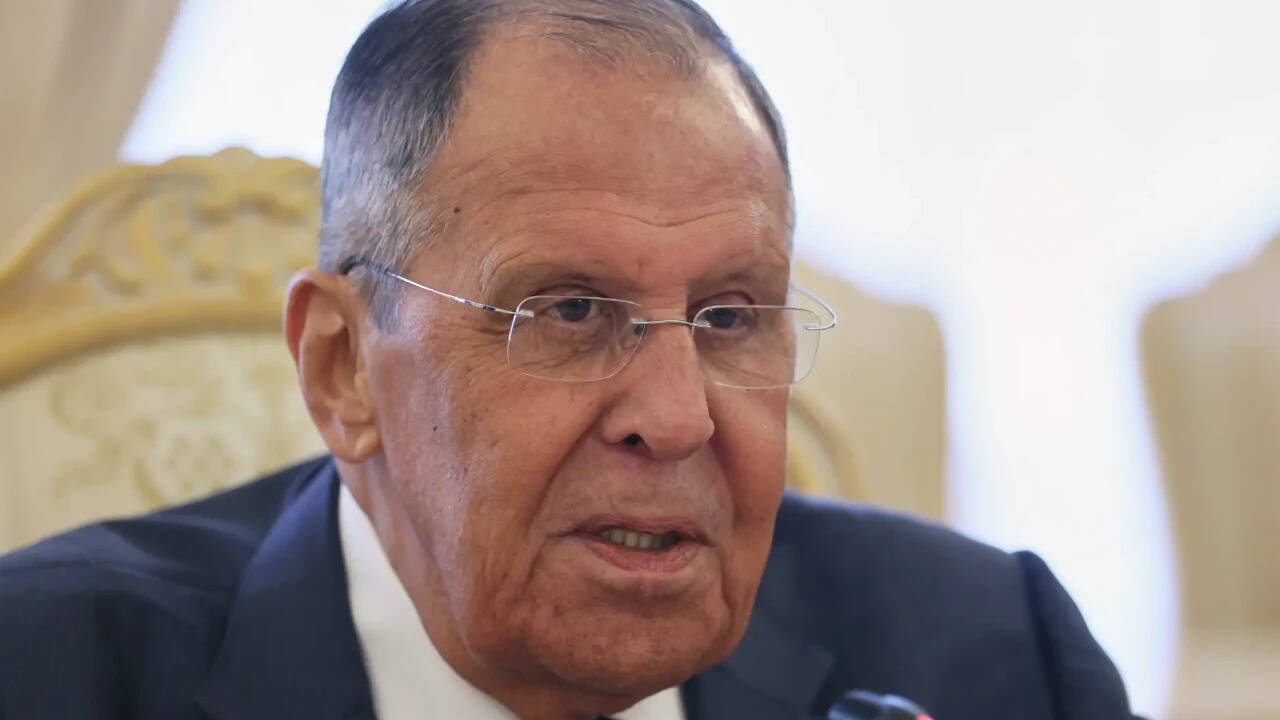
The reciprocal closure of the Goethe-Institut branches across Russia and the rapid expulsion of Russian diplomatic footprints from Bonn and Berlin marks the final, violent severing of civilian bridges that took decades to build. When Russian Foreign Minister Sergey Lavrov announced the complete termination of German cultural operations from Moscow to Yekaterinburg, he was not merely retaliating for the shuttering of the Russian House in Berlin. He was cementing an institutional iron curtain. This escalation follows Berlin's definitive attribution of an attempted explosives-laden drone attack targeting a Ukrainian logistics aircraft at Leipzig/Halle Airport to Russian state actors. Traditional diplomacy has officially been replaced by total structural attrition.
For decades, cultural diplomacy operated on a Cold War logic. Even at the height of ideological hostility, libraries, language institutes, and art houses served as pressure valves and low-level communication channels. Those valves are now welded shut. When German authorities moved to close the Russian consulate in Bonn and strip the Russian House of its legal status, they crossed a line from quiet intelligence monitoring to active institutional amputation. Berlin realized that maintaining soft-power outposts while facing aggressive sabotage operations within its own borders was an untenable paradox.
The spark that incinerated what remained of bilateral trust occurred on August 4 at Leipzig/Halle Airport. A drone packed with explosives was discovered immediately adjacent to a freight aircraft designated for Ukrainian support operations. German federal investigators, backed by intelligence findings from domestic security agencies, mapped the operational chain directly back to Russian handlers. Interior Minister Alexander Dobrindt and Foreign Minister Johann Wadephul did not mince words when presenting the findings. They categorized the incident not as a random act of criminality, but as a deliberate state-sponsored kinetic probe executed right in the heart of Western Europe's supply lines.
Moscow dismissed the accusations as fabricated theater designed to deflect domestic German political friction. Yet the speed and scale of the countermeasures reveal how sensitive both capitals are to the erosion of their respective sovereign domains. Lavrov stated bluntly from the Eastern Economic Forum in Vladivostok that any response short of annihilating Germany's official cultural footprint in Russia would demonstrate a lack of national self-respect. Goethe-Institut facilities in Moscow, St. Petersburg, and Yekaterinburg received their death warrants within hours. Generations of student exchanges, language learners, and academic partnerships were collateral damage in an escalating intelligence war.
Europe is waking up to a grim operational reality. What security analysts call hybrid warfare is no longer an abstract theory discussed in think tanks. It is an active daily reality featuring cyber disruptions, infrastructure targeting, and close-call kinetic sabotage. Danish intelligence services recently issued stark warnings regarding specific Russian targeting of defense manufacturing companies supplying components to Ukraine. Similar threat assessments echo through security corridors in London, Paris, and Rome. European Union foreign policy chiefs meeting in Ireland found themselves grappling with a stark question. How do open, democratic societies defend themselves against an adversary that exploits the openness of liberal institutions to launch covert attacks, without transforming themselves into garrison states?
The calculus in Berlin has shifted fundamentally. For years, Germany walked a tightrope, trying to balance economic entanglements, historical sensitivities stemming from the twentieth century, and its security commitments to the North Atlantic Treaty Organization. That balancing act is dead. By openly confronting the Kremlin over the Leipzig airport plot and absorbing the inevitable tit-for-tat blows, German foreign policy has entered an era of unvarnished confrontation. The government insists it is not at war, but it treats the homeland as a primary target of hostile state operations.
This institutional decoupling carries heavy long-term costs. Cultural institutions often acted as the last remaining seedbeds for future understanding between populations when political leaderships were completely alienated from one another. By erasing the Goethe-Institut from Russian soil and ejecting Russian cultural workers from Germany, both states have ensured that future generations will view each other exclusively through the optics of threat matrices and military preparedness. There is no middle ground left to occupy. The diplomatic channels are choked with suspicion, and the physical spaces where citizens of both nations could once interact independently have been wiped off the map.
As sanctions expand to catch more financial entities, drone component suppliers, and high-ranking officials, the economic and social walls grow thicker. The European Union prepares waves of travel bans and asset freezes, knowing full well that these measures will do little to immediately deter covert operations. Moscow digs in its heels, betting that Western political resolve will fracture under the weight of economic fatigue and domestic electoral shifts. The closure of cultural centers across both countries is merely the visible symptom of a deeper, more permanent fracture. The institutional architecture that defined European security for the last thirty years has crumbled to dust, leaving behind two heavily armed camps staring each other down across an ever-widening chasm.