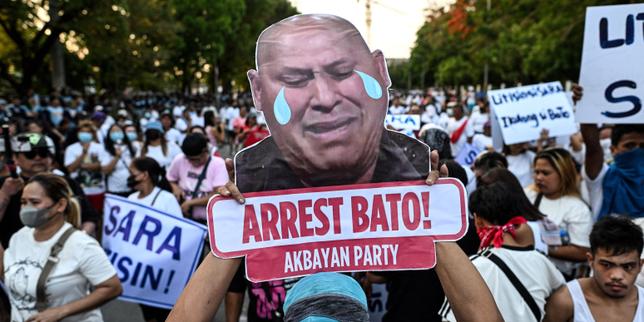
The Philippine Supreme Court has cleared the legal path for the International Criminal Court to pursue high-ranking officials tied to the bloody war on drugs. By refusing to block the potential arrest of Oscar Albayalde, a former national police chief, the tribunal effectively dismantled the primary domestic defense erected by the previous administration. This decision means local law enforcement and international investigators no longer face an absolute constitutional barrier when executing ICC warrants on Philippine soil. It shatters the long-held assumption that national sovereignty would completely immunize the architects of the drug campaign from international prosecution.
For years, the political establishment in Manila operated under a comfortable premise. They believed that because former President Rodrigo Duterte withdrew the Philippines from the Rome Statute in 2019, the ICC lost all jurisdictional teeth. This calculation proved wrong. The legal machinery set in motion during the country’s period of membership remains active, and the highest court in the land has now signaled that it will not use its judicial powers to obstruct international law.
The Failure of the Sovereignty Shield
When Oscar Albayalde petitioned the Supreme Court for an injunction against the ICC, his legal team relied on a traditional nationalist argument. They contended that foreign investigators entering the country to arrest citizens violated Philippine sovereignty and bypassed domestic courts. It was a well-worn strategy that had succeeded in political rhetoric but failed to hold up under strict judicial scrutiny.
The court's refusal to intervene exposes a fundamental misunderstanding of international treaties. When a state signs a global pact, it incurs obligations that do not instantly vanish upon withdrawal. The justices recognized that crimes allegedly committed while the Philippines was a state party remain within the ICC's purview. This distinction is vital. It prevents leaders from committing widespread atrocities, exiting a treaty, and claiming instant immunity.
This development catches the current administration of Ferdinand Marcos Jr. in a difficult political squeeze. Marcos has spent his term trying to rehabilitate the international image of the Philippines, courting Western investment and strengthening defense ties with Washington. He cannot easily dismiss a major international legal body without damaging those diplomatic efforts. Yet, he still relies on political alliances with factions loyal to the Duterte family. The Supreme Court decision forces the current government to choose between international legitimacy and domestic political convenience.
The Police Command Structure under Fire
To understand why Oscar Albayalde is central to this investigation, one must look at how the anti-drug campaign functioned on the ground. This was not a series of isolated incidents involving rogue officers. It was a systematic, top-down operation.
Albayalde served as the chief of the Philippine National Police during a period of intense violence. Under his watch, the official death toll from police operations climbed into the thousands, while human rights organizations estimated the actual number was far higher. The core of the ICC’s case relies on proving command responsibility. Investigators do not just want the low-level officers who pulled the triggers; they want the commanders who signed the operational orders, allocated the budgets, and set the quotas.
+-------------------------------------------------------------+
|               POLICE COMMAND RESPONSIBILITY                 |
+-------------------------------------------------------------+
|  Operational Orders   ->   Budget Allocation   ->   Quotas  |
|  (Policy Directives)       (Resource Flow)          (Targets) |
+-------------------------------------------------------------+
Domestic investigations into these killings were notoriously weak. Out of thousands of deaths, only a handful of officers were ever convicted in Philippine courts, usually because video evidence left prosecutors with no other choice. The legal system suffered from institutional paralysis. Local prosecutors feared retaliation, witnesses went missing, and internal police inquiries routinely wiped away suspicion by claiming self-defense, or nanlaban. The ICC steps into this vacuum not as a replacement for local courts, but as a mechanism of last resort when local systems prove unwilling or unable to act.
Institutional Fractures and Bureaucratic Panic
The ruling has sent shockwaves through the rank and file of the Philippine National Police. Officers who once believed they were operating with total state protection now face a cold reality. The institutional cover is eroding.
Current police leadership faces an unprecedented dilemma. If the ICC issues formal arrest warrants, the duty to execute them normally falls on local law enforcement via Interpol channels. A scenario where Philippine police officers are ordered to arrest their former boss is no longer a theoretical exercise. It is a distinct operational possibility. This dynamic creates deep internal friction within the security forces, splitting loyalties between the chain of command and historical political allegiances.
Behind closed doors, the bureaucratic panic is palpable. Legal defense funds are being organized, and former officials are scrutinizing old operational logs to distance themselves from the most flagrant abuses. The defense of "just following orders" has a miserable track record in international tribunals, and the smarter actors within the security apparatus know it. They are beginning to realize that the political patrons who promised them lifetime protection are currently scrambling to protect themselves.
The Limits of Political Realignments
The political landscape in Manila has shifted dramatically since the height of the drug war. The unity alliance that brought Marcos Jr. and Vice President Sara Duterte to power has broken apart, replaced by bitter rivalries and public trading of accusations. This political divorce directly impacts the legal vulnerability of those involved in the drug war.
When the Duterte faction held absolute sway over the legislative and executive branches, an ICC investigation was a distant threat. The current administration, however, has less incentive to shield Duterte’s inner circle from international scrutiny. While Marcos has stated that his government will not actively assist the ICC, there is a vast difference between active cooperation and passive non-obstruction. By allowing the judiciary to handle the matter without executive interference, the current government can let the legal process weaken its political rivals while maintaining a veneer of neutrality.
This approach carries significant risks. The Duterte base remains powerful, particularly in the southern region of Mindanao. Any move that looks like a betrayal to international actors could trigger deep civil unrest or a mutiny within sections of the military and police who remain loyal to the former president. It is a high-stakes gamble where legal mandates clash directly with survival politics.
A Precedent for Global Accountability
The implications of this judicial shift extend far beyond the borders of the Philippine archipelago. It serves as a stark warning to authoritarian leaders globally who believe that national sovereignty can be weaponized as a permanent shield against human rights accountability.
International law moves slowly, often frustratingly so. It takes years to build cases, verify evidence, and navigate the complex web of diplomatic objections. However, the decision by the Philippine Supreme Court demonstrates that the framework established by the Rome Statute possesses a stubborn durability. Once the wheels of international justice begin to turn, stopping them requires more than just political theater or executive decrees.
The focus now shifts to the ICC prosecutors in The Hague. The legal barriers within the Philippines are falling away, leaving the executive branch with fewer excuses to dodge the issue. If warrants are unsealed, the international community will be watching to see whether Manila honors its global commitments or retreats into isolation to protect individuals accused of crimes against humanity. The space for political maneuvering has shrunk completely, leaving former officials to face the consequences of a campaign that transformed the streets of the country into a battlefield.