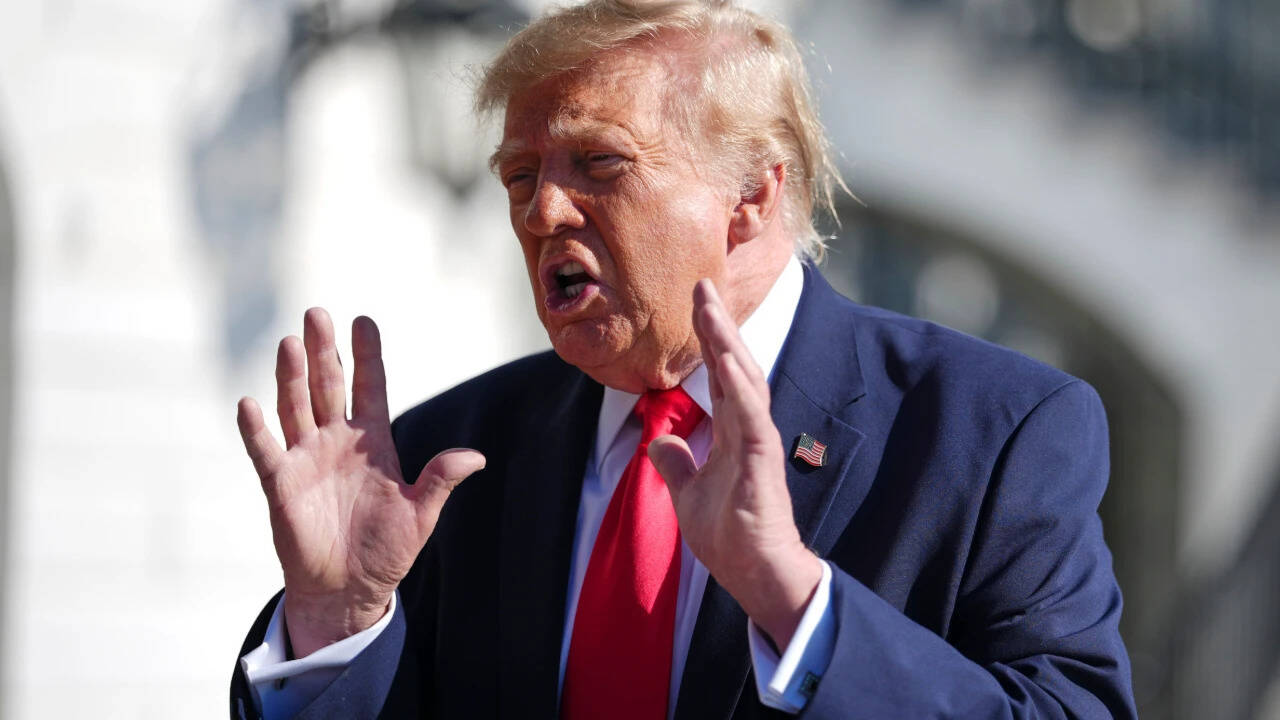
President Donald Trump has signaled he may move the White House press corps out of its West Wing quarters to what he called a "less obnoxious location," even while denying reports that he plans to restore the historic indoor swimming pool built beneath the room during Franklin D. Roosevelt's presidency. That throwaway line on social media masks a far older and more consequential tug-of-war over proximity, control, and physical access to the American presidency. When a leader talks about moving the press room, the real story is rarely the drywall or the floor tiles. It is about distance.
Spend thirty years covering Washington and you stop treating real estate disputes inside the executive mansion as trivia. Every administration eventually discovers that geography inside 1600 Pennsylvania Avenue dictates the rhythm of daily accountability. Put reporters steps away from the Oval Office and senior staff offices, and rumors travel in real time, doors get caught before they latch, and officials have to walk past cameras on their way to meetings. Push reporters out of the building or down to another annex, and every interaction becomes scheduled, screened, and mediated. Also making waves in related news: Inside the California Republican Identity Crisis (And Why Election Day Feels Like a Coin Toss).
Why Geography Inside the West Wing Matters More Than Podiums
Reporters have held dedicated workspaces inside the White House complex for more than a century, turning a cramped corner of the building into a nerve center for political reporting. The current James S. Brady Press Briefing Room sits on top of the former Roosevelt pool, a space Richard Nixon converted into a press center in 1970 after deciding the pool went underused. Ronald Reagan later turned the lounge into a formal briefing room with a low stage and fixed seating, and George W. Bush oversaw an $8.5 million overhaul in 2007 that wired the space with hundreds of miles of fiber-optic cable and turned the old pool basin below into a server and electronics hub.
That physical layout is not accidental. It is an ecosystem. Additional details into this topic are explored by BBC News.
Television crews rely on dedicated camera decks, audio feeds, and cooling units that keep broadcast gear from overheating during long afternoons. Print and wire correspondents sit in tight quarters where a quick hallway word with a press aide or deputy chief of staff can clarify a policy shift before a formal statement ever hits an inbox. Moving the White House press room out of the West Wing—or off the main complex altogether—would break that muscle memory overnight.
Consider a hypothetical example that illustrates the stakes without inventing a single fact. Suppose a press corps is shifted from the West Wing into a separate annex across a courtyard or down the block. Even if the new room has bigger desks, better lighting, and newer screens, a reporter trying to verify a sudden personnel change or a shifting foreign policy line loses the immediate hallway friction that catches officials off guard. A five-minute walk through security checkpoints turns a live scoop into a delayed press release.
- Proximity creates accidental accountability. Officials who share tight corridors with reporters cannot easily pretend the press does not exist.
- Infrastructure is expensive and specialized. Fiber runs, broadcast feeds, and server cooling built into the Brady space do not simply pack up into cardboard boxes.
- Distance changes the power balance. Relocating reporters shifts the burden of movement onto journalists while giving the White House tighter control over who gets near decision-makers.
A Century of Friction Between Presidents and the Press Corps
Talk of moving or shrinking the White House press room is not a sudden invention, nor is it unique to one party or one president. Frictions over space have flared whenever a White House felt cornered by coverage or eager to reshape how news leaves the building. Even during the 2006–2007 renovation, reporters had to vacate the space for nearly a year and operate out of temporary quarters while construction crews gutted aging utilities.
What makes the current moment sharper is the broader pressure campaign surrounding press access. Over the past year and more, clashes between the Trump administration and news organizations have escalated across multiple fronts—from disputes over wire service access to temporary bans on outlets such as CNN, MS NOW, and Politico before a federal judge ordered their credentials restored as likely unconstitutional, a ruling the administration continues to fight. Similar moves to push journalists into outer facilities have shown up elsewhere in Washington as well, including Pentagon plans to shift press workspace into an annex outside the main building.
A relocation threat works even before a single contractor is hired because it forces news organizations to spend energy defending their turf instead of pressing for answers.
Still, there is a counter-argument worth taking seriously—one that veteran correspondents privately admit has a grain of truth. The modern White House press room has grown theatrical, crowded, and often performative. Daily briefings sometimes resemble cable-news auditions more than serious policy interrogation, with cameras rolling on every raised hand and shouted question. Supporters of shaking up the arrangement argue that moving briefings or changing workspaces could strip away some of that daily theater and force deeper, more substantive engagements elsewhere.
That argument has limits. A change of scenery does not automatically improve the quality of questions asked or the candor of the answers given. If a president prefers brief, tightly controlled appearances or social media posts over unscripted exchanges, moving the room to a quieter corner of the grounds will not create transparency; it will only make absence more convenient.
The Pool Rumor, the Legal Fight, and the Real Leverage
When reports surfaced that Trump had floated moving briefings out of the Brady room to bring back FDR's old indoor pool, the president pushed back flatly. He called the old pool idea something he never thought to do, while keeping the door open to shifting "Fake News" to a "less obnoxious location". Former press secretary Karoline Leavitt, appearing on HBO's Real Time with Bill Maher, noted that he had flirted with the history of the space underneath the floor, where old pool tile still sits below the briefing room.
History buffs enjoy the irony of Nixon paving over FDR's pool and later presidents wiring the basin beneath the podium. Politically, though, the pool detail is a distraction from the harder legal and institutional questions sitting right in front of the courts and the White House press corps.
| Factor | What It Looks Like on the Surface | What It Actually Means for Coverage |
|---|---|---|
| Relocation Talk | Floating a move to a "less obnoxious location" | Tests press pushback and signals willingness to alter long-standing spatial norms |
| Court Battles Over Access | Disputes over bans and credentials for specific outlets | Draws a constitutional line around executive control over who enters the White House |
| Broadcast and Tech Wiring | Decades of fiber, cameras, and server infrastructure | Makes any sudden move logistically messy and costly for news networks |
| Daily Proximity | Tight West Wing hallways and adjacent offices | Preserves spontaneous contact that structured press events cannot replicate |
The real leverage point is not whether reporters sit in leather-trimmed chairs or folding seats. It is whether accredited journalists have reliable, non-punitive access to the seat of government regardless of how sharply their coverage angers the sitting president. A federal court pushing back on outlet bans shows that physical access to the White House has constitutional boundaries, even when executives claim broad discretion over their own house.
At the same time, news organizations cannot rely solely on tradition or courtroom rulings to protect their reporting. Traditions only hold when institutions defend them consistently and when reporters show why their presence serves the public rather than their own egos. If the White House press corps wants to keep its footing near the center of power, newsrooms have to focus relentlessly on verifiable facts, clear context, and dogged follow-through—because once a press room gets pushed out of sight, getting back inside rarely gets easier.