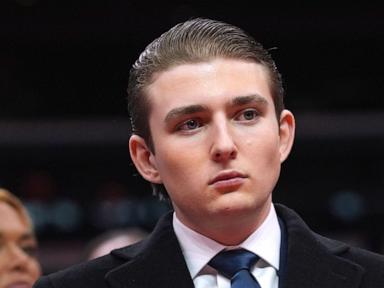
The United States Secret Service has formally acknowledged its awareness of a disturbing three-minute broadcast aired by Iranian state media featuring explicit threats against twenty-year-old Barron Trump, the youngest son of President Donald Trump. The broadcast, which originated from networks aligned with Iran's Islamic Revolutionary Guard Corps, opened with a graphic titled "Where to kill Barron Trump?" and alleged a ten-million-dollar bounty on his life. This escalation marks a significant pivot in state-sponsored psychological operations, moving the aperture of geopolitical conflict away from traditional military targets and toward the immediate family members of American leadership.
Decades of friction between Washington and Tehran have established a predictable rhythm of rhetoric, but the operational mechanics behind these recent digital threats reveal a distinct structural shift. Intelligence analysts tracking Iranian state media note that the broadcast utilized crude computer-generated models, mapped locations associated with his university, and even cited internal communications handles purportedly tied to gaming platforms. While federal law enforcement sources emphasize that these claims lack independent verification, the public distribution of such material forces an urgent reassessment of how modern protective details operate in an era of open-source intelligence and hyper-connected targets.
The Anatomy of State-Sanctioned Intimidation
State television broadcasts carrying simulated violence against western figures are not entirely new, yet the granularity of the recent media packages suggests a calculated attempt to exploit perceived vulnerabilities. Following the February deaths of high-ranking Iranian leadership figures during joint military operations, hardline commentators in Tehran have heavily invoked doctrines of retributive justice.
The primary vector for these threats has shifted from general anti-American propaganda to targeted, personalized dossiers. Earlier cycles of media output focused similarly on First Lady Melania Trump, detailing shopping routines and security staging areas in New York. When the apparatus turned its attention to Barron Trump, the broadcast incorporated specific geographical references to academic facilities and motorcade positioning.
The integration of digital footprints—specifically referencing chat handles and multiplayer gaming environments—highlights a modern security nightmare. Younger members of high-profile political families inhabit digital spaces that inherently resist traditional hardening protocols. Maintaining complete operational security around an individual who utilizes consumer communication networks requires an invasive level of digital isolation that few public figures are willing or able to sustain indefinitely.
The Secret Service Response and Operational Realities
Faced with these broadcasts, the Secret Service maintains a rigid public posture. Agency spokesperson Nate Herring reiterated standard protocol in an official statement, noting that the organization investigates any credible indicators directed toward protectees while declining to discuss operational intelligence due to security imperatives.
Behind closed doors, the pressure on protective details is immense. Protecting a twenty-year-old university student in a bustling metropolitan environment presents a logistical geometry problem. Agents must blend into academic and social surroundings without drawing undue attention, a task complicated when hostile intelligence services attempt to map agent positioning through systematic surveillance or local informants.
The threshold between propaganda and actionable operational planning remains blurred. Intelligence assessments often categorize foreign-produced bounty videos as low-confidence psychological warfare designed to provoke anxiety rather than coordinate a sophisticated domestic attack. Yet, federal agencies cannot afford the luxury of skepticism. Past security lapses involving high-profile political figures have permanently altered the risk calculus in Washington, transforming theoretical threats into immediate operational mandates.
As diplomatic channels remain frozen and economic pressure campaigns intensify, the collateral exposure of family members underscores the brutal human cost of geopolitical escalation. The shadow war between Washington and Tehran has broken past traditional diplomatic boundaries, landing directly on the digital and physical doorstep of a college student whose primary ambition was maintaining a semblance of normal life.