Cold does not merely preserve. Cold remembers.
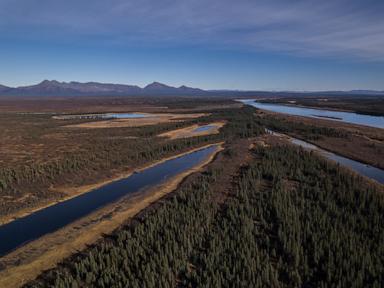
Walk across the high northern tundra in the dead of July, when the perpetual sun casts long, amber shadows over a bruised landscape of peat and stone, and you will feel it beneath your boots. The ground is spongy. It yields. It breathes. For generations, we treated this place as a giant deep freezer, a pristine vault locked away from the rushing currents of time, holding fast to ice sheets and frozen ghosts. For a different view, consider: this related article.
We were wrong.
The vault is leaking. Deep inside the permafrost, ancient echoes of a vastly different planet are stirring. Scientists studying these high latitudes have found themselves staring at a staggering reality: a hidden, miniature greenhouse effect is quietly rewriting the rules of the northernmost edge of the world. It is not just that temperatures are climbing twice as fast as the global average. It is that the soil itself is waking up. Related analysis on this trend has been published by TIME.
Listen.
Do you hear that trickling sound beneath the moss? That is the voice of ancient carbon, locked away for millions of years, finally finding its way back into the atmosphere.
To understand what is happening now, we have to look backward. Millions of years ago, long before human footprints scarred the earth, the Arctic was a very different place. Picture a dense, mist-shrouded swamp forest where dawn broke through heavy humidity. Towering redwoods and ancient ferns dominated the horizon. Dinosaurs wandered through a humid, swampy canopy where the air felt thick and heavy. There were no glaciers crowning the top of the globe. There was only green. Endless, stubborn, opportunistic green.
When the planet eventually cooled and the great freeze descended, it did not destroy that ancient world. It buried it. Layers of organic matter, frozen stiff and preserved in a state of suspended animation, became the foundation of modern permafrost.
Until recently, that vault stayed shut.
Consider what happens when a deep freeze begins to fail. The ice crystals holding the ancient soil together melt. Microbes, dormant for millennia, suddenly find themselves bathed in liquid water and warmth. They wake up hungry. They begin to consume the ancient organic matter, digesting roots, leaves, and needles that fell when the Earth wore a different climate. As they digest, they respire. They exhale carbon dioxide and methane.
A miniature greenhouse, built entirely of microscopic life, begins to pulse beneath the tundra.
This is where abstract statistics become a human story. We read about parts per million and radiative forcing in air-conditioned rooms thousands of miles away, and the numbers slide off our minds like rain on a windowpane. But the reality on the ground is tactile. It smells like damp earth and decaying vegetation—a scent that should belong to an autumn forest in New England, not the frozen shores of the Arctic Ocean.
Dr. Aris Thorne, a paleoclimatologist who has spent thirty summers tracking soil respiration north of the Arctic Circle, remembers the exact moment the shift became undeniable. It was not a grand epiphany in a laboratory. It was a pair of muddy boots.
"We used to set up our stakes on solid, frozen ground," Thorne recalls, leaning against a rusted truck outside a remote research outpost. "You could drive a steel rod into the permafrost like it was concrete. Now? Last summer, I watched a three-hundred-pound sensor rig slowly tilt and swallow itself into the mud over the course of forty-eight hours. The ground is turning to soup. And the air above it is practically humming with heat."
The phenomenon creates a vicious feedback loop. The warming thaws the permafrost. The thaw releases greenhouse gases. The gases trap more heat in the atmosphere. The atmosphere warms the permafrost further.
Round and round it goes. A planetary flywheel spinning out of control.
Yet, human beings have a remarkable capacity for compartmentalization. We look at the Arctic as a distant abstraction, a postcard of polar bears on dwindling floes, detached from our daily routines of mortgage payments, morning traffic, and coffee shops. We treat it as someone else's weather.
That is a dangerous illusion.
The changes unfolding in the northern permafrost do not stay in the north. The atmosphere has no borders. Every ton of ancient carbon exhaled by awakened microbes in the tundra enters the global air mass, accelerating the warming trajectory of cities thousands of miles to the south. The ancient jungle beneath the ice is reaching out across time, touching the climate of the present day with fingers of heat.
We are witnessing a ghost story written in real time.
The landscape is shifting from a carbon sink—a massive planetary sponge that actively vacuumed carbon out of the air and buried it—into a carbon source, actively bleeding greenhouse gases back into the sky. For thousands of years, the high north helped keep the rest of the planet stable. It acted as Earth's natural thermostat. Now, that thermostat is jammed in the 'on' position.
What makes this particularly unsettling is the sheer scale of the hidden inventory. The northern permafrost holds roughly twice as much carbon as is currently floating in the entire Earth's atmosphere. Let that sink in. Twice as much. Locked in ice. Waiting.
When we talk about climate change, we usually focus on what we are doing to the planet today through tailpipes and smokestacks. We talk about coal plants, container ships, and jet fuel. But the Arctic reveals a sobering twist: the planet itself is now beginning to join the conversation. The Earth is starting to emit greenhouse gases independently of human action, driven by the momentum of past warming that we set into motion decades ago.
We have kicked open a door that was bolted shut by the ice ages.
Standing on the tundra today, watching the surface slump and buckle into thermokarst lakes—bodies of water born from melted permafrost that bubble constantly with escaping methane—you realize how fragile our sense of permanence truly is. We build our civilizations on the assumption that the ground beneath our feet is a given. We assume the seasons will follow their ancient choreography.
The Arctic is telling us that the choreography is broken.
The miniature greenhouse beneath the moss is expanding. The ancient ferns and swamp soils are breathing again. And as the northern horizon softens into a strange, unfamiliar warmth, the silence of the far north is broken by the quiet, relentless hiss of a world transforming before our eyes.