It was a diplomatic bombshell masquerading as a cultural miracle. When the announcement broke that France would loan the Bayeux embroidery to the British Museum, headlines celebrated it as a historic gesture of goodwill. They lied. Behind the scenes, the proposed transit of this 950-year-old masterpiece was never a simple museum loan. It was a high-stakes political gamble that weaponized medieval art to paper over fracturing modern alliances, ignoring a terrifying reality. Moving it might destroy it.
The public narrative focused on a grand reunion. For the first time in recorded history, the textile depicting William the Conqueror’s 1066 invasion of England would cross the English Channel. But cross-channel diplomacy is rarely built on pure altruism. This deal was struck in the shadows of intense political friction, serving as a smoke screen for tense defense negotiations and post-Brexit posturing. Beneath the rhetoric of shared history lies a brutal truth of conservation nightmares, bureaucratic warfare, and a fragile linen relic that became a pawn in a game it was never meant to play.
The Diplomatic Smoke Screen
Cultural diplomacy is often the last refuge of desperate politicians. When the French state agreed to the loan, the geopolitical landscape was fracturing. Officials needed a grand, symbolic gesture to prove that Anglo-French relations remained intact despite escalating disputes over borders, fishing rights, and defense treaties. The medieval narrative of conquest was suddenly repackaged as a symbol of shared heritage.
It was a brilliant piece of misdirection. While prime ministers and presidents smiled for the cameras in front of press backdrops, curators on both sides of the Channel were privately panicking. The political decree had bypassed the standard channels of museum consultation. Politicians made a promise that their cultural institutions were entirely unprepared to keep.
By forcing the British Museum and the Bayeux museum into a forced marriage of convenience, governments created an impossible timeline. The logistics of moving a continuous strip of linen measuring nearly 70 meters long are staggering. It is not a painting that can be crated and shipped on a cargo plane. It is a living, breathing textile that reacts violently to changes in humidity, vibration, and atmospheric pressure.
The Physical Impossible
To understand why this loan was an act of madness, one must understand the physical state of the artifact itself. This is not a robust piece of canvas. It is a fragile linen band embroidered with woolen yarn, surviving nearly a millennium of fires, wars, and clumsy restorations.
[Linen Base: Extremely brittle, prone to tearing under its own weight]
       │
       ├─► [Woolen Embroidery: Subject to insect damage and fading]
       │
       └─► [Previous Restorations: Uneven tension causing structural stress]
A comprehensive structural assessment revealed thousands of micro-tears, stains, and structural vulnerabilities. The textile is currently held together by tension and luck. For decades, it has been housed in a custom-built, curved glass case in Normandy, stabilized in a strictly controlled microclimate. Removing it from this environment poses an immediate threat.
The mechanism of decay is relentless. When old linen is disturbed, the fibers undergo mechanical stress. Vibration from transport—even in specialized, air-cushioned vehicles—acts like a microscopic saw on the degraded fibers. The wool embroidery, stitched with varying degrees of tension over the centuries, pulls against the weakening linen base.
The British Museum faced the monumental task of constructing a bespoke gallery space capable of maintaining identical atmospheric conditions to the Normandy facility. A single degree of temperature fluctuation or a minor drop in relative humidity could cause the linen to contract or expand, snapping ancient threads that can never be replaced.
The Hidden Conservation Report
A suppressed concern among textile experts was the presence of historical patches and poor restoration work from the 19th century. These interventions created uneven tension zones across the length of the piece.
- Tension Imbalances: Some sections are stretched tighter than others, making uniform rolling or folding impossible without causing creases.
- Atmospheric Sensitivity: The backing fabric added during past restorations reacts differently to moisture than the original 11th-century linen.
- Fungal Risks: Spores dormant for decades could activate if exposed to the airflow of an international transit operation.
The Battle of the Curators
Behind the united front presented to the press, a bitter bureaucratic war raged between French and British cultural institutions. French curators, fiercely protective of their crown jewel, viewed the loan with deep suspicion. They recognized that the political capital gained by the French presidency would be paid for in the currency of structural damage to the artifact.
British curators found themselves in an equally uncomfortable position. While eager to host what would undoubtedly be the exhibition of the century, they were acutely aware of the reputational risk. If a section of the embroidery tore while under their stewardship, the institutional fallout would be catastrophic. The British Museum was already reeling from internal security scandals and debates over disputed artifacts; it could ill afford to be the place where Europe's most famous textile was ruined.
Demands from the French side grew increasingly stringent. They insisted on a level of surveillance and environmental control that pushed the limits of the British Museum's budget. Every kilometer of the transit route had to be scanned for road quality to minimize vibrations. The specialized display case required a completely independent backup power grid. The financial costs began to dwarf the projected revenue from ticket sales, turning a cultural triumph into a fiscal black hole.
The True Cost of Cultural Logistics
The financial reality of moving an object of this scale is staggering. Standard fine art insurance policies do not apply to irreplaceable national treasures. The indemnity agreements required state-level backing, meaning taxpayers in both nations were underwriting a massive financial risk for a political photo opportunity.
| Operation Phase | Primary Risk | Estimated Cost Factor |
|---|---|---|
| Extraction | Fiber snapping during unmounting | High |
| Transit | Micro-vibrations and humidity shifts | Critical |
| Installation | Structural sagging under new lighting | Medium |
The Narrative Warfare
The conflict was not merely logistical; it was ideological. For centuries, the story told by the stitches has been interpreted through two entirely different lenses. To the English, it is the tragic tale of Harold Godwinson’s downfall and the brutal birth of a new kingdom. To the French, it is the triumphant justification of William's legitimate claim to the throne, a narrative of Norman supremacy.
French Interpretation: Legitimate succession and Norman triumph
               │
               ├─► THE STITCHES ◄─┐
                                  │
English Interpretation: Tragic invasion and the fall of Anglo-Saxon England
By bringing the artifact to London, the context shifts entirely. Displayed in the heart of the former British Empire, the piece inevitably becomes a trophy of conquest in reverse—a piece of French heritage brought to heal modern British diplomatic isolation.
Nationalist factions in France openly criticized the move, viewing it as a capitulation. They argued that a monument to French military triumph should not be used to comfort a neighbor struggling with its own identity crisis. Meanwhile, British commentators weaponized the loan, using it as proof that European culture is fundamentally intertwined with Britain’s destiny, regardless of modern political alignments. The artifact itself was drowned out by the noise of modern commentators spinning 11th-century propaganda to suit 21st-century agendas.
The Logistics of Catastrophe
What happens if it breaks? This is the question that no official wanted to answer on the record. If a major tear occurs during transit, the repair process would take years, requiring the textile to be locked away from public view in a highly restricted laboratory setting.
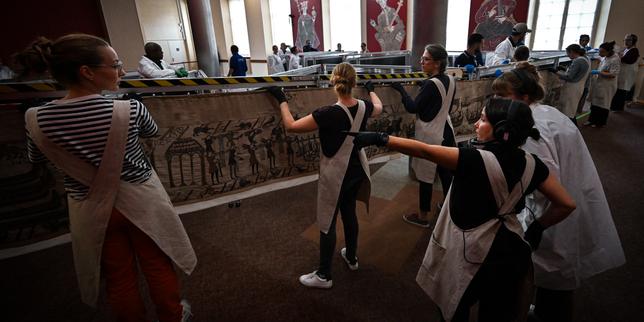
The physical extraction process alone requires a team of dozens of specialized conservators working in shifts, handling the material with custom-molded supports. The piece cannot be rolled tightly without crushing the embroidery, nor can it be kept flat without requiring a transport container the size of a commercial airliner.
The solution proposed was a massive, custom-engineered drum mechanism that would slowly wind the textile around a specialized core, decoupled from the outer shell of the transport vehicle to absorb kinetic energy. This system alone took months to design, consuming resources that could have been spent on the conservation of hundreds of other deteriorating artifacts in provincial museums.
The Environmental Factor
London’s atmospheric profile differs significantly from the coastal climate of Bayeux. The air quality in Bloomsbury, dominated by urban pollutants and particulate matter, poses a direct chemical threat to the ancient dyes used in the wool threads.
- Particulate Matter: Microscopic soot can settle into the loose weave of the wool, causing permanent discoloration.
- Chemical Interactions: Urban sulfur oxides can interact with trace moisture to create acidic compounds that eat away at ancient linen.
- Light Degradation: Even the lowest levels of modern LED museum lighting cause cumulative damage to natural vegetable dyes like woad and madder.
The decision to move the artifact was never about education, art history, or shared European heritage. It was an exercise in raw political cynicism, a desperate attempt by modern leaders to wrap themselves in the mantle of historical greatness while ignoring the fragile reality of the medium they chose to exploit. The survival of the ancient weave depends entirely on whether the cool heads of conservation can permanently stall the reckless ambitions of statecraft.