The math is impossible.
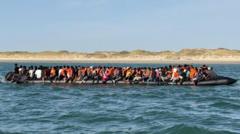
Physics does not negotiate with human need. When you cram two hundred and thirty human beings into a single inflatable watercraft designed for a fraction of that weight, you are no longer operating a vessel. You are riding a floating geometry puzzle where every single variable points toward catastrophe.
We talk about the English Channel in statistics. We talk about dry numbers, quarterly tallies, and policy updates delivered by bureaucrats in pressed suits who have never tasted saltwater mixed with aviation fuel. But I remember the spray. I remember the specific, bone-chilling weight of a jacket soaked through with freezing Atlantic spray, the kind of cold that starts at your fingertips and slowly wraps its icy fingers around your heart.
Two hundred and thirty souls.
Let that number sit in your chest for a moment. Picture a standard passenger bus. Now take everyone off that bus, add another bus worth of people, strip away the seats, the airbags, the climate control, and the structural integrity. Place them instead inside a fragile rubber tube powered by a sputtering outboard motor, pushed out into one of the busiest, most unforgiving shipping lanes on Earth under the cover of a pitch-black midnight.
It defies reason. Yet, it happened. A record-breaking vessel, groaning under the collective weight of families, children, dreamers, and the deeply terrified, slipped away from a French beach and somehow survived the crossing.
Why?
To understand that, you have to strip away the abstractions of geopolitical debate. You have to stop looking at migration as a line on a graph and start looking at it as a desperate reaction to a world that has run out of safe doors.
Imagine, for a hypothetical moment, that your home is burning. Not metaphorically. The roof is caving in, the air is thick with smoke, and every authority figure you trusted has either fled or locked the cellar from the inside. Outside that burning house lies a raging, freezing river. There is a man on the bank with a leaky rowboat, demanding everything you own for a single seat.
Do you stay in the fire?
That is the entire calculation. It is not an economic optimization exercise. It is not a casual holiday choice. It is a binary equation written in smoke and blood. When the choice is between certain destruction where you are and a terrifying gamble on the water, the water suddenly looks like salvation.
The people who engineered this specific crossing—the smugglers who crammed bodies gunwale to gunwale—understand this calculus better than any lawmaker in London or Paris. They are merchants of gravity. They know that desperation has no price ceiling. They pump cheaper air into thinner rubber, knowing that the demand will always outstrip supply, safety, and common sense.
Consider what happens next: the boat hits the water.
The engine coughs. Blue exhaust mixes with the thick, salty air. Two hundred and thirty pairs of lungs begin to breathe the same damp oxygen. Knees press into ribs. Shoulders lock against shoulders. There is no room to fall down, which means if someone panics, nobody can catch them. They remain upright simply because there is nowhere else to go.
Hours bleed into the dark. In the shipping lanes, massive container ships tower over them like floating skyscrapers. To a cargo vessel cruising at twenty knots, a rubber boat with a failing engine is practically invisible. A collision doesn't register as a crash; it registers as a minor bump on the hull, a ripple in the wake.
Yet they kept going.
Why did this particular boat hold together? Sheer, unadulterated human stubbornness. The collective will to breathe tomorrow can perform miracles that engineering textbooks refuse to account for. When the hull began to sag in the middle, sagging under the immense, distributed weight of human hope, someone likely shifted their weight. Someone whispered a prayer in Arabic, in Farsi, in Tigrinya. Someone held a crying child tighter against their chest, absorbing the vibration of the outboard motor through their own spine.
We look at these events through the lens of crisis management. We ask how to secure borders, how to deter departures, how to fix the system. But we rarely ask the harder question.
What kind of world do we inhabit where two hundred and thirty people climbing into a death trap counts as a step up?
The record will show that they landed. The statistics will be logged, debated, weaponized, and filed away. Talk radio will buzz with indignation. Politicians will draft statements about control and sovereignty.
But out there on the water, long after the politicians have gone home to their heated rooms, the salt remains. The memory of that rubber hull flexing against the dark swells stays in the marrow of the bone.
The boat is empty now. The passengers have scattered into the labyrinth of processing centers, detention facilities, and underground networks. But the wake they left behind still ripples across the surface of our collective conscience, refusing to settle, refusing to disappear.