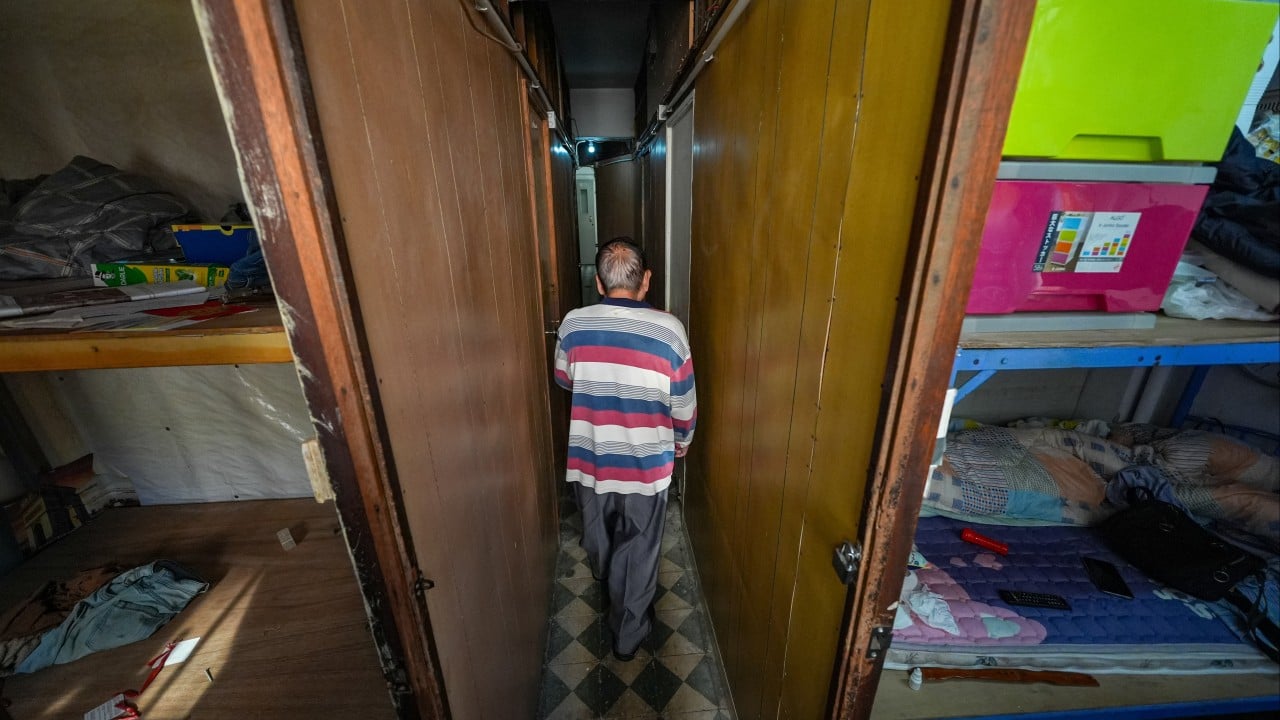
The ceiling is so low that if you stretch your arms up when you wake, your knuckles graze the raw concrete.
To live in a subdivided flat in Hong Kong—a tong fong—is to live in a world measured in inches. You learn to move sideways. You learn to cook, sleep, and watch your children do their homework on the exact same square of linoleum. For a long time, the city looked away from these spaces. They were an open secret, a desperate solution to an impossible housing market, squeezed into the underbelly of one of the richest square miles on earth.
Then the rules changed.
When the government introduced its latest sweeping housing regulations, the intent sounded noble on paper. It was framed as a triumph of human dignity. The policy aimed to eradicate the most hazardous sub-standard subdivisions, setting strict new benchmarks for fire safety, ventilation, and window placement. It was supposed to protect the vulnerable.
Instead, it turned a fragile survival mechanism into a countdown clock.
Within weeks of the policy taking effect, thirty-five families received the exact same piece of paper. An eviction notice. Not because they couldn’t pay the rent, but because the very walls shielding them from the streets had suddenly become illegal.
The Geometry of Survival
To understand what happens next, consider a hypothetical resident. Let's call her Mrs. Lin. She is not a statistic, though her life fits neatly into the data columns of a government spreadsheet. She works six days a week cleaning office towers in Central, earning just enough to keep her ten-year-old son in school uniform.
Their home is a sliced-up portion of an aging tenement building in Sham Shui Po. It measures precisely forty-five square feet.
If you have never stepped inside a shoebox flat, the smell is what hits you first. It is a dense, humid cocktail of kerosene, damp laundry that never fully dries, and the faint, metallic tang of old pipes. There is no kitchen. There is a single electric hotplate balanced on top of a mini-fridge, sitting two paces from the toilet.
Yet, for Mrs. Lin, this room was a victory. It had a door that locked. It kept the rain off her son’s textbooks.
The new ordinance mandates that any residential unit must possess an external window of a specific size to ensure proper airflow. It requires a distinct structural separation between the cooking area and the rest of the living space. These are reasonable, civilized demands. Nobody should have to live without air or fire escapes.
But logic collapses when theory meets reality.
The landlords who own these tenements face a stark financial calculation. To bring an old, crumbling structure up to the new legal code requires thousands of dollars in structural engineering. Walls must be torn down. Plumbing must be rerouted. In a building containing ten tiny units, compliance might mean consolidating those spaces into three legal apartments.
The math is brutal. Seven units disappear. Seven families are cast out. The landlord simply raises the rent on the remaining three compliant apartments to cover the losses, pricing out the original tenants anyway.
The law did not eliminate sub-standard housing. It just eliminated the people living in it.
The Fiction of the Safety Net
When a policy creates a crisis, the official response is almost always to point toward the safety net. The public is assured that welfare systems, transitional housing schemes, and public estates stand ready to absorb the displaced.
That is a comforting fiction.
The waiting list for public housing in Hong Kong does not move in months; it moves in lifetimes. The average wait time drags on for years, a bureaucratic logjam that swallows up entire childhoods. For a single mother like Mrs. Lin, the immediate alternative is not a clean, subsidized apartment in the city center. The alternative is a transitional housing block located deep in the New Territories, miles away from her cleaning job and hours away from her son’s school.
Displacement is expensive. A moving van costs money. A new school uniform costs money. The loss of a localized support network—the grandmother downstairs who watches your child when you work the late shift—is a catastrophic tax on the poor.
This is where the emotional core of the housing crisis rots. It breaks the subtle, unwritten contracts that keep marginalized communities afloat. When you evict thirty-five families simultaneously in a tight neighborhood, you aren’t just moving bodies from one postcode to another. You are dismantling an ecosystem of mutual survival.
The policy makers look at blueprints. The tenants look at their children’s faces.
The Weight of a Locked Door
The debate surrounding these evictions usually splits into two predictable camps. One side argues for rule of law, safety, and modern standards. The other side cries out for compassion. Both arguments miss the point entirely.
The real tragedy is the illusion of choice.
People do not live in shoebox flats because they lack awareness of fire hazards. They live there because the alternative is a bench in a concrete park, or a wire cage stacked three-high in a hidden warehouse. When the state removes the lowest rung of the housing ladder without building a replacement that people can actually reach, it doesn't elevate them. It simply leaves them suspended in mid-air.
Consider what happens when the notices expire.
The thirty-five families currently facing eviction cannot simply browse online listings for a better apartment. They are forced into a frantic, subterranean scramble. They search for landlords who are willing to break the new law in secret, or they look for even smaller, more obscured spaces that the building inspectors haven't discovered yet. The market does not disappear; it just goes further into the shadows.
Dignity cannot be legislated into existence by a stroke of a pen. It requires brick, mortar, and land.
On the final night before an eviction deadline, the atmosphere inside a tenement changes. The usual ambient noise of the building—the clatter of chopsticks, the blare of Cantonese soap operas through thin plywood partitions—gives way to an oppressive silence. Bags are packed. Blue plastic tarps are tied with frayed twine.
Mrs. Lin sits on the edge of the mattress that she shares with her son. The boy is asleep, his arm thrown over a backpack filled with his schoolbooks. She watches the small square of sky visible through the single, un-regulation window that caused their eviction.
Tomorrow, the inspectors will arrive with clipboard and seals. Tomorrow, this room will cease to be a home and return to being a non-compliant structural entity.
The city outside continues to burn bright, its neon towers reflecting off the harbor, completely indifferent to the thirty-five small doors clicking shut for the last time.