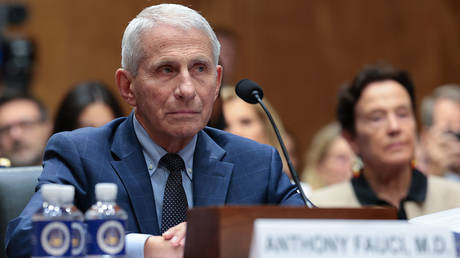
Every time a state government decides to launch an investigation into a federal bureaucrat, the political theater plays out like a predictable script. Florida announces a probe into Anthony Fauci following Senate hearings, and the headlines write themselves. Outraged citizens cheer. Institutional defenders roll their eyes. Everyone settles into their pre-assigned ideological trenches.
It is political performance art at its finest, and it completely misses the point. In similar developments, we also covered: Why Every Security Pact in the Middle East is Just Expensive Noise.
I have spent decades watching accountability mechanisms fail inside massive institutional frameworks. I have seen billion-dollar budgets misallocated, oversight committees perform scripted kabuki theater, and public trust erode not because of a single mastermind, but because of a sprawling, self-perpetuating administrative apparatus that outlasts every politician who tries to cage it.
Fixating on one retired doctor as the architect of all public health missteps is a comforting delusion. It lets the system off the hook. Reuters has analyzed this fascinating subject in great detail.
The Anatomy of Institutional Immunity
The lazy consensus in modern political commentary is that public administration functions like a traditional corporate hierarchy. People assume that if you remove the CEO at the top, the entire corporate strategy shifts.
That theory is dead wrong when applied to the administrative state.
Agencies like the National Institutes of Health or the Centers for Disease Control do not operate on the whims of a single director. They run on institutional momentum, career incentives, peer-review groupthink, and statutory inertia. When a committee hauls a high-ranking official onto Capitol Hill for a televised grilling, nothing changes structurally. The agency's middle management—the career bureaucrats who draft the grants, shape the consensus, and bury the dissent—remain untouched.
Focusing state-level investigative powers on a retired figurehead is like trying to drain a swamp by swatting at a single mosquito. You get a good soundbite for the evening news, but the breeding grounds expand unbothered.
Why Florida Is Barking Up the Wrong Tree
State attorneys general love jurisdiction battles against federal agencies because they poll well. They signal strength to a domestic base. But legally and operationally, a state-level probe into federal pandemic response decisions is an exercise in jurisdictional theater.
Let us look at the mechanics. State statutes govern state agencies and state-funded entities. Federal research grants, inter-agency communications, and national emergency declarations sit squarely outside the reach of a state prosecutor's subpoena power, barring a federal coordination or clear statutory crossover that rarely survives a motion to dismiss in federal court.
Even if the investigation uncovers embarrassing internal emails or contradictory statements, it lacks teeth. It cannot restructure grant review panels. It cannot rewrite the Bayh-Dole Act, which governs intellectual property arising from federal government-funded research. It cannot reform how peer-review boards insulate themselves from outside critique.
By turning a systemic governance failure into a personal vendetta, state leaders trade structural reform for short-term media cycles.
The Real Crisis of Expertise
The deeper issue exposed by these Senate hearings and subsequent state reactions is the collapse of calibration in expert consensus.
For decades, institutional science operated on a model of managed authority. The public was expected to defer to credentialed bodies because the underlying mechanics were deemed too complex for lay comprehension. When a crisis hit, that model fractured under the weight of political pressure, shifting data, and corporate influence.
Instead of fixing the broken feedback loops that allowed groupthink to override empirical skepticism, we got a culture war.
On one side, you have defenders treating institutional guidelines as infallible dogma. On the other, you have inquisitors treating every misstep as a grand criminal conspiracy. Both narratives are lazy. The truth is far more mundane and far more dangerous: a massive scientific bureaucracy optimized for risk avoidance, grant acquisition, and institutional self-preservation.
When safety is defined solely as avoiding political embarrassment rather than discovering objective truth, science stops being an inquiry and starts being a protection racket.
What Real Accountability Looks Like
If Florida or any other state genuinely wanted to disrupt the status quo instead of performing for the cameras, they would stop chasing retired bureaucrats and start changing the local incentives that tie their own public health departments to federal mandates.
True institutional reform requires three unglamorous shifts:
- Decouple funding from federal top-down mandates. States must build independent evaluation boards that re-analyze raw data rather than rubber-stamping federal advisories.
- Abolish qualified immunity and bureaucratic opacity for public health directives. If an emergency mandate causes economic or social devastation, the metrics used to justify it must be transparent, auditable, and subject to immediate independent review.
- Enforce competitive pluralism in advisory panels. No single agency should possess a monopoly on defining what constitutes a health emergency or an acceptable intervention.
None of these solutions fit on a campaign flyer. None of them generate viral clips for social media.
As long as voters reward politicians for staging high-profile investigations into yesterday's targets while leaving tomorrow's administrative machinery entirely intact, the system wins. Fauci will fade into a comfortable retirement, the investigators will move on to their next press conference, and the next crisis will be managed by the exact same broken bureaucracy, using the exact same playbook. Stop fighting the individual. Dismantle the machine.