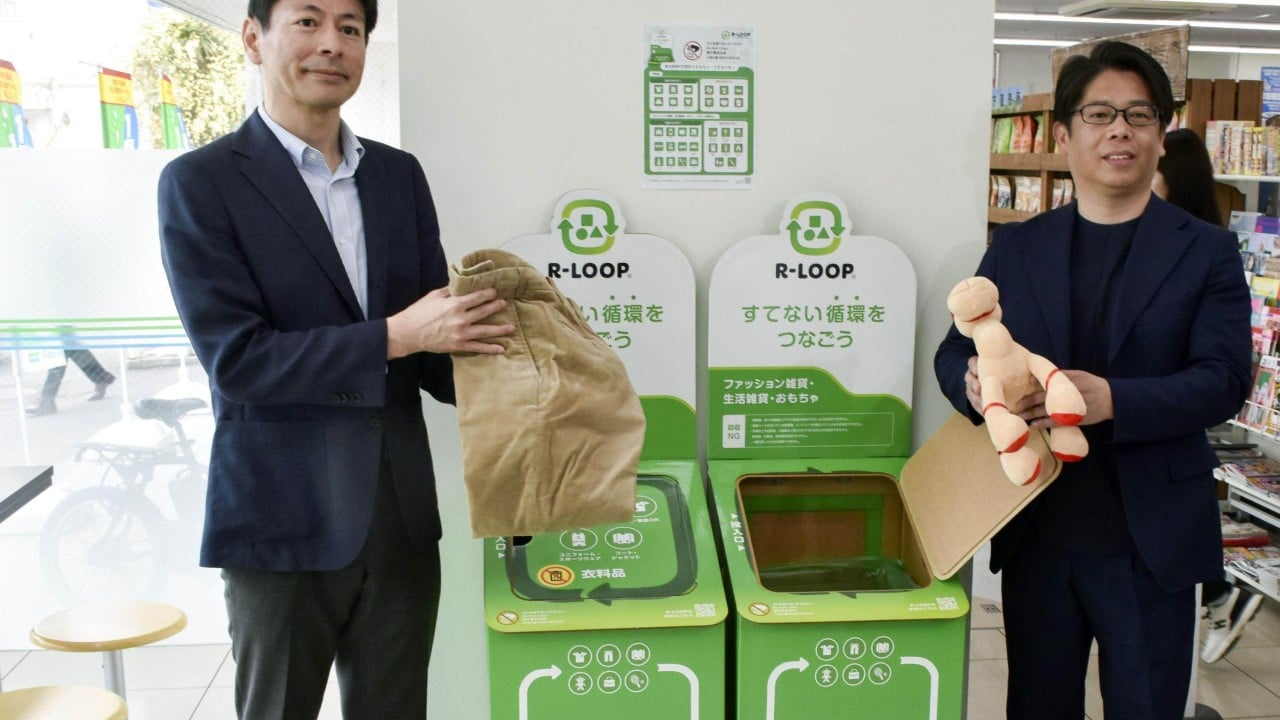
The convergence of convenience retail and textile circularity in Japan represents a fundamental shift from traditional disposal-centric consumption to a distributed recovery model. FamilyMart’s initiative to integrate garment collection within its 16,000+ storefront network is not a philanthropic gesture; it is an experiment in solving the terminal inefficiency of the "last mile" in reverse logistics. By leveraging existing physical infrastructure to capture low-value textile waste, the model attempts to bypass the prohibitive costs of household-to-processing-center transport that have historically rendered textile recycling economically non-viable.
The Structural Mechanics of Reverse Logistics in Proximity Retail
The primary friction point in textile circularity is the cost of collection relative to the residual value of the material. Traditional municipal waste streams treat textiles as a nuisance variable, leading to high incineration rates in land-scarce regions like Japan. The FamilyMart model shifts the burden of the first-mile transit—the movement from the home to the collection point—onto the consumer.
This system relies on three specific operational variables:
- Network Density and Proximity: The utility of a collection point is inversely proportional to its distance from the user's daily transit path. High-density convenience store networks minimize the "effort-cost" for the consumer, effectively crowdsourcing the logistics of material consolidation.
- Existing Supply Chain Backhauling: The strategy succeeds only if the collection of waste does not necessitate new, dedicated vehicle routes. True efficiency is found in utilizing the empty space on return trips of delivery trucks already servicing the stores.
- Material Purity at Source: Unlike curbside pickup, storefront collection allows for immediate, localized filtering. By defining strict intake parameters (e.g., clean, wearable, or specific fiber types), the retailer reduces the downstream cost of manual sorting at industrial processing facilities.
The Cost Function of Textile Waste Mitigation
To evaluate the impact of FamilyMart’s partnership with textile processors, one must analyze the cost function of a garment’s lifecycle. The objective is to move the "Terminal Value" of a garment from a negative (the cost of incineration/landfill) to a neutral or positive (raw material input for secondary markets).
The economic equation for textile recovery can be expressed through the relationship between volume, contamination, and processing energy. The total cost ($TC$) of the recovery process is defined as:
$$TC = C_{c} + C_{s} + C_{p} - V_{r}$$
Where:
- $C_{c}$ is the cost of collection and consolidation.
- $C_{s}$ is the cost of sorting and decontamination.
- $C_{p}$ is the energy and labor cost of processing (shredding, chemical recycling, or cleaning).
- $V_{r}$ is the market value of the recovered fiber or resale item.
The retail-based collection model specifically targets $C_{c}$ and $C_{s}$. By incentivizing consumers to pre-sort and deliver items to a central hub, the firm reduces the labor-intensive sorting requirements at the back end. However, the limitation of this model remains the $V_{r}$ variable. Low-quality "fast fashion" items often possess fiber blends—typically polyester-cotton mixes—that are technically difficult and energetically expensive to separate, often resulting in a $V_{r}$ that fails to offset the costs of $C_{p}$.
Categorization of Recovered Material Streams
The success of the initiative is measured by how effectively the gathered textiles are triaged into distinct utility tiers. The logic of a circular system requires a hierarchy of outcomes, ranked by the preservation of embodied energy.
Tier 1: Resale and Reuse (High Value Retention)
Items that maintain structural integrity are diverted to secondary markets. In the Japanese context, this often involves export to developing markets or domestic vintage retail. This tier represents the highest $V_{r}$ because it requires the least energy expenditure ($C_{p} \approx 0$).
Tier 2: Downcycling (Medium Value Retention)
Textiles that are unwearable but possess high fiber density are converted into industrial rags, insulation, or automotive soundproofing. While this prevents incineration, it is a linear path to an eventual dead end, as the material quality degrades to a point where further recovery is impossible.
Tier 3: Chemical and Mechanical Recycling (Low Value Retention)
This involves breaking fibers down to the molecular or polymer level to create "new" raw materials. This process is the most technically ambitious but faces significant scaling hurdles due to the energy intensity required to combat entropy in blended fabrics.
Bottlenecks in the Distributed Collection Model
The transition from a pilot program to a national standard faces several structural bottlenecks. The most significant is the "Storage-to-Sales-Floor Ratio." Convenience stores in urban Japan are optimized for maximum inventory turnover per square meter. Dedicating physical floor space to "trash"—even high-potential textile waste—directly competes with the high-margin shelf space of consumer packaged goods.
The second limitation is the psychology of the "Nudge." For the system to achieve the necessary volume to justify industrial-scale processing, the retailer must balance consumer convenience with the prevention of illegal dumping. If the collection bins become a site for non-textile waste (contamination), the $C_{s}$ (sorting cost) spikes, potentially collapsing the economic viability of the entire branch of the supply chain.
Strategic Integration of IoT and Traceability
To elevate this from a physical collection tactic to a data-driven strategy, the integration of traceability technology is necessary. Current textile recovery is "blind"; processors do not know the exact fiber composition of the intake until manual inspection occurs.
The implementation of Digital Product Passports (DPP) or RFID tags within the garments sold by the retailer’s private labels (such as Convenience Wear) creates a closed-loop data set. When a garment is dropped in a collection bin, an automated scanner could theoretically:
- Identify the exact chemical composition of the garment.
- Assign it a sorting category instantly.
- Track the total carbon mitigation of that specific unit.
This transparency converts a vague "green" initiative into a quantifiable ESG (Environmental, Social, and Governance) asset. For a corporation, this data is valuable for regulatory compliance and for securing lower-cost "green financing" from institutional investors who demand precise metrics on carbon reduction.
The Role of Consumer Behavior and the Convenience Premium
The Japanese consumer's relationship with convenience stores (konbini) is unique. These hubs act as post offices, banks, and grocery stores. Integrating textile waste collection into this ritual capitalizes on the "Convenience Premium." The consumer is not motivated by a small financial incentive or a sense of environmental duty alone, but by the reduction of friction in their personal life.
In Japan, strict municipal rules for "burnable" versus "non-burnable" waste create a high mental load for citizens. A retail-based system that simplifies this process by saying "bring it here, we handle the complexity" effectively buys consumer participation through the currency of time and simplicity.
Competitive Advantage Through Reverse Supply Chain Mastery
Companies that master the reverse supply chain gain a defensive moat against future regulatory shocks. As Extended Producer Responsibility (EPR) laws become more stringent globally, manufacturers and retailers will be legally mandated to manage the end-of-life of their products. By building the infrastructure for textile recovery now, a retailer like FamilyMart is not just reducing waste; it is stress-testing the logistics network it will be forced to operate in the coming decade.
The competitive edge shifts from who can sell the most units to who can manage the total lifecycle of the unit at the lowest cost. The retailer becomes a resource manager rather than just a distributor.
Systematic Scaling and Industrial Synthesis
For the model to reach a state of equilibrium, the volume of collected textiles must match the demand for recycled feedstock. This requires a symbiotic relationship with chemical companies capable of processing high-volume polyester flows. If the collection rate exceeds the processing capacity, the retailer is left with a storage crisis. Conversely, if processing plants scale without consistent collection streams, the high capital expenditure ($CapEx$) of the facilities cannot be amortized.
The strategic play is to synchronize the rollout of collection points with the modular expansion of processing centers. This avoids the "bullwhip effect" in the waste supply chain, where small fluctuations in consumer drop-offs lead to massive inefficiencies at the industrial processing level.
To achieve a dominant position in the circular economy, the following strategic actions are required:
- Fiber Homogenization: Design private-label apparel with mono-materials (100% cotton or 100% polyester) to eliminate the separation costs in the $C_{s}$ phase of the cost function.
- Backhaul Optimization: Use real-time inventory management to trigger waste collection only when delivery trucks have the specific volumetric capacity, ensuring that the marginal cost of transport remains near zero.
- Tiered Incentivization: Replace flat "goodwill" models with a tiered reward system where consumers receive higher loyalty points for "clean-stream" textiles (unblended fibers) compared to "dirty-stream" textiles, directly reflecting the downstream processing value.
- Modular Consolidation Hubs: Transform regional distribution centers into secondary sorting facilities. By doing the first pass of sorting at the distribution center rather than the final processing plant, the retailer captures more of the value chain and reduces the transport of non-recyclable "residue."
The future of retail is not found in the acquisition of new customers, but in the total ownership of the material flow, turning every exit point of the consumer's home into a new entry point for the firm's supply chain.