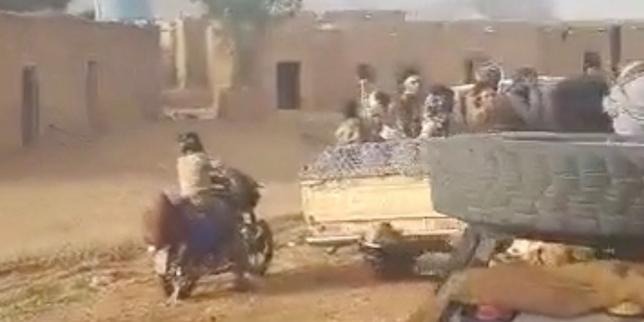
The wind in northern Mali does not blow; it hunts. It carries a fine, choking silt that settles into the creases of your skin, the mechanisms of your rifle, and the tea everyone drinks to pretend the heat is manageable. For years, the tarmac running through the desert was a line drawn in shifting sand. To control the road was to control life, death, and the fragile peace of a broken nation.
Then the trucks arrived.
When the Malian armed forces, flanked by white soldiers speaking rapid, heavy Russian, rolled into the desert town of Anéfis, the world watched a strategic map change color. Analysts in distant capitals counted troop numbers and calculated distances to the rebel stronghold of Kidal. They drew arrows on digital screens. But on the ground, the reality of this military advance looks less like a chess game and more like a fever dream of metal, sweat, and displacement.
To understand why a small town matters, you have to look at the dust.
The Crossroads of Dust and Iron
Anéfis is not a metropolis of towering concrete. It is a choke point. Imagine a funnel carved out of the Sahel, where every vehicle traveling from Gao toward the northern strongholds must pass. If you hold Anéfis, you hold the throat of the region. For a long time, that throat was held by the Coordination of Azawad Movements, a coalition of Tuareg-led rebels who viewed the distant government in Bamako with deep suspicion.
For the people living in these mud-brick homes, power was always a revolving door. One day it was the United Nations peacekeepers in their painted vehicles. The next, it was local fighters. Now, the new masters of the highway wear patchless camouflage and carry automatic weapons that glint under an unyielding sun.
The Malian army called the operation a restoration of territorial integrity. They spoke of national pride, of reclaiming land that belonged to the state. The narrative from Bamako was triumphant. But victory in the desert is never clean. It arrives on the back of heavy artillery, preceded by the drone of aircraft that turn the sky into a source of constant anxiety for families hiding behind thin walls.
Consider a family caught in the middle. Let us call the father Ibrahim, a composite of the merchants who have watched decades of rebellion wash over their doorsteps. Ibrahim does not care about geopolitical alliances. He cares about the price of millet. He cares about whether his children can walk to the well without stepping on an improvised explosive device. When the shells began to fall on the outskirts of Anéfis, Ibrahim did not think about sovereignty. He packed what could fit on a motorbike and looked north, toward the open, unforgiving desert.
The Men in the Unmarked Uniforms
The arrival of the Malian military was expected. The presence of their partners was what changed the atmosphere entirely. These were the men of the Wagner Group, later repositioned under various Russian state banners, whose presence in Africa has rewritten the rules of post-colonial influence.
They do not speak French. They do not speak Bambara or Tamasheq. They communicate through interpreters and the raw language of force.
For the young Malian soldiers marching alongside them, the alliance represents a radical break from the past. For decades, France was the security umbrella in Mali. Operation Serval, then Operation Barkhane—thousands of French boots on the ground, supposedly hunting jihadists. Yet, the security situation worsened year after year. The villages felt no safer. The roads remained lethal.
The military junta that seized power in Bamako tapped into a deep, burning resentment. They told the public that the old colonial masters were playing a double game. They promised a new way. They threw out the French, told the UN peacekeepers to pack their bags, and invited Moscow to fill the void.
Watch the foot soldiers on the road to Anéfis. The young Malian recruits look at their Russian counterparts with a mixture of awe and unease. The Russians bring heavy fire power, thermal optics, and a reputation for ruthlessness that precedes them like a shadow. They do not operate under the same rules of engagement that hamstrung Western forces. There are no human rights observers riding in their armored columns. There are no press briefings discussing collateral damage. There is only the objective.
But the real problem lies elsewhere. Violence is a currency that devalues quickly when everyone starts printing it.
The Long Road to Kidal
Taking Anéfis was never the final goal. It was merely the gatehouse. Eighty kilometers to the north lies Kidal, the emotional and political capital of the Tuareg rebellion. For a decade, Kidal was an untouchable sanctuary, a place where the Malian state flag could not fly.
The march from Gao to Anéfis was a bloody rehearsal. The convoys were ambushed repeatedly. Mines tore through the undercarriages of supply trucks. The rebels used the terrain—the rocks, the wadis, the blinding dust storms—to hit the advancing forces and vanish into the haze.
The cost of this advance is written in the graveyards that dot the highway, but also in the silence of the abandoned villages. When the army takes a town, they do not find cheering crowds. They find empty streets. The inhabitants flee before the column arrives, terrified of what happens when two forces with heavy weaponry collide in narrow alleys.
The strategy of the Malian-Russian alliance relies on overwhelming kinetic force. If a sniper fires from a building, the building is erased. It is effective for clearing a path. It is disastrous for building a nation.
Think about what happens when the smoke clears. The state claims it has liberated the population. But liberation implies there is someone left to celebrate. Instead, the conquest of Anéfis left behind a ghost town of shuttered stalls and stray animals wandering through the debris. The victory is real on paper, but the human reality is a vacuum.
The Illusion of Control
Can you truly own a desert?
The French tried. The United Nations spent billions of dollars trying. The Tuaregs have claimed it for centuries by adapting to its cruelty. Now, Bamako believes that with Russian steel, they can finally tame the north.
But the desert has a way of digesting empires. The supply lines stretching from Bamako to Anéfis are thousands of kilometers long. Every liter of fuel, every box of ammunition, every loaf of bread must travel down roads that are vulnerable to sabotage. The rebels have not been destroyed; they have simply melted into the landscape, waiting for the heavy armor to become stationary targets.
Security is not the absence of gunfire. It is the presence of trust. When a shopkeeper looks at a soldier and sees a protector rather than a potential predator, security exists. Right now, in the wake of the battle for Anéfis, trust is the rarest commodity in Mali. The local populations see the army not as their defenders, but as an invading force allied with foreign mercenaries who have no stake in the future of the country.
The stakes are invisible but immense. This is a testing ground for a new style of warfare in Africa, one where Western ideals of governance and human rights are discarded in favor of raw transactional security. If Bamako succeeds in holding Anéfis and taking Kidal, other capitals across the Sahel will follow the blueprint. They will see that you can trade sovereign gold mines for mercenary iron and win battles.
What they forget to calculate is the price paid by those who live along the highway.
The dust settles again over Anéfis. The tanks are parked in the square. The new flags flutter in the hot wind. A soldier sits on a crate, cleaning the sand from his rifle, while somewhere out in the dunes, those who fled watch the horizon, waiting for the wind to turn.