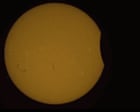
Millions of spectators across Spain, the United Kingdom, and Iceland flocked to coastal overlooks and mountain ridges to witness the high-stakes shadow play of the total solar eclipse. Yet, beneath the veneer of tourist-heavy celebration and communal awe lies a grinding infrastructure test that modern European urban centers are poorly equipped to handle. When the Moon slipped precisely between the Earth and the Sun, plunging targeted corridors into eerie late-evening twilight, it triggered a localized economic windfall coupled with an immediate logistical stress test for regional grids, emergency services, and municipal transit networks.
The Geography of Scarcity
Total solar eclipses are ordinary celestial mechanics rendered rare by terrestrial geography. Only a fraction of the planet's surface experiences the path of totality, and the August 12, 2026 event favored a tight, unforgiving band slicing across eastern Greenland, western Iceland, and northern Spain before grazing Portugal.
For the United Kingdom and continental Europe outside that narrow corridor, viewers settled for an impressive partial obscuration. London watched roughly ninety percent of the solar disk vanish, while northern regions of Spain prepared for full, dramatic totality just minutes before sunset.
This geometry creates intense demographic spikes. Small towns in northern Spain and isolated coastal settlements in Iceland suddenly absorbed population inflations rivaling their entire annual tourist volumes within a forty-eight-hour window. Municipalities with baseline workforces meant for quiet agrarian or fishing economies had to manage sudden influxes of vehicular traffic, makeshift campsites, and strain on local medical infrastructure.
Grid Shock and Renewable Vulnerability
Beyond the romance of gazing upward through certified protective eyewear, structural engineers faced a far more mechanical anxiety. Modern European power grids rely heavily on photovoltaic solar installations. When a continent experiences a sudden, sweeping drop in ambient sunlight, power operators encounter an immediate generation cliff.
During peak partial obscuration across the UK and mainland Europe, solar output plummeted within minutes, only to surge back aggressively as the Moon continued its orbit. Grid operators spent months modeling these fluctuations, dispatching backup natural gas and hydroelectric reserves to balance frequency drops.
Consider a hypothetical grid balancing scenario in central Spain: a sudden loss of three gigawatts of solar generation requires secondary peaker plants to ramp up output at unprecedented speeds. If those plants fail to sync with the load drop, rolling brownouts threaten regional infrastructure. The eclipse acted as a live-fire stress test for continental energy storage capabilities, proving that battery infrastructure remains the ultimate bottleneck for green transitions.
The Economics of Transient Tourism
Local businesses reaped immediate financial benefits, but the economic ripple effect carried distinct operational friction. Hotels in Reykjavik and rural Spanish provinces booked out years in advance, driving prices to astronomical levels.
Yet, transient tourism offers dubious long-term value for regional economies. Small businesses reported severe supply chain disruptions in the days leading up to the event. Delivery trucks found themselves gridlocked on rural two-lane highways that were never engineered to absorb thousands of parked camper vans and amateur astronomers hauling heavy telescope mounts.
Municipal waste management systems buckled under unexpected trash generation. Local councils absorbed cleanup costs that rarely balance out against the transient tax revenue collected from short-stay visitors who brought their own provisions rather than supporting local hospitality venues.
Safety Panic and the Infrastructure of Squinting
Public health authorities launched exhaustive awareness campaigns regarding eye safety, warning against the permanent retinal damage caused by staring at un-occluded partial phases. Despite millions of distributed ISO-certified viewing glasses, emergency departments braced for a surge of careless observers.
The obsession with capturing the event on smartphones added another layer of cultural absurdity. Millions of travelers prioritized digital documentation over physiological experience, clogging cellular networks to the point of local bandwidth failure. Emergency dispatchers struggled with dropped calls in rural sectors where mobile towers were overwhelmed by tourists attempting to livestream the horizon.
As the shadow lifted and normal solar radiation flooded back across the European continent, the immediate crisis subsided. Yet, the systemic vulnerabilities exposed by the event remain. Europe will face another total solar pass over the Iberian Peninsula next August, offering regional planners precious little time to fix the structural gaps laid bare by nature's most disruptive spectacle.