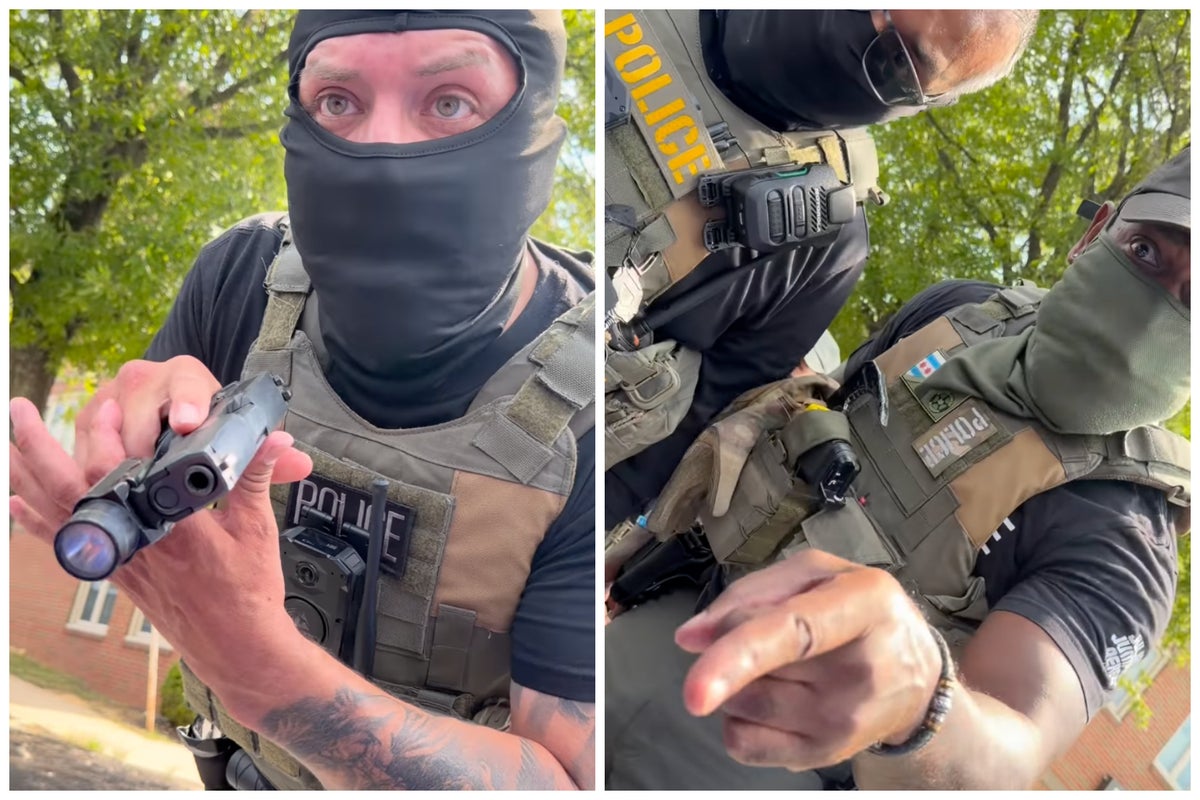
The Trigger and the Badge
A citizen standing on a public sidewalk holds a camera. An armed federal agent draws a weapon, escalating a routine administrative presence into a lethal confrontation over a fundamental constitutional protection. This scenario played out on camera, capturing an ICE agent pulling a gun on a woman for exercising her First Amendment rights. It is not merely an isolated behavioral lapse by an exhausted bureaucrat. It represents a systemic institutional failure born from relaxed hiring standards, deficient training protocols, and a culture of near-total operational impunity within domestic immigration enforcement agencies.
For years, watchdogs have tracked the rapid expansion of federal enforcement bodies. When agencies scale up personnel rapidly, background checks loosen. Accountability mechanisms fracture. The line between constitutional policing and authoritarian intimidation blurs. When an ICE agent draws a firearm on a civilian recording police activity, the public witnesses the raw cost of systemic immunity.
The Mechanics of Federal Immunity
Why do armed agents routinely react with hostility to civilian recording devices? The answer lies in the unique legal architecture shielding federal law enforcement officers from civil liability. Qualified immunity doctrine, combined with federal sovereign immunity statutes, creates an environment where the immediate consequence for constitutional violations is functionally zero.
When a municipal police officer infringes upon civil liberties, local departments face Section 1983 lawsuits that hit municipal budgets directly. City councils panic. Chief of police officials implement mandatory de-escalation training and strict internal affairs investigations. Federal agencies operate under an entirely different structural reality.
Civilian oversight boards hold zero jurisdiction over Department of Homeland Security personnel. Internal affairs divisions within Immigration and Customs Enforcement operate behind opaque brick walls. Complaints vanish into digital black holes. Without external pressure, internal discipline becomes optional. Officers learn early in their tenure that drawing a weapon carries few professional risks, whereas enduring public mockery or civilian recording triggers a hyper-defensive, aggressive ego response.
This ego protection mechanism governs everyday interactions. Federal agents receive tactical training focused heavily on threat neutralization and perimeter control, but they receive dangerously inadequate instruction on civil liberties jurisprudence. To an agent steeped in a warrior-cop subculture, a citizen with a smartphone is not a constituent exercising a constitutional birthright. That citizen is an operational hazard, an enemy combatant violating an imaginary safety perimeter.
The First Amendment on Public Concrete
The legal reality is unambiguous. Filming law enforcement officers performing their duties in public spaces is protected under the First Amendment across every federal judicial circuit in the United States. Courts have repeatedly affirmed that public servants operating in public view enjoy no reasonable expectation of privacy.
Yet, operational reality on the ground diverges sharply from constitutional law.
[Constitutional Right: Filming in Public]
        vs.
[Operational Reality: Retaliation and Intimidation]
        =
[Systemic Accountability Gap]
Field agents frequently conflate lawful observation with obstruction of justice. They rely on vague, catch-all charges like disorderly conduct or failure to obey a lawful order to justify detaining citizens who refuse to lower their cameras. When a woman stands her ground, refusing to capitulate to unlawful intimidation, the agent faces a psychological crisis. The badge demands total submission. The Constitution demands public accountability. When those two forces collide on public concrete, violence often becomes the default response for an agent unaccustomed to being challenged.
Recruitment Valleys and Training Deficits
The institutional rot traces back to recruitment pipelines. Over the past decade, federal immigration enforcement agencies faced severe staffing shortages. Congressional mandates required massive influxes of new personnel. To meet arbitrary hiring quotas, human resources departments slashed psychological screening thresholds, shortened academy durations, and waived rigorous background scrutiny.
The result is a diluted workforce. Young recruits are handed tactical gear, a firearm, and federal law enforcement authority after accelerated training programs that prioritize firearms proficiency and quick-draw drills over constitutional law, civil rights, and psychological de-escalation.
Consider the contrast. A traditional law enforcement officer often spends months in an academy studying state criminal codes, constitutional law, and community policing strategies. Many federal enforcement positions utilize expedited training tracks focused narrowly on border enforcement and immigration processing. When these agents deploy into metropolitan neighborhoods across the interior United States, they lack the cultural competency and the legal sophistication required to navigate complex urban environments where citizens know their rights and demand respect.
The Ripple Effect of Visual Evidence
Without smartphone video, incidents like this evaporate. Historically, the narrative belonged exclusively to the agency holding the pen. The official report would state that an unruly subject interfered with an active operation, creating an immediate danger that necessitated tactical measures. The civilian would be slapped with trumped-up charges of obstruction to justify the agent's aggressive posture.
Video changes the calculus of power. It strips away the protective insulation of the official police report. It forces the public to confront the reality of federal overreach in broad daylight.
Yet, the existence of a viral video rarely triggers institutional reform. It triggers damage control. Public relations teams issue boilerplate statements about reviewing the incident. The offending agent is placed on administrative leave with pay, effectively receiving a paid vacation while public outrage cycles through the news cycle. A few months later, the dust settles, the officer quietly returns to duty, and the systemic conditions that produced the initial confrontation remain completely untouched.
Reforming the Unaccountable State
Dismantling this culture requires structural legislative intervention that current political bodies have consistently refused to enact.
- Abolish Absolute Federal Immunity: Congress must pass legislation allowing citizens to sue federal agents directly in civil court for constitutional violations, stripping away the impenetrable shield of sovereign immunity.
- Mandate Independent Civilian Oversight: Establish an independent oversight commission with subpoena power to investigate misconduct within Immigration and Customs Enforcement and Customs and Border Protection, completely separate from internal affairs channels.
- Overhaul Academy Curriculums: Tie federal agency funding directly to the expansion of constitutional law and de-escalation training, doubling the instructional hours dedicated to civil liberties.
- Enforce Strict Decertification: Create a national federal law enforcement decertification database to ensure officers fired for civil rights violations cannot simply transfer to another federal or private security apparatus.
Until these structural remedies are forced upon federal agencies, the badge will remain a shield against accountability, and every citizen standing on a public sidewalk with a camera remains a target for armed intimidation.
The camera lens points upward. The metal of the firearm gleams under streetlamps. The agent steps forward, shouting orders that carry no weight in constitutional law, but immense weight in raw, unbridled coercion. The woman refuses to back down, holding her ground against the full weight of the federal apparatus. The recording continues, capturing every second of the state threatening its own people.