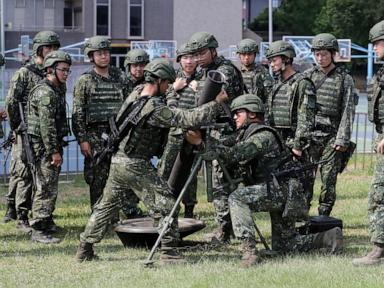
Every summer, the routine plays out with clockwork precision. Sirens wail across Taipei. Traffic halts. Millions of citizens duck into underground shelters while politicians pose in command bunkers, projecting an image of unyielding resolve against a looming superpower. The standard narrative in global media treats these annual exercises as proof of a hardened, prepared democracy ready for the worst.
It is theater. Expensive, dangerous, and utterly detached from the mechanics of modern great power conflict. In other developments, read about: The Structural Anatomy of Failure in Multi Party Peace Frameworks.
Focusing on scripted beachhead defense drills creates a comforting illusion of security while ignoring the actual vectors of modern coercion. If you think a fleet of amphibious landing craft constitutes the primary threat to the island, you are fighting the last war. Worse, you are falling for a political distraction that keeps systemic vulnerabilities hidden in plain sight.
The Flawed Logic of the Scripted Siege
The conventional wisdom surrounding cross-strait defense relies on a simplistic calculation. Analysts look at the geography, tally up missile batteries, count fighter jets, and assume any conflict will resemble a high-tech version of Normandy. This model comforts defense contractors and gives politicians a reliable script to read for international cameras. Reuters has also covered this critical subject in extensive detail.
It ignores how modern asymmetric friction actually operates.
Imagine a scenario where no invasion fleet ever crosses the median line. Instead, critical undersea fiber-optic cables face simultaneous, unexplained severances. Energy terminals experience crippling software anomalies. Financial networks stutter and freeze under asymmetric cyber operations that leave no clean attribution trail.
When you prepare exclusively for a kinetic D-Day scenario, you spend billions of dollars on hardware that becomes obsolete the moment gray-zone tactics paralyze your infrastructure without a single shell being fired. The annual drills do not simulate this reality because a five-day blackout of the banking system does not look good on the evening news.
The Attrition Trap Nobody Wants to Talk About
Military spending often acts as a proxy for political legitimacy. When governments stage massive mobilization exercises, they are signaling strength to domestic constituents and foreign allies. However, obsessive focus on conventional territorial defense creates a resource drain that starves non-kinetic resilience.
I have watched organizations and governments pour fortunes into redundant heavy platforms while ignoring basic software hygiene and supply chain redundancy. The math of total defense is brutal. When one side out-manufactures the other by orders of magnitude in basic industrial output, symmetric deterrence is a losing game.
Sticking strictly to traditional defense paradigms guarantees that any prolonged standoff favors the larger economy. By playing on the adversary's home turf of mass and industrial capacity, defenders walk straight into an attrition trap.
Shifting From Showmanship to Resilience
Fixing this requires dropping the comfort of traditional military pageantry. Real preparation is boring, unglamorous, and invisible.
True resilience looks like decentralized energy grids that cannot be taken out by a single missile strike. It means decentralized food stockpiles managed at the neighborhood level rather than centralized warehouses vulnerable to sabotage. It means hardening digital infrastructure against constant, low-level infiltration instead of buying prestige fighter jets that require hours of maintenance for every hour in the air.
The honest truth is that deterrence today depends less on how fast you can roll tanks through city streets and more on how quickly a society can bounce back after its digital and physical nervous systems go dark.
Stop funding the theater. Start building the architecture of endurance.