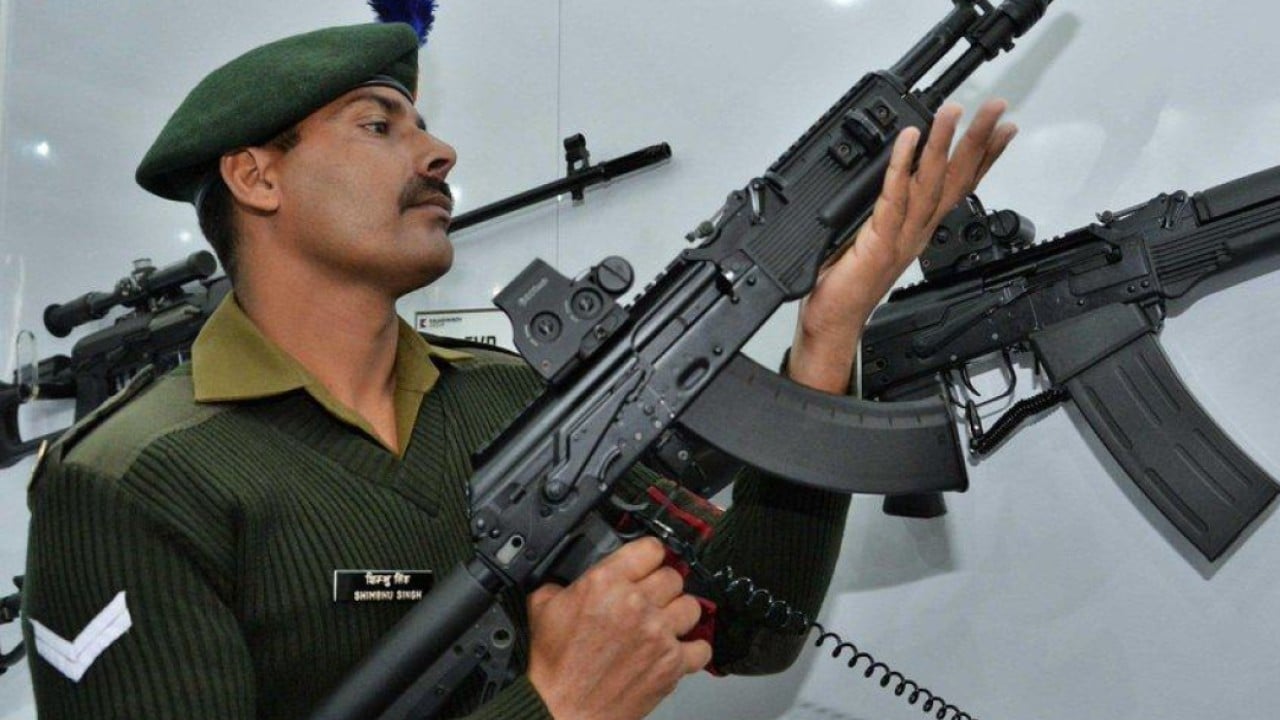
National security procurement strategies frequently confuse industrial assembly with sovereign technological capability. When state actors pursue domestic production mandates for complex military hardware, the transition from importing finished goods to indigenous material sourcing relies on capital allocation, metallurgy, and the friction of technology transfer agreements. The recent production milestones achieved by Indo-Russian Rifles Private Limited at the Korwa Ordnance Factory in Uttar Pradesh, where the AK-203 assault rifle has reached complete local material integration, provide a concrete framework to evaluate how defense ecosystems actually mature.
Analyzing this trajectory requires stripping away political rhetoric and examining the operational mechanics of weapon manufacturing. The shift from partial assembly to end-to-end domestic fabrication exposes structural bottlenecks, cost functions, and the true price of military self-reliance.
The Three Economic Pillars of Small Arms Localization
Sovereign manufacturing programs do not happen overnight; they progress through distinct operational phases. Each phase shifts the financial and technical burden from the licensor to the domestic manufacturer.
- Phase One involves Complete Knock Down assembly. The host nation imports fully fabricated components and merely performs final fitting and quality checks. Local value addition remains minimal, typically staying under ten percent.
- Phase Two introduces Semi Knock Down production alongside raw material adaptation. Machining lines are established locally, requiring the conversion of foreign metallurgical standards into domestic equivalents. Tooling calibration, precision gauge replication, and operator training consume the majority of this cycle.
- Phase Three represents full indigenization. Raw polymers, forged steel blanks, and chemical treatments originate entirely within the domestic supply chain.
The Korwa facility spent years navigating the transition from Phase One to Phase Three. Absorbing over one hundred manufacturing processes and thousands of precision gauges illustrates that the primary barrier to small arms production is not mechanical design genius, but industrial metrology and metallurgical consistency.
The Cost Function of Delayed Substitution
When domestic production timelines slip, the military apparatus faces an immediate capability deficit. Procurement agencies must bridge the gap between infantry requirements and factory output, creating parallel expenditure lines.
When domestic manufacturing delays plague an indigenous program, the Ministry of Defence must execute emergency procurements from international vendors. For instance, the extended timeline required to stabilize the AK-203 production line forced interim imports of foreign rifles, such as the SIG716 platform from the United States. This creates a dual-cost penalty. First, capital is diverted to foreign suppliers for stopgap measures. Second, maintaining multiple rifle platforms in active service strains logistics, training pipelines, and ammunition supply chains.
The economic equation dictates that local production only achieves cost efficiency past a high volume threshold. Fixed capital expenditure for CNC machinery, transfer of tens of thousands of pages of technical documentation, and joint venture overhead require massive scale to drive down per-unit costs. Until that scale is reached, domestic production remains more expensive than direct importation.
Industrial Transfer Versus Indigenous Innovation
A persistent point of confusion in defense analysis is the conflation of manufacturing localization with original research and development. Licensing a foreign design and manufacturing it with local labor is an industrial achievement, not a technological breakthrough.
The AK-203 is fundamentally a 21st-century evolution of the classic Kalashnikov pattern. It incorporates improved polymer furniture, a telescopic folding stock, and Picatinny rails for optics integration. While these upgrades solve the acute ergonomic and modularity failures of legacy systems like the domestic INSAS rifle, they do not represent new intellectual property originated by domestic research bodies.
True technological self-reliance requires mastering the entire defense-industrial feedback loop:
- Theoretical ballistic research conducted by domestic laboratories.
- Prototype iteration driven by direct user feedback from active infantry units.
- Metallurgical formulation tailored to extreme environmental parameters without foreign license dependency.
- Complete freedom to export or modify the underlying intellectual property without third-party vetoes.
By licensing a proven design, the state bypasses the high failure rate of experimental R&D. However, it binds its manufacturing ceiling to the parameters set by the original designer.
Strategic Allocation of Capital and Infrastructure
Scaling a factory floor to produce hundreds of thousands of infantry weapons demands synchronization across the entire domestic manufacturing ecosystem. Small arms depend on specialized steel alloys, heat treatment facilities, chromium-lining techniques for barrels, and rigorous stress testing protocols.
When a facility claims complete local material sourcing, it signals that secondary and tertiary domestic vendors—foundries, chemical processors, and polymer fabricators—have met military-grade specifications. This broader supply chain uplift is the hidden dividend of small arms localization. The precision machining standards mastered for rifle receivers and bolt carriers directly transfer to other sectors, including aerospace and automotive components.
The strategic imperative moving forward requires shifting focus from assembly-line milestones to core metallurgical independence. To eliminate supply chain vulnerability entirely, defense planners must invest heavily in domestic raw material refinement and proprietary design bureaus, ensuring that future small arms programs originate on domestic drafting tables rather than through foreign transfer agreements.