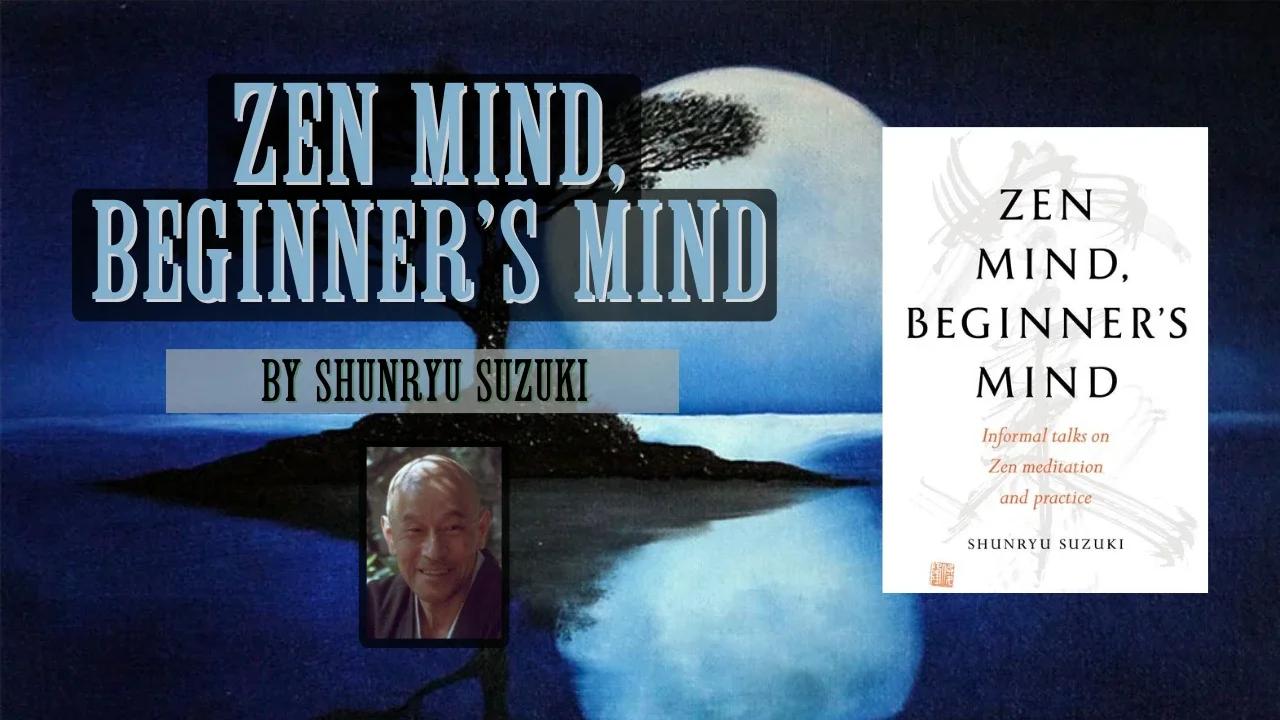
You’ve probably seen the cover. It’s that minimalist blue and white design sitting on every bookshelf from Brooklyn to Berlin. Zen Mind Beginner's Mind by Shunryu Suzuki isn't just a book; it’s basically the "How-To" manual for the Western soul that feels a little too crowded.
People think Zen is about becoming a blank slate. Empty. Void of thoughts. Honestly, that’s a bit of a misconception. Suzuki Roshi—the guy who founded the San Francisco Zen Center—wasn't trying to turn us into robots. He wanted us to be more human, not less. He famously said, "In the beginner's mind there are many possibilities, but in the expert's there are few."
That’s the hook. That's the whole game.
Why Beginner's Mind is Harder Than It Looks
The "beginner's mind," or shoshin, is this state of being where you approach things with zero prejudice. Think about how a kid looks at a ladybug. They aren't thinking about the genus Coccinellidae or how it helps the garden. They’re just... seeing it.
Most of us can't do that. We’ve been "experts" for too long. We have degrees, jobs, and decades of baggage. When we sit down to meditate, or even just try to drink a cup of coffee, we’re doing it through a filter of everything we already know. We’re bored before we even start.
Suzuki emphasizes that this isn't some fancy achievement. It’s not like leveling up in a video game where you eventually become a "Master." In Zen, the highest achievement is staying a beginner forever. It’s a paradox. You practice for thirty years just to realize you still don't know anything. And that's where the freedom is.
The San Francisco Connection and the 1960s
Context matters. Suzuki arrived in San Francisco in 1959. At the time, Zen was this exotic, intellectual curiosity for the Beat poets. People like Jack Kerouac and Alan Watts were writing about it, but Suzuki brought the actual practice. He didn't want to talk about philosophy all day. He wanted people to sit.
He taught zazen (seated meditation). Just sitting. Not sitting to get enlightened. Not sitting to reduce stress. Just sitting. This frustrated the hippies. They wanted the "Aha!" moment. Suzuki told them the "Aha!" moment was the sitting itself.
He didn't use big, flowery words. If you read the transcripts in the book—which were compiled by his student Trudy Dixon—the language is surprisingly plain. He talks about frogs. He talks about weeds. He talks about how your mind is like a big pasture where you let your cows wander. If you try to control the cows, they get restless. If you give them a big field, they’re fine.
Practical Zazen: It’s Not About the Legs
Most people get hung up on the posture. They think if they can't get into a full lotus position, they’re failing at Zen Mind Beginner's Mind.
Suzuki was actually pretty chill about the physical side, though he was firm on discipline. The point of the posture—straight back, chin tucked, eyes slightly open—isn't to look like a statue. It’s to keep you awake. If you’re too relaxed, you fall asleep. If you’re too tense, you get agitated.
It’s about finding the middle.
What your mind does while you sit
- You notice a thought about lunch.
- You realize you’re thinking about lunch.
- You come back to your breath.
- You get mad at yourself for thinking about lunch.
- You realize you're being an "expert" judge.
- You come back to the beginner's mind.
It’s a loop. You’ll do this a thousand times in ten minutes. That's not failure. That’s the practice. Suzuki suggests that "the weeds of the mind" are actually necessary. You shouldn't try to pull them out. You should use them as fertilizer for your practice. It’s a messy, organic process, not a sterile one.
The Problem with "Expert" Mindsets
The expert's mind is closed. It’s "been there, done that." It’s why relationships get stale. It’s why we burn out at work. We think we know our partner. We think we know our job.
When you apply Zen Mind Beginner's Mind to real life, you start to see that you actually don't know what’s going to happen next. Every moment is actually new. It sounds like a Hallmark card, but in practice, it’s terrifyingly true. If you treat your morning commute like you’ve never done it before, you notice things. The light hitting a brick wall. The way the air feels.
It prevents that "autopilot" mode that eats up most of our lives.
Misconceptions About Enlightenment
One of the most famous lines in the book is: "Strictly speaking, there are no enlightened people, there is only enlightened activity."
This is huge. It de-mythologizes the whole thing. People want to reach a state where they are "fixed" or "done." Suzuki says that’s not how it works. Enlightenment isn't a destination. It’s how you wash the dishes. It’s how you talk to your neighbor.
If you think you’re enlightened, you’ve lost the beginner's mind. You’ve become an expert again.
The Role of the Teacher
Suzuki was often asked if a teacher was necessary. In the book, he’s kind of nuanced about it. You can't really do this alone because your ego is too good at tricking you. You’ll sit there and think you’re being very Zen, but you’re actually just daydreaming.
A teacher—or even a community (sangha)—acts as a mirror. They show you where you’re full of it. They keep you honest. But ultimately, the teacher isn't giving you anything you don't already have. They’re just helping you strip away the layers of "expert" junk you’ve piled on top of your original nature.
Why This Book Still Sells After 50 Years
We live in a world of optimization. We have apps for everything. We track our sleep, our steps, our calories. Everything is about progress.
Zen Mind Beginner's Mind is the ultimate "anti-optimization" book. It tells you that you’re already enough. It tells you that the "goal" is to stop trying to reach a goal. In 2026, when our attention spans are basically non-existent and we’re constantly being told we need to be better, faster, and smarter, Suzuki’s message is a massive relief.
It’s a quiet book. It doesn't shout. It doesn't promise you’ll make a million dollars or find your soulmate. It just suggests that maybe, if you stop trying so hard to be someone else, you might actually experience your life.
Real-World Application: How to Start
If you want to actually use this, don't just read the book and put it back on the shelf. That’s just adding more "expert" knowledge to your brain.
Start with something small. Pick one thing you do every day—like brushing your teeth or walking to your car. For those two minutes, try to have a beginner's mind. Don't think about what you have to do at 9:00 AM. Don't think about the email you forgot to send. Just feel the bristles. Feel the pavement.
When your mind wanders—and it will—just notice it. "Oh, there’s the expert mind trying to plan my day again." Then come back.
Actionable Steps for Today
- Stop Labeling Everything: Try to look at something in your room for 30 seconds without naming it. Don't think "chair" or "blue." Just see the shapes. It's surprisingly hard.
- Listen Without Interjecting: Next time someone talks to you, don't wait for your turn to speak. Don't prepare your "expert" response. Just listen to the sound of their voice and what they're actually saying.
- Embrace "I Don't Know": Practice saying these three words more often. We’re terrified of looking stupid. But "I don't know" is the doorway to the beginner's mind.
- Sit for 5 Minutes: Don't call it meditation if that feels too heavy. Just sit in a chair, keep your back straight, and watch your breath go in and out. That's it.
The beauty of Zen Mind Beginner's Mind is that it’s always available. You don't need a monastery. You don't need a special robe. You just need to be willing to be a beginner, over and over again, for the rest of your life.
It’s not about finding the truth. It’s about realizing that the truth is already there, under all that expert noise.



