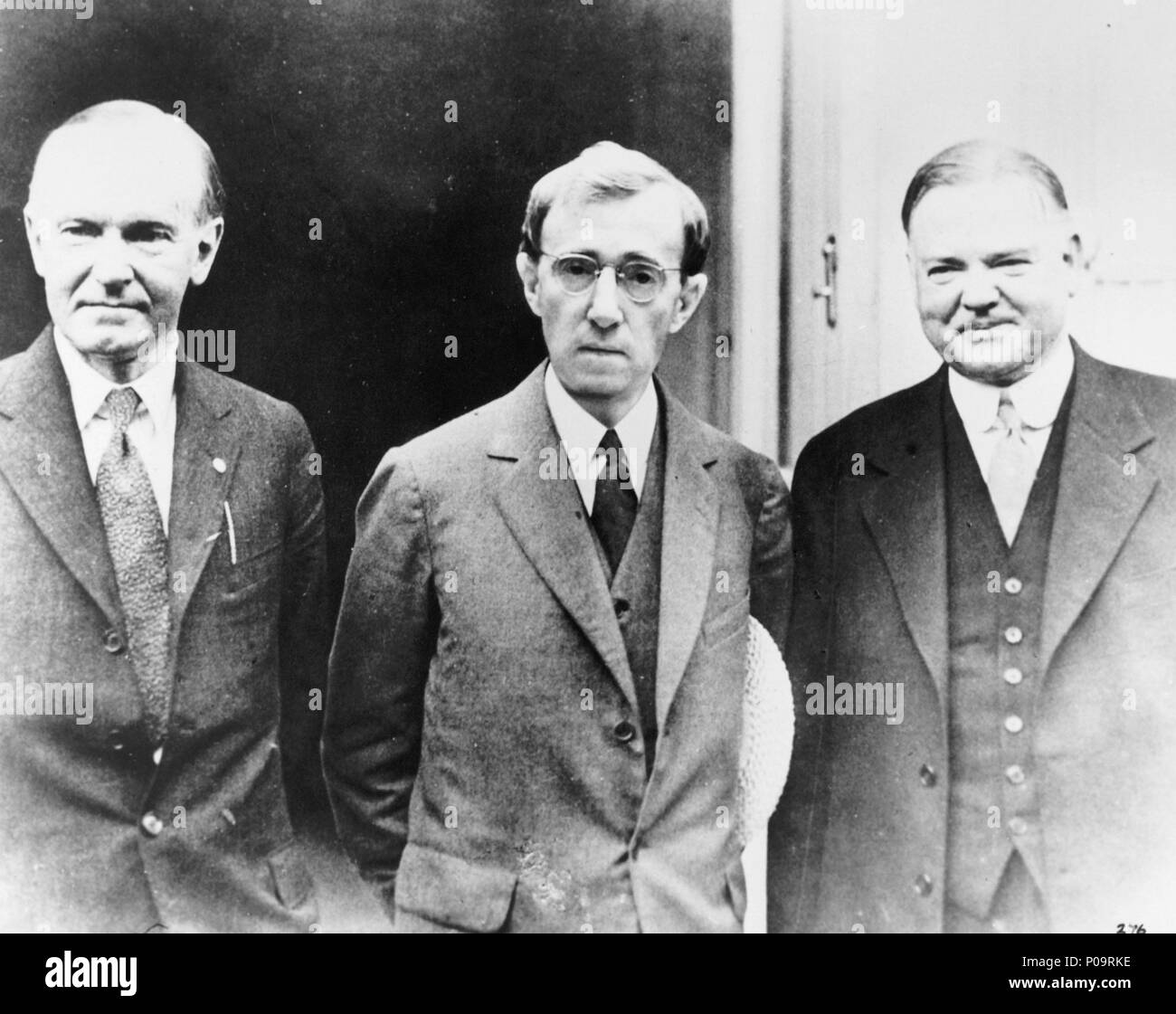
Honestly, if you watch Zelig today, it’s kinda hard to believe it came out in 1983. Long before Forrest Gump shook hands with JFK or deepfakes started ruining our collective sense of reality, Woody Allen and cinematographer Gordon Willis were pulling off some of the most insane technical feats in cinema history. They didn't have CGI. There were no digital shortcuts. They just had old cameras, some blue screens, and a lot of grit.
The film is a "mockumentary." It’s barely 79 minutes long.
But in that short runtime, it manages to say more about the human need to fit in than almost any three-hour drama. We follow Leonard Zelig, played by Allen, a man so desperate for approval that his body literally transforms to match the people around him. He's the "Human Chameleon." Put him next to a jazz band, and he’s playing the trumpet with a new skin tone. Stand him next to two overweight men, and he suddenly develops a massive gut. It’s hilarious, sure, but it’s also pretty dark when you think about it.
The Technical Wizardry of Gordon Willis
You can't talk about the woody allen film zelig without talking about the look of it. Gordon Willis—the guy who shot The Godfather—was a literal genius. To make the new footage look like authentic 1920s newsreels, the crew didn't just use filters. They went old school.
They tracked down actual antique cameras and lenses from the 20s and 30s. They used flicker mattes to get that shaky, old-timey light effect. But the best part? The physical damage. Legend has it the crew would take the film negatives into a shower, stomp on them, and scratch them up just to get that authentic "found in an attic" vibe. Willis once said he thought he was going to "go nuts" trying to make something so difficult look so simple.
How they "Cheated" History
- The Blue Screen: They used early blue-screen tech to insert Allen into real archival footage.
- The Cameos: They got real-life intellectuals like Susan Sontag and Saul Bellow to talk about Zelig as if he were a real historical figure.
- The Music: Dick Hyman wrote "period-accurate" songs like Leonard the Lizard that sounded so real people actually thought they were old standards.
It’s that "verisimilitude"—that feeling of truth—that makes the movie work. If it looked like a fake, the joke wouldn't land. But because it looks 100% real, the absurdity of a man turning into a Chinese immigrant or a high-society Republican becomes a biting satire on how we all lose ourselves just to be liked.
Identity Crisis as Art
At its heart, Zelig is about the "chameleon" in all of us. Under hypnosis with Dr. Eudora Fletcher (played by Mia Farrow), Leonard admits the truth: "I want to be liked."
It’s a simple line. It's also devastating.
Zelig is a man who has no "self." He is whatever the room needs him to be. Allen was basically exploring his own neuroses here—the Jewish desire to assimilate, the artist's need for public approval, and the fear of being "found out." There’s this great scene where he's at a party with F. Scott Fitzgerald and starts talking in a thick Boston accent because he’s around aristocrats. Then he goes to the kitchen and instantly switches to a working-class Democrat vibe to vibe with the servants.
The movie isn't just a gimmick. It’s a warning about what happens when you let the world dictate who you are. The film even takes Zelig to Nazi Germany, where he’s seen standing behind Hitler. It's a chilling moment. It suggests that the ultimate end of "just trying to fit in" is the loss of morality itself. If you have no core, you can be shaped by anything—even evil.
Why People Still Talk About It
A lot of critics at the time didn't know what to make of it. Pauline Kael famously said she felt "a little hungry" after watching it because there weren't really any "characters." But that was the point! Zelig isn't a character; he's a void.
The film was nominated for two Oscars: Best Cinematography and Best Costume Design. It lost both to Ingmar Bergman’s Fanny and Alexander, which is ironic because Allen was a huge Bergman fanboy.
Despite the lack of trophies, its influence is everywhere. You see "Zelig" mentioned anytime a politician changes their accent to suit a crowd or a celebrity tries to reinvent themselves for the tenth time. It’s become a shorthand for the modern condition of performance.
Actionable Insights for Cinephiles
- Watch for the "Interviews": Pay attention to the real-life intellectuals. The way they deadpan their "analysis" is where the best comedy hides.
- Check the Length: At 79 minutes, it’s a masterclass in "less is more." Use it as a palette cleanser if you're tired of bloated modern blockbusters.
- Compare to Forrest Gump: If you’re a tech nerd, watch both movies back-to-back. It’s fascinating to see how Willis achieved with physical film what Zemeckis did with computers a decade later.
If you haven't seen it, find a copy. It’s weird, it’s short, and it’s probably more relevant in the era of social media "curated identities" than it was back in the 80s. We’re all a little bit like Leonard Zelig now, aren't we?
Try to spot the seams where the old footage meets the new. You probably won't find many. That’s the magic of the woody allen film zelig. It’s a trick that actually tells the truth.
To truly appreciate the craft, look for a high-definition restoration. The grain and scratches are intentional, but seeing the "layered" shots in 4K reveals just how precise the alignment had to be for the illusion to hold.



