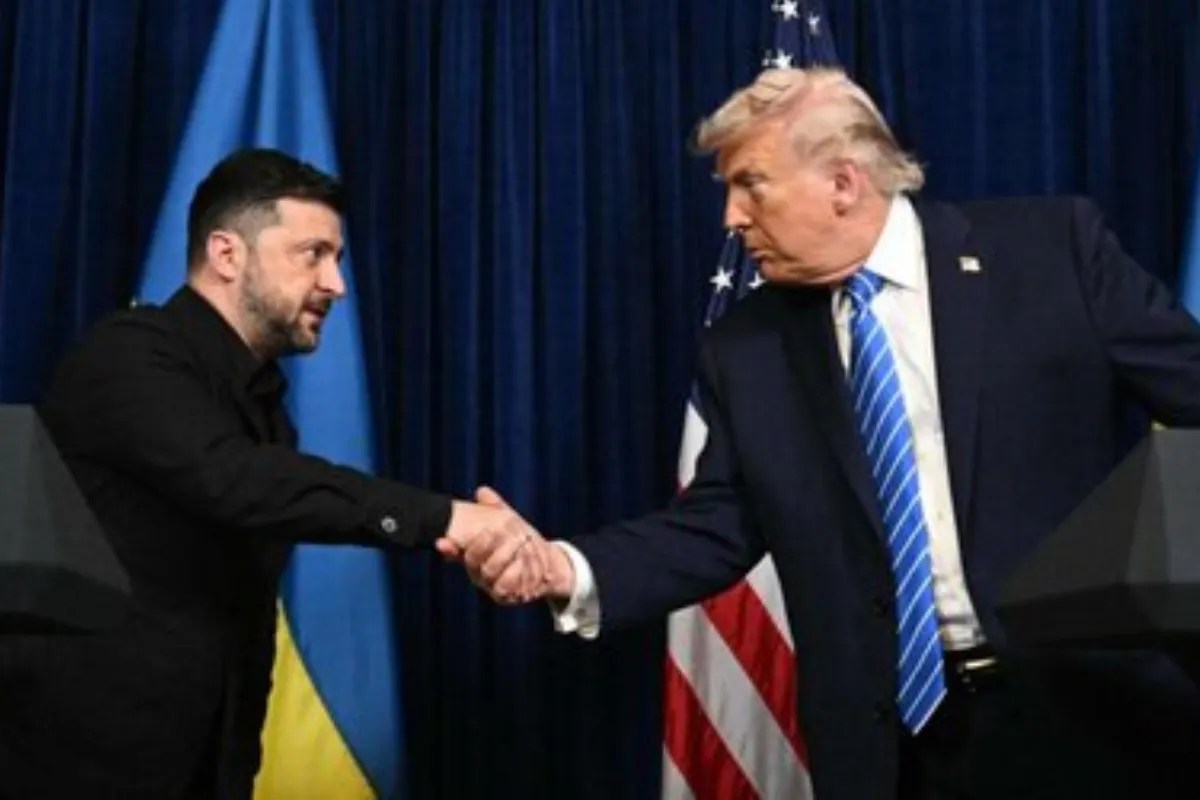
The mainstream media treats every high-altitude handshake in Washington like a tectonic shift in global security. When a foreign leader lands on American tarmac with an agenda packed tightly against the backdrop of escalating tensions with Moscow, the pundits dust off their favorite clichés. They talk about ironclad solidarity, historic moments, and turning points.
They are lying to you. Or worse, they are simply too lazy to look past the optics.
Strip away the motorcades, the staged photo-ops on the South Lawn, and the solemn press conferences. What actually happens behind closed doors when Volodymyr Zelensky sits down with Donald Trump? Not a grand strategic realignment. Not a sudden epiphany that rewrites the map of Eastern Europe. Just a high-stakes collision of two entirely different political survival instincts, completely divorced from the fairy tale of unconditional alliance.
Let us dismantle the lazy consensus.
The Myth of the Decisive Meeting
The standard narrative goes something like this: Zelensky arrives in Washington to secure the keys to the kingdom, pleading for more artillery, longer-range missiles, and blank-check financial commitments to hold the line against Russian aggression. Trump, cast in the role of the unpredictable wild card, either holds the cards or threatens to tear up the rulebook entirely.
This framing assumes that a single conversation between two men can override structural economics, logistics, and raw domestic political survival. It cannot.
I have watched foreign policy analysts obsess over these summits for decades, treating diplomacy like a dramatic screenplay where a passionate speech changes the protagonist's mind. Realpolitik does not work that way. Leaders do not make multi-billion-dollar strategic pivots because someone looked them in the eye and explained the moral weight of history. They move because their incentives force them to.
And right now, the incentives for Washington and Kyiv are pulling in radically different directions.
Follow the Leverage, Not the Rhetoric
To understand why this trip changes nothing fundamental, you have to look at the balance of leverage.
Kyiv’s objective is existential. For Zelensky, maintaining continuous Western military and financial throughput is the absolute difference between state survival and total collapse. Every trip to Washington is an exercise in resource extraction and narrative preservation. He has to convince a skeptical American electorate and an increasingly transactional American political establishment that their investment is yielding returns.
Trump’s objective is entirely domestic and transactional. His entire foreign policy brand is built on disruption, fatigue with endless foreign entanglements, and the promise of a rapid negotiated settlement. To a leader whose primary domestic mandate is "America First," a protracted European land war looks less like a crusade for democracy and more like a bottomless drain on national resources.
When these two forces collide, you do not get a breakthrough. You get a stalemate wrapped in diplomatic theater.
The Accounting Problem Nobody Wants to Discuss
Let us talk about the math, because the commentators in prime time certainly will not.
War is an industrial math problem. Modern high-intensity conflict eats ammunition, spare parts, and capital at a rate that industrial supply chains in the West simply were not designed to sustain indefinitely. When politicians promise support "for as long as it takes," they are using a rhetorical shield to mask a logistical nightmare.
Consider a scenario where Washington decides to abruptly cut off financial lifelines or drastically restrict the supply profile. Kyiv’s military posture shifts within weeks. Conversely, imagine a scenario where Washington doubles down permanently. The domestic political fracture in the United States deepens, turning foreign policy into an even more toxic partisan football.
Neither outcome is solved by Zelensky shaking hands with Trump in front of a forest of microphones. The constraints are baked into industrial capacity and voter fatigue.
The Real Question We Should Be Asking
Instead of asking what Trump and Zelensky talked about behind closed doors, ask a more uncomfortable question: Why do we keep pretending that personal diplomacy can fix systemic structural impasses?
The media loves framing geopolitics as a clash of personalities because personalities make for good television. It is easy to write a script about a fiery wartime president locking horns with a billionaire populist. It is much harder to explain procurement bottlenecks, GDP-to-debt ratios, and the grinding realities of attrition warfare.
Zelensky’s visit to Washington is a symptom of a deeper anxiety, not a cure for it. It is a desperate bid to manage perceptions in a political capital that is losing its attention span.
The cameras will pack up. The motorcade will head back to the airport. The talking heads will declare the summit a success or a disaster depending on which cable news network sign they hold. And the artillery shells will keep flying across the Dnieper, completely indifferent to what was said in the Oval Office.
Stop looking for saviors in the West Wing. Look at the ledger.


