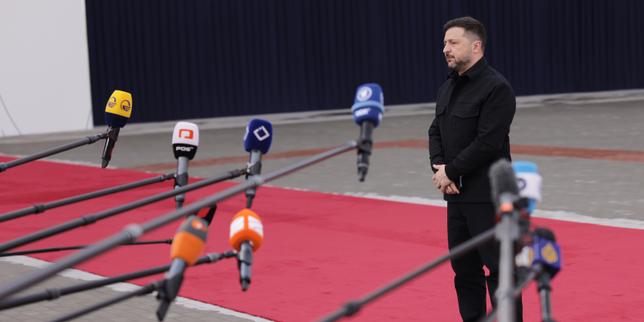
You can only ignore a political earthquake for so long before the cracks reach your own desk. Right now, Ukrainian President Volodymyr Zelensky is testing the absolute limits of that rule.
As the war against Russia drags through its fifth brutal year, Kyiv is dealing with an internal explosion that threatens the very core of its state security and international backing. The National Anti-Corruption Bureau of Ukraine (NABU) and the Specialized Anti-Corruption Prosecutor's Office (SAPO) just named Andriy Yermak, Zelensky’s former chief of staff and arguably the most powerful puppet master in the country until his abrupt resignation, as a primary suspect in a massive 460-million-hryvnia (about $10.5 million) money-laundering scheme. For an alternative perspective, see: this related article.
And from Bankova Street? Absolute silence.
Zelensky hasn't uttered a single public word about his former top aide being under the microscope. His press team tried to brush it off, saying it's too early to draw conclusions while investigations are ongoing. But let's be real. When the man who handled your critical diplomatic negotiations, controlled access to your office, and ran your wartime political apparatus gets hit with laundering charges linked to luxury real estate during a war for national survival, "no comment" doesn't cut it anymore. Related analysis regarding this has been shared by USA Today.
The Reality of Operation Midas and the Luxury Behind the Lines
To understand why this silence is dangerous, you have to look at what investigators are actually digging up. This isn't just about some minor bureaucrat skimming off the top. This is "Operation Midas," a sweeping investigation tracking millions of dirty dollars allegedly funnelled into the Dynasty residential complex, an ultra-luxury housing development located just outside a heavily shelled Kyiv.
Think about the optic. While regular citizens crowd into basements and soldiers ration ammunition on the front lines, court documents suggest elite networks were moving vast amounts of cash to build luxury real estate. Even worse, leaked transcripts from the investigation hint that the cash flows tie directly back to shady procurement deals involving drone manufacturing, energy infrastructure, and military hardware. Prominent businessman Tymur Mindich is heavily implicated, and authorities are even checking into what roles other high-ranking officials played as witnesses or accomplices.
Yermak's lawyers claim the entire case is groundless and driven entirely by public pressure. They managed to secure his release on bail, but the damage to the administration's narrative is already deep. For years, Zelensky successfully pushed the idea that his inner circle was unified, laser-focused, and completely clean of the old oligarchical rot. Operation Midas destroys that illusion completely.
Why a Backstage Strategy is Backfiring With Western Allies
Zelensky’s team seems to think they can handle this the old-fashioned way: shut down public discussion, wait out the news cycle, and use state levers to manage the fallout. Just days before the formal suspicion notice against Yermak dropped, Zelensky signed a highly controversial decree slapping heavy state sanctions on another former chief of staff, Andriy Bohdan.
The administration didn't give a single reason for sanctioning Bohdan, who happens to be a fierce critic of the current government. The word on the street in Kyiv is that the presidential office panicked, thinking Bohdan was the source leaking the devastating Yermak transcripts to the press. Using national security sanctions to target a Ukrainian citizen without public evidence looks incredibly defensive. It looks like an attempt to scare other potential whistleblowers into keeping their mouths shut.
It's a terrible strategy, mostly because Ukraine's lifelines depend entirely on external trust. Kyiv is desperately trying to fast-track its admission into the European Union. Western capitals are watching every single move. If the White House and European parliaments see an administration that uses state power to muzzle critics while burying its head in the sand over top-tier graft, the flow of billions in financial and military aid could dry up fast.
The Dangerous Patterns of Inner Circle Scandals
If Yermak were an isolated incident, maybe the silence would fly. But it's part of a broader, systemic pattern of elite misconduct that keeps bubbling to the surface. Just last year, another former deputy head of the Presidential Office, Andriy Smirnov, was hit with severe corruption and bribery charges.
Investigators found that Smirnov had pocketed millions and tried to launder it by building elite private homes in the recreational zones of the Odesa region. He allegedly traded official favors, using his massive political clout to influence the Antimonopoly Committee to cancel legitimate business tenders and hand a $100,000 construction contract to a friendly builder.
When you stack the Smirnov case right next to the massive Yermak money-laundering investigation, it becomes impossible to argue that these are just "bad apples." These are individuals who sat at the absolute pinnacle of Ukrainian administrative power during a historical crisis.
Moving Past Rhetoric to Fix the System
The time for slick public relations and ignoring the elephant in the room has run out. If Zelensky wants to protect Ukraine's future, his administration needs to take immediate, transparent actions that go beyond empty promises:
- Acknowledge the Investigation Publicly: The president must address the nation directly regarding the Yermak case, validating the independence of anti-corruption bodies like NABU without trying to shield former allies.
- Establish Full Transparency in Military Procurement: Create an independent, internationally vetted oversight board to audit every major drone and defense infrastructure contract to ensure funds aren't being diverted into luxury construction.
- Stop Using Sanctions Against Citizens Without Due Process: Revoke the opaque use of security decrees against political critics and handle domestic disputes exclusively through open court systems to preserve democratic credibility.
Chasing EU membership while keeping quiet about top-level money laundering is a losing game. The anti-corruption courts are showing they have the teeth to go after the biggest names in the country. Now, the presidency needs to show it has the stomach to let them do their job.