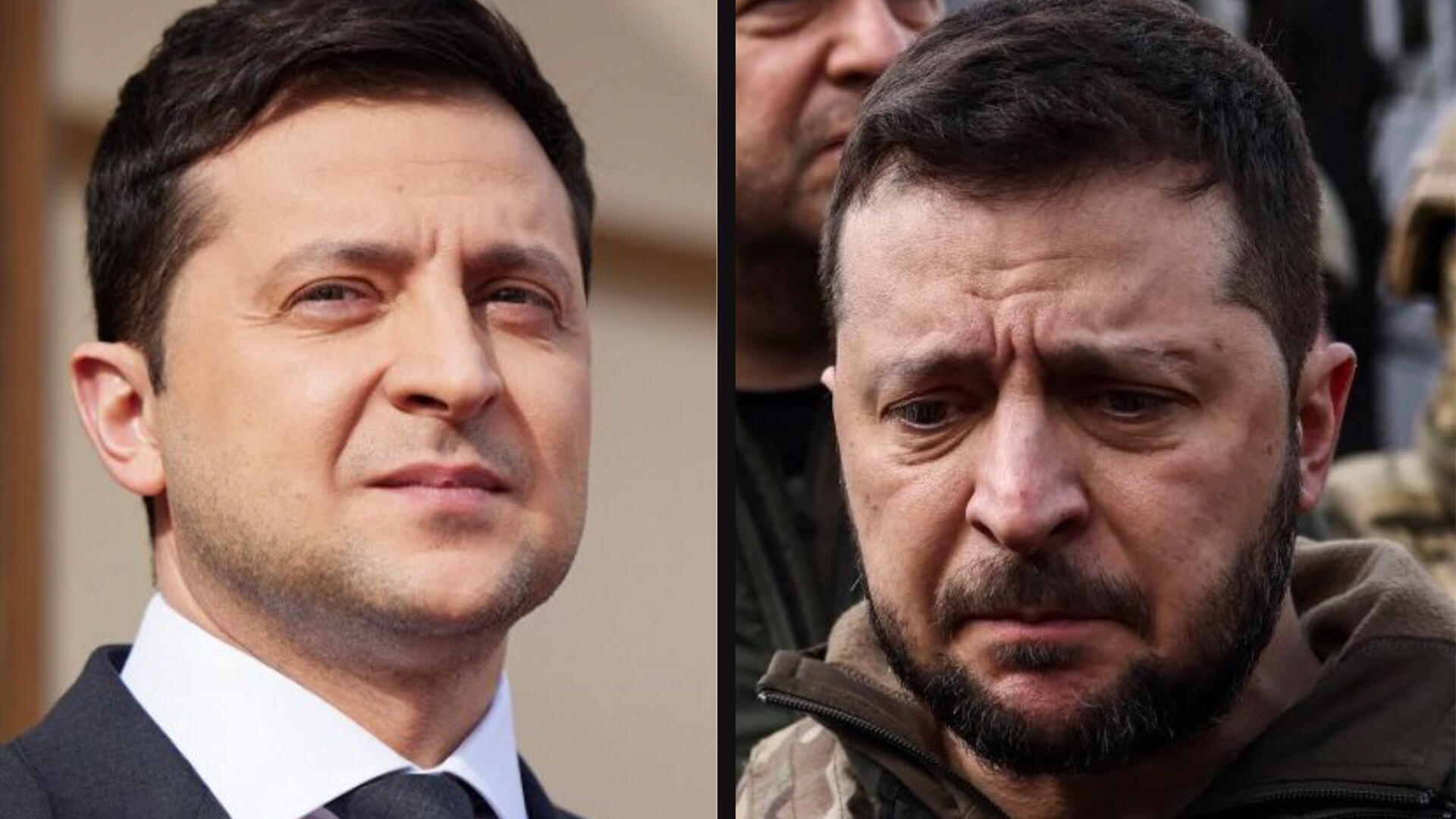
If you had walked into a Kyiv coffee shop in 2018 and told people that the guy playing the piano with his—well, let’s say "without his hands"—on TV would one day be compared to Winston Churchill, they’d have laughed you out of the room. Honestly. Volodymyr Zelensky was the guy who made you laugh after a long work week. He was the "everyman" who poked fun at the stuffy, corrupt elite. Today? He’s the face of a nation fighting for its life, wearing olive drab every single day, and looking like he hasn’t slept since February 2022.
The story of Zelensky before and after isn’t just about a change in wardrobe or a beard. It’s a total metamorphosis of a man and a country.
The "Before": A Comedian with a Law Degree
People often forget that Zelensky isn't just some guy who fell into acting. He actually graduated from the Kryvyi Rih Institute of Economics with a law degree in 2000. He never practiced law, though. Instead, he chose the stage. By his early 20s, he was already a powerhouse in KVN, a massive comedy competition that was basically the Saturday Night Live of the post-Soviet world.
He co-founded Kvartal 95 in 2003. It wasn't just a comedy troupe; it became a media empire. They produced movies, cartoons, and variety shows. But the big one—the one that changed everything—was the TV series Servant of the People. In it, Zelensky played Vasyl Holoborodko, a high school history teacher who gets caught on camera ranting about corruption and accidentally becomes president.
The irony is thick. In the show, Holoborodko is a naive, Russian-speaking guy who thinks he can fix Ukraine with honesty and a bicycle. In 2019, life imitated art. Zelensky ran for president under a party named after the show. He won with a massive 73% of the vote. People weren't just voting for a comedian; they were voting for the hope that a regular guy could actually clean up the mess.
The "Middle": A President Under Pressure
The first two years of his presidency were... complicated. If we're being real, his approval ratings were tanking by late 2021. They had dropped to around 31%. Why? Because politics is harder than a thirty-minute sitcom.
He tried to tackle corruption, but it’s a deep-rooted monster. He lifted legal immunity for members of parliament, which was a big win, but the "Big Construction" infrastructure projects he started were often criticized for lack of transparency. Then COVID-19 hit. Like every other leader, he struggled to balance the economy and public health.
Back then, his "before" vibe was still very much there. He was informal. He asked people to call him by the informal "Ty" instead of the formal "Vy." He wore suits. He looked like a young, energetic CEO trying to disrupt an old industry. Critics called him a "dilettante." They said he was out of his depth.
The "After": The 24th of February
Everything changed on February 24, 2022. This is the "after" that the world knows. The suit disappeared. The clean-shaven face disappeared. The man who once voiced Paddington Bear in the Ukrainian dub of the movie was suddenly ordering a general mobilization.
When the US offered to evacuate him, his response became legendary: "I need ammunition, not a ride." That single sentence probably saved Kyiv. It showed his soldiers and his people that the captain wasn't leaving the ship.
What Actually Changed?
It’s not just the clothes. The shift in Zelensky before and after is psychological.
- Language: Before the war, Zelensky was primarily a Russian speaker. It was his first language. After the invasion, he switched almost entirely to Ukrainian for public addresses, symbolizing a hard break from the "Russian world."
- Leadership Style: He went from a consensus-builder who tried to negotiate with Putin in Paris (back in 2019) to a commander-in-chief who refuses to negotiate until every inch of territory is returned.
- Physicality: Look at photos from early 2019 versus now. The lines around his eyes are deeper. There's a weight in his posture. He’s aged a decade in four years.
Comparing the Two Eras
| Feature | Before (2019-2021) | After (2022-Present) |
|---|---|---|
| Primary Goal | Economic reform & ending Donbas conflict | National survival & territorial integrity |
| Public Image | The "Everyman" Reformer | The "Wartime" Churchillian Leader |
| Communication | Viral social media sketches | Nightly somber video addresses |
| Approval Rating | Hovering around 30% (late 2021) | Peak of 91% (early 2022); stabilized at high levels |
Recent Moves and the 2025/2026 Reality
By late 2025 and moving into 2026, the "Zelensky effect" has faced its toughest test. The war became a stalemate for a long time. People got tired. Corruption scandals—the very thing he promised to end—started popping up in military procurement.
Recently, he’s had to make some brutal calls. He reshuffled his cabinet significantly, bringing in people like Mykhailo Fedorov (the digital transformation whiz) to take over bigger defense roles. He even had to distance himself from long-time allies like Andriy Yermak after public trust dipped following moves to curb the independence of anti-corruption bodies.
It’s a gritty, messy "after." It’s no longer the heroic movie montage of 2022. It’s the hard work of keeping a country running while it’s being shelled.
Actionable Insights: Lessons from the Transformation
So, what can we actually learn from this?
- Communication is a Weapon: Zelensky’s background in media wasn't a "weakness" as critics claimed. It was his greatest strength. He knew how to talk to a camera and, by extension, the world.
- Adaptability Wins: The "before" Zelensky was a pacifist who thought he could look Putin in the eye and find a deal. The "after" Zelensky realized that wasn't possible and pivoted completely.
- Authenticity Scales: Whether he’s making a joke or announcing a tragedy, he feels real. In a world of scripted politicians, that's why people still listen.
If you want to understand the modern geopolitical landscape, you have to look at the Zelensky before and after timeline. It’s a case study in how crisis doesn't just create character—it reveals it. The "showman" was always a patriot; it just took a tragedy of "Churchillian" proportions for the rest of the world to see it.
To keep up with how these shifts are impacting global security, you should monitor the official reports from the Institute for the Study of War (ISW) or the latest diplomatic briefings from the 2026 Budapest Summit. These sources give the hard data that backs up the visual transformation we see on our screens every day.