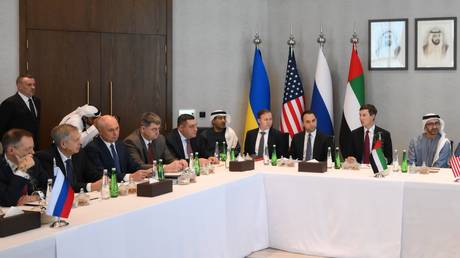
Ukrainian President Volodymyr Zelenskiy’s public satisfaction with recent messages from United States diplomatic envoys signals a calculated shift in Kyiv’s wartime communication strategy, rather than an imminent breakthrough toward peace. By praising American diplomatic efforts openly, Zelenskiy is working to lock Washington into Kyiv’s preferred framework for ending the war with Russia while neutralizing political narratives in the United States that portray Ukraine as an obstacle to a negotiated settlement.
Diplomacy in wartime rarely operates at face value. When a head of state expresses being "pleased" with behind-the-scenes messaging from an ally, that statement is almost always engineered for multiple audiences simultaneously. In this case, the primary audience sits in Washington, the secondary audience sits in European capitals, and the third sits in the Kremlin.
The Anatomy of Diplomatic Signaling
Public optimism is a tool. In high-stakes international negotiations, leaders use carefully calibrated praise to create diplomatic momentum and box in their counterparts.
For months, friction between Kyiv and Washington over the pace of military aid, restrictions on long-range strikes, and the contours of a eventual settlement has simmered beneath the surface of official joint statements. American political discourse has increasingly fractured over the long-term cost of supporting Ukraine, giving rise to loud demands for an immediate, negotiated exit from the conflict. Against this backdrop, Zelenskiy cannot afford to look like a leader clinging to maximalist demands while refusing to engage with American peace proposals.
By stepping forward to endorse the tone and substance of messages delivered by US envoys, Zelenskiy accomplishes three immediate objectives. First, he projects alignment with the White House and the State Department, signaling to skeptical lawmakers on Capitol Hill that Kyiv is a constructive, flexible partner. Second, he subtly defines what "successful" US diplomacy looks like—implying that the American messages he received validate Ukraine’s core security requirements rather than demanding unilateral territorial concessions. Third, he shifts the burden of intransigence squarely onto Moscow. If Kyiv is publicly pleased with American diplomatic efforts, any subsequent collapse in talks automatically frames Russia as the sole aggressor rejecting reasonable terms.
This is a classic diplomatic maneuver known as preemptive framing. Rather than waiting for leaks from Washington or Moscow to define the narrative around secret envoy discussions, Zelenskiy seized the microphone first. Once a leader publicly characterizes a private diplomatic exchange as positive and aligned with their national interests, it becomes significantly harder for the sending party to pivot toward a harsher, more coercive stance without suffering a public relations blow.
Why US Envoys Are Changing Their Tone
The messages arriving in Kyiv from Washington are not emerging in a vacuum. They reflect an evolving realization within the American foreign policy establishment that the war has entered a grueling phase of attrition where neither side possesses the immediate conventional capacity for a decisive knockout blow.
Throughout the earlier stages of the conflict, US diplomacy centered almost entirely on coalition management, sanctions enforcement, and weapons logistics. Discussions of an end-state were largely deferred to an unspecified future date when Ukraine would negotiate from a position of overwhelming battlefield strength. That timeline has collided with hard realities: manpower shortages in Ukrainian brigades, the reconstitution of Russia’s defense industrial base, and growing fatigue among Western electorates.
Consequently, the mandate of US envoys has expanded from pure wartime coordination to active conflict termination architecture. Special representatives and senior State Department officials are now tasked with testing the diplomatic waters to see what a durable freeze or settlement might actually look like on the ground.
The Core Friction Points in Washington’s Messaging
To understand what Zelenskiy is actually praising, it helps to examine the specific pillars that any credible US diplomatic proposal must address to avoid immediate rejection in Kyiv:
- Security Guarantees Over Paper Promises: Kyiv will not accept another Budapest Memorandum. Any diplomatic framework that pleases Zelenskiy must include binding, multi-year military commitments, air defense integration, or a concrete pathway toward NATO membership that deters future Russian invasions.
- Territorial Reality Versus Legal Recognition: While military realities on the front lines make the immediate expulsion of all Russian forces exceptionally difficult, Kyiv draws a hard red line against legally ceding sovereign territory. US envoys have likely floated formulas that distinguish between temporary de facto lines of control and permanent de jure recognition.
- Sanctions Relief Leverage: Washington holds the primary economic cards regarding frozen Russian central bank assets and sectoral sanctions. Zelenskiy’s satisfaction suggests US envoys are assuring Kyiv that Western economic pressure on Moscow will not be dismantled prematurely in exchange for a fragile ceasefire.
- Reconstruction Financing: A peace deal without massive, guaranteed capital inflows leaves Ukraine economically hollowed out and politically unstable. Diplomatic messages from Washington increasingly tie security arrangements to long-term financial recovery packages.
When US envoys present a package that preserves these four elements, Zelenskiy has every incentive to applaud publicly. Doing so reinforces the faction within the US administration that favors a "peace through strength" model over those advocating a rapid, unconditional disengagement.
The Trap of Premature Optimism
While Zelenskiy’s upbeat assessment serves immediate tactical purposes, it carries substantial domestic and strategic risks. Managing expectations during a brutal war of survival is notoriously difficult, and signaling diplomatic progress can trigger unintended consequences both at home and on the front lines.
Inside Ukraine, the population has endured years of missile strikes, blackouts, and devastating military casualties. Public opinion polling consistently shows a complex psychological split: an overwhelming majority of Ukrainians reject trading land for peace, yet an exhaustion with endless war is steadily growing. When the president speaks positively about diplomatic efforts to end the war, citizens naturally begin to anticipate an imminent halt to the bloodshed. If those diplomatic tracks stall—as they frequently do when Moscow demands terms tantamount to capitulation—the resulting disillusionment can erode domestic morale and political cohesion.
Furthermore, perceived diplomatic momentum can directly impact the battlefield. Frontline psychology is fragile. Soldiers holding defensive trenches under relentless artillery fire need absolute clarity of purpose. If troops believe politicians are weeks away from signing a ceasefire, the willingness to take high-casualty tactical risks diminishes rapidly. At the same time, Russian commanders routinely escalate offensive operations during diplomatic windows, attempting to seize as much territory as possible before any potential freeze locks the front lines in place.
Moscow’s Calculation and the Illusion of Talks
Any analysis of US-Ukrainian diplomatic alignment must confront the elephant in the room: the Kremlin’s total lack of genuine interest in a compromise that preserves an independent, Western-aligned Ukraine.
Russian President Vladimir Putin views the conflict not as a localized border dispute, but as an existential struggle to dismantle the post-Cold War European security architecture. From Moscow’s perspective, time remains an ally. The Kremlin’s war economy is running at full capacity, domestic political dissent has been systematically crushed, and Russian leadership believes it can outlast Western political attention spans.
For Russian diplomats, engaging with US envoys or floating vague signals about openness to talks is often a delaying tactic designed to slow down Western weapons deliveries. Whenever Washington and Kyiv appear close to finalizing a new tranche of advanced weaponry, Moscow historically drops hints about potential negotiations, prompting hesitant Western policymakers to pause escalatory aid so as not to "derail diplomacy."
Zelenskiy is acutely aware of this pattern. His expression of pleasure regarding US envoy messages is partly a defensive shield against this exact Russian playbook. By loudly affirming that Kyiv and Washington are already on the same diplomatic page, Zelenskiy attempts to prevent Moscow from driving a wedge between the two allies or using fake peace overtures to stall military aid packages.
Historical Precedents for Wartime Envoy Diplomacy
History offers sobering lessons about secret envoy shuttling during active wars. Rarely do such missions produce clean, rapid resolutions; more often, they serve as prolonged probing exercises that take years to mature.
During the Korean War, armistice negotiations dragged on for two full years—from July 1951 to July 1953—while some of the bloodiest battles of the conflict raged simultaneously. Throughout that period, American and South Korean leaders frequently clashed behind closed doors over acceptable terms, while publicly projecting unified resolve to prevent Communist negotiators from exploiting divisions. South Korean President Syngman Rhee fiercely resisted any settlement that left the peninsula divided, forcing US envoys to construct elaborate bilateral defense treaties and economic aid packages to secure his reluctant cooperation.
A similar dynamic played out during the final years of the Vietnam War. Henry Kissinger’s secret shuttle diplomacy in Paris involved intense, often bitter negotiations not just with North Vietnam, but with South Vietnamese President Nguyen Van Thieu. Thieu’s public statements regarding American diplomatic progress were carefully calibrated attempts to extract ironclad security guarantees from Washington before signing onto an agreement he feared would leave his country vulnerable.
In both historical cases, the public expressions of satisfaction from the smaller, embattled ally were conditional. They reflected temporary alignment on negotiation tactics rather than a finalized blueprint for lasting peace.
European Anxiety and the Transatlantic Equation
Zelenskiy’s remarks also land squarely in the middle of growing European anxiety over who controls the diplomatic steering wheel. European Union leaders and NATO allies in Eastern Europe have invested tens of billions of euros in Ukraine’s survival, yet they frequently find themselves reacting to bilateral initiatives hatched between Washington and Kyiv.
Countries like Poland, the Baltic states, and the Nordic nations view Russian aggression as an immediate, existential threat to their own borders. For these governments, any US-led diplomatic effort that hints at a premature ceasefire or a "frozen conflict" triggers deep alarm. They fear that a pause in fighting will simply give Russia three to five years to rebuild its armored divisions and missile stockpiles before striking again—either against Ukraine or against a NATO member state.
Conversely, political factions in Western Europe—particularly in Germany, France, and Southern Europe—quietly welcome any sign that Washington is exploring off-ramps to a war that has disrupted European energy markets and strained national budgets.
By praising US envoys without revealing the specific contents of their messages, Zelenskiy walks a tightrope across these European fault lines. He reassures hawkish Eastern European allies that Ukraine is not being sold out by Washington, while simultaneously signaling to war-weary Western European capitals that Kyiv is actively participating in serious diplomatic efforts to restore stability to the continent.
What Actually Determines the End of the War
Strip away the diplomatic niceties, the envoy shuttles, and the carefully scripted press statements, and the trajectory of the war still comes down to raw material leverage.
Diplomacy does not create leverage; it merely registers it. Envoys can draft brilliant legal frameworks, design intricate demilitarized zones, and propose innovative monitoring mechanisms, but none of those documents will stop a single artillery shell unless the underlying balance of power forces Moscow to conclude that continuing the war is more dangerous than ending it.
Right now, that threshold has not been crossed. Until Ukraine possesses the sustained air defense coverage to protect its energy grid, the long-range strike capabilities to disrupt Russian logistics deep behind the front lines, and the stabilized manpower to halt incremental Russian advances in the Donbas, diplomatic messages will remain exploratory exercises.
Zelenskiy’s public satisfaction with US envoys is a smart, disciplined piece of statecraft designed to keep American political and military support flowing during a treacherous diplomatic season, but the real test of those messages will not be measured in press conferences—it will be measured in the tonnage of ammunition arriving at the front lines over the next six months.