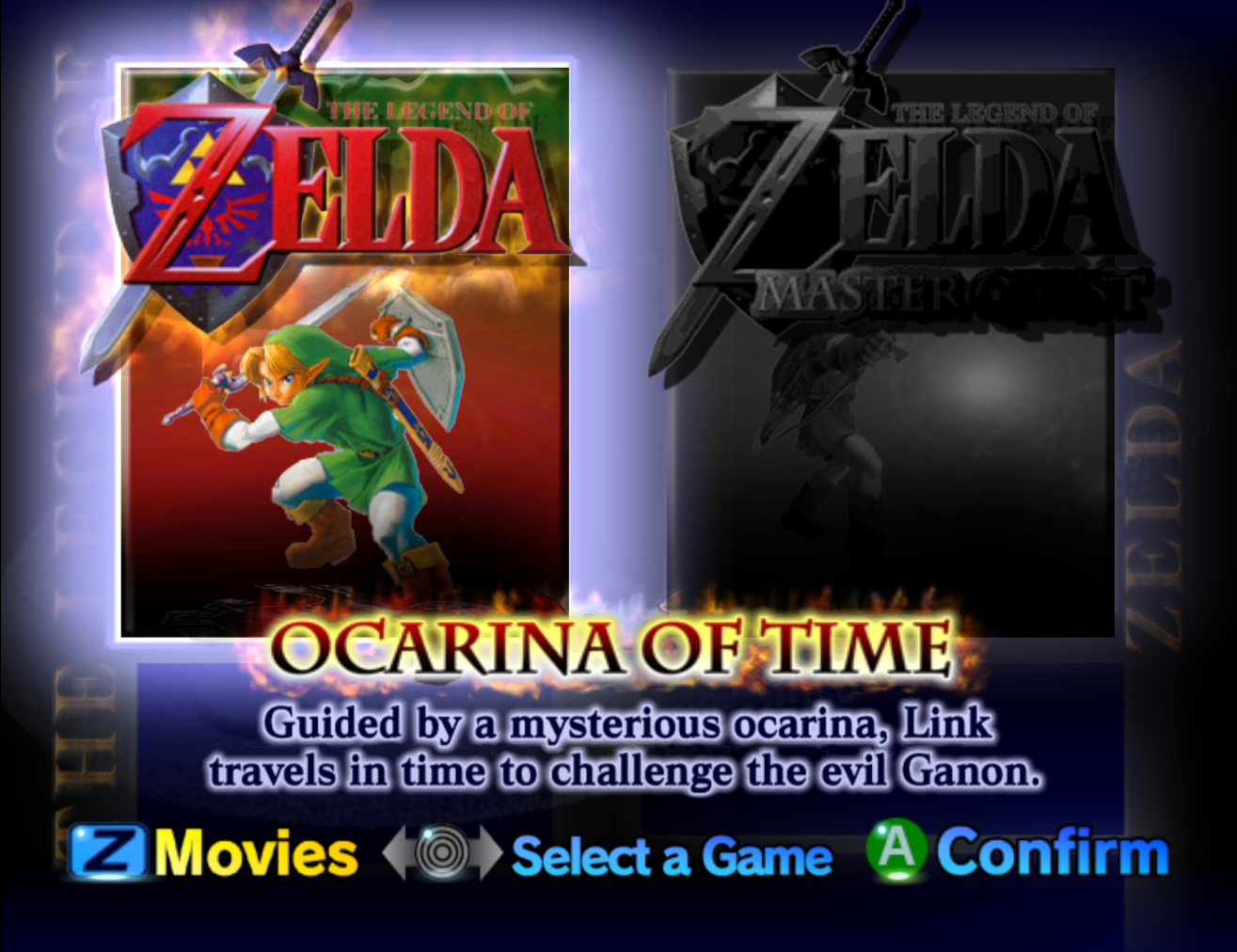
If you grew up in the late nineties, you probably remember the playground rumors about a "secret" version of Ocarina of Time. Some kids called it Ura Zelda. Others swore it was a lost expansion for the ill-fated 64DD peripheral. For years, it felt like a gaming urban legend, right up there with the Triforce being hidden behind the Temple of Time. Then, in 2003, Nintendo actually dropped it. Zelda Master Quest Ocarina of Time arrived as a pre-order bonus for The Wind Waker on GameCube, and honestly, it wasn't at all what most people expected.
It wasn't a sequel. It wasn't a brand-new world.
Basically, Master Quest is a remix. It's the same Hyrule, the same story about a boy becoming a man, and the same clunky (but nostalgic) camera controls. But the dungeons? They’re a fever dream. If the original game is a well-paced journey, Master Quest is a chaotic obstacle course designed by someone who really, really wanted to mess with your muscle memory.
What’s Actually Different in Zelda Master Quest Ocarina of Time?
Don't go in expecting new cutscenes or a different ending. You’re still collecting three spiritual stones and seven medallions. However, the second you step into the Great Deku Tree, you’ll realize the rules have changed.
The core gimmick of Master Quest is the complete overhaul of dungeon layouts. The physical geometry—the walls, the floors, the doors—remains identical to the 1998 classic. What changes is how you interact with that space. Switches are hidden in nonsensical places. Puzzles that once required a simple slingshot shot now require you to find a torch, light a stick, jump across a gap, and burn a web that you didn't even know was there.
Nintendo also decided to crank the absurdity up to eleven. Remember Lord Jabu-Jabu’s Belly? In the original, it’s a fleshy, organic dungeon. In Zelda Master Quest Ocarina of Time, it’s a fleshy, organic dungeon with cows. Yes, actual cows are embedded in the walls like switches. You have to shoot them with your slingshot to open doors. It’s weird. It’s nonsensical. It’s exactly the kind of "tacked-on" strangeness that defines the Master Quest experience.
The combat is also significantly more aggressive. You'll face Iron Knuckles and Big Octos much earlier than you’re supposed to. In the original game, the difficulty curve is a smooth slope. In Master Quest, it’s a jagged cliff. You might walk into a room in the first dungeon and find yourself staring down a group of enemies that would usually be reserved for the endgame.
The Mirror Effect in the 3DS Remake
If you played the version on the Nintendo 3DS, the "difficulty" took a literal turn. Grezzo, the studio behind the remake, decided to mirror the entire world. East became west. Left became right. For a veteran player, this is arguably more difficult than the new puzzles. Your brain knows that Kakariko Village is to the right of Hyrule Castle, but your eyes see it on the left. It creates a genuine sense of vertigo.
Plus, in the 3DS version of Master Quest, Link takes double damage. This makes the early game particularly brutal. A couple of hits from a Deku Baba can send you straight back to the Game Over screen. It forces a level of precision that the original game never really demanded.
Why Ura Zelda Became a Legend
To understand why this game exists, we have to talk about the 64DD. This was a disk-drive add-on for the Nintendo 64 that was supposed to change everything. It had a real-time clock and writable storage. Eiji Aonuma and the team at Nintendo EAD originally planned "Ura Zelda" (translated as "Another Zelda") as an expansion pack.
The 64DD flopped. Hard.
Most of the ambitious ideas for Ura Zelda—like persistent footprints in the dirt or more complex world-building—were scrapped. What remained were the redesigned dungeon files. These sat in Nintendo’s vaults for years until they needed a "hook" to sell The Wind Waker to a skeptical audience who wasn't sold on the new cel-shaded art style.
Some fans argue that Master Quest is the "true" version of the game, intended for those who found the original too easy. I don't buy that. When you look at the puzzle design, it feels reactive. It feels like it was designed specifically to punish people who already knew the solutions to the original puzzles. It’s a "meta" game.
Is It Better or Just Different?
Honestly? It's polarizing. Some players love the challenge of the redesigned Water Temple. Others find the puzzle logic in Zelda Master Quest Ocarina of Time to be borderline unfair. In the original game, puzzles usually have a clear internal logic. If there's a torch, you light it. If there's a cracked wall, you bomb it.
In Master Quest, that logic often flies out the window. You might need to stand on a specific pixel to trigger a sensor or find a switch hidden behind a decorative object that was never interactable in the base game. It feels less like a natural progression of difficulty and more like a mod made by a fan who wanted to troll their friends.
That said, there is a certain thrill in being surprised by a game you thought you knew by heart. Seeing a Stalfos in a room where there used to be a simple puzzle provides a genuine jolt of adrenaline. It keeps you on your toes.
The Best Ways to Play Today
If you want to experience the madness of the cow-switches for yourself, you have a few options.
- Nintendo Switch Online: This is the easiest way. It’s included in the Expansion Pack. You get the GameCube version's layout, though you'll have to deal with the N64-to-Switch controller mapping, which can be a bit finicky for the Ocarina songs.
- The 3DS Remake: Generally considered the superior version for its updated graphics and the "Mirrored" world. However, it’s an unlockable content piece; you usually have to beat the main game first to access it.
- Original GameCube Disc: If you’re a collector, the Zelda Collector’s Edition or the Wind Waker Bonus Disc is the way to go. It runs in 480i, which looks surprisingly sharp on a CRT.
Pro-Tips for Surviving the Remix
If you're diving into Zelda Master Quest Ocarina of Time for the first time, forget everything you know. Seriously.
- Look Up: A huge number of switches are placed on the ceiling or high up on walls in corners you’d never think to check. Use the first-person camera constantly.
- Carry Fire: Din’s Fire is no longer just a cool combat spell. It is a mandatory tool for progression in several dungeons. Get it as soon as you can.
- Don't Save Your Bombs: The game expects you to be aggressive with your inventory. If a room seems like a dead end, try bombing everything. Even the stuff that doesn't look breakable.
- The Lens of Truth is Your Best Friend: In the original game, you only really needed the Lens in the Shadow Temple and the Well. In Master Quest, fake walls and invisible chests are everywhere. Keep your magic meter full.
Master Quest is a fascinating piece of gaming history. It’s a relic of an era when Nintendo was experimenting with how to extend the life of their biggest hits. It’s not a perfect game—some of the puzzles are genuinely frustrating—but for anyone who has played Ocarina of Time until the cartridges wore out, it’s a necessary experience. It forces you to look at Hyrule with fresh, slightly terrified eyes.
Moving Forward with Your Playthrough
To get the most out of your run, try playing without a guide for as long as possible. The frustration is part of the intended experience. When you finally find that hidden switch in the Spirit Temple that you've been searching for for forty minutes, the sense of relief is unparalleled. Once you've conquered it, try a "No-Death" run on the 3DS version. The double-damage modifier turns the game into a survival horror experience where every Keese is a legitimate threat to your existence.
Check your map frequently. Because the room layouts are familiar but the "flow" is different, it is incredibly easy to get turned around and forget which keys you've already used. Focus on the Water Temple first when you reach adulthood; getting that out of the way will make the rest of the game feel like a breeze by comparison.