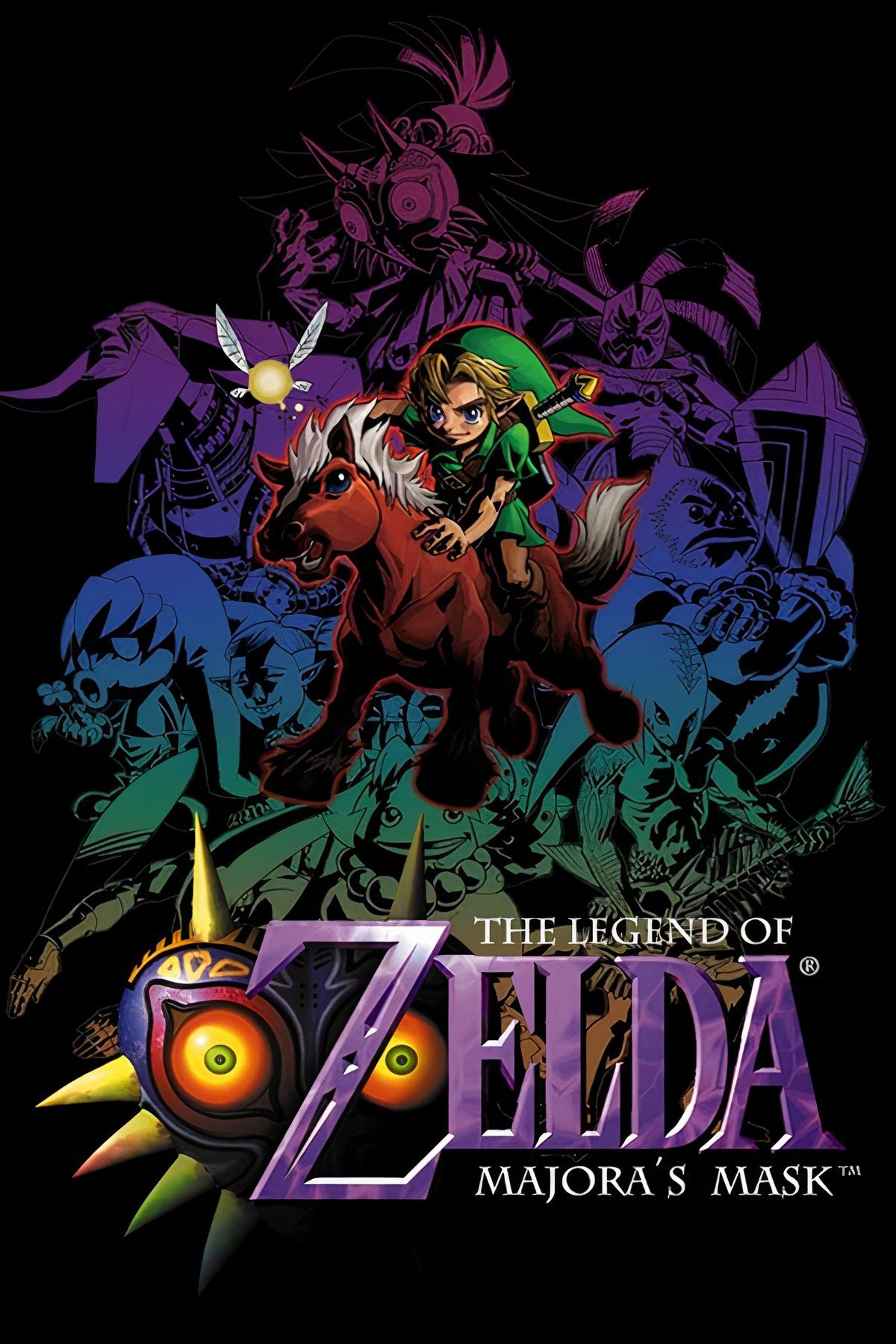
Honestly, the first time I popped the gold cartridge of Zelda Majora's Mask 64 into my N64, I was terrified. It wasn't just the moon with the screaming face. It was the vibe. Everything about the game felt like a fever dream that shouldn't have been allowed to exist in a Triple-A Nintendo franchise. You’ve got the familiar face of Link, but he’s trapped in a world that’s literally scheduled to die in 72 hours.
It's a ticking clock. Stressful? Absolutely.
Most people remember Ocarina of Time as the gold standard of 90s gaming, but Zelda Majora's Mask 64 is the one that actually sticks in your brain like a splinter. It was developed in about a year. Eiji Aonuma and Yoshiaki Koizumi basically pulled a miracle out of their hats by reusing assets from Ocarina to create something that felt completely alien. It’s a sequel, sure, but it’s more like a psychological horror experiment disguised as an action-adventure game.
What People Get Wrong About the Three-Day Cycle
There’s this massive misconception that the time limit in Zelda Majora's Mask 64 is there to rush you. That’s not it at all. If you play it like a standard Zelda game, you’re going to have a bad time. You'll feel panicked. You'll hate the "Song of Time."
The clock is actually the main character.
In Termina, everyone has a schedule. Anju and Kafei are trying to find each other. The Postman is obsessively delivering mail even as the sky falls. The Gorman Brothers are being jerks. If you just rush to the dungeons, you miss the entire point of the game. It’s a clockwork world. You’re meant to fail, reset, and use your knowledge of the past to fix the future. It’s basically Groundhog Day but with more existential dread and a kid who turns into a wooden doll.
A lot of players complain about losing their "progress." But in Zelda Majora's Mask 64, progress isn't your rupee count or your bombs. It’s the notebook. The Bombers' Notebook is the most important item because it tracks the lives of the NPCs. When you play the "Song of Time," you lose your consumables, but you keep the memories. That’s the core loop. It’s a game about intimacy and regret, not just slaying monsters in a forest.
The Expansion Pak: A Technical Necessity
You couldn't even run Zelda Majora's Mask 64 without that little red brick in the front of your console. The Expansion Pak.
Nintendo needed it. Why? Because the game was trying to track too many variables at once. Ocarina of Time had static NPCs who stood in one spot forever. In Termina, every single person is moving. The RAM upgrade allowed the N64 to handle the complex AI schedules and the increased polygon counts for the transformation masks.
Speaking of masks, the transformation sequences are still some of the most unsettling animations on the system. When Link puts on the Deku, Goron, or Zora mask, he screams. It’s a visceral, painful-sounding yelp. It implies that the transformation isn't just magic; it’s a physical restructuring of his body using the soul of a dead person. That’s heavy. That’s not the kind of stuff you usually see in a game rated E for Everyone, even by 2000s standards.
The Tragedy of the Four Heroes
Each of the transformation masks in Zelda Majora's Mask 64 is tied to a specific character who died in grief.
- The Deku Butler’s Son: You find his twisted, wooden corpse in the opening tunnel.
- Darmani the Third: A fallen Goron hero who died trying to save his people from a supernatural blizzard.
- Mikau: A Zora guitarist who dies on the beach after trying to rescue his partner’s eggs.
When you play the "Song of Healing," you aren't just getting a power-up. You are literally performing a funeral rite. You’re turning their trauma into a mask so you can wear their face and finish their unfinished business. It’s morbid. It's beautiful. It's why this game has a cult following that's arguably more passionate than the Breath of the Wild crowd.
Why the N64 Original Hits Different Than the 3DS Remake
If you’re looking to play Zelda Majora's Mask 64 today, you have choices. You can find an original cart, use the Switch Online service, or play the 3DS remake.
Controversial opinion: the 3DS version broke the game’s soul.
Grezzo, the studio behind the remake, made some "quality of life" changes that fundamentally altered the difficulty and the vibe. They changed the boss fights. They added glowing eyes to the bosses that basically scream "HIT ME HERE." They also nerfed the Zora swimming. In the original Zelda Majora's Mask 64, swimming as a Zora felt like being a torpedo. It was fast, fluid, and fun. In the remake, they tied that speed to your magic meter, making it clunky.
The lighting is another big deal. The original N64 version is dark. It’s moody. The fog and the limited draw distance actually add to the sense of claustrophobia. The 3DS version is bright and colorful, which kind of ruins the "everything is about to end" atmosphere. If you want the authentic experience, stick to the 64-bit version. The jagged edges and the blurry textures actually make the horror elements work better.
The Mystery of the Moon Children
Near the end of Zelda Majora's Mask 64, you end up in a surreal meadow with a single tree and five kids wearing masks. This is where the game gets philosophical. They ask you questions that have haunted forum boards for decades.
"Your friends... What kind of... people are they? I wonder... Do those people... think of you... as a friend?"
These aren't questions for a kid. They're questions for someone having a mid-life crisis. The game forces you to confront the idea that maybe the "villain," Skull Kid, was just lonely. He wasn't some cosmic evil like Ganon. He was a kid who felt abandoned by his friends (the Giants) and got possessed by an ancient, malevolent artifact.
It reframes the whole journey. You aren't saving the world because you’re a chosen hero with a destiny. You’re saving the world because everyone in it is struggling with something human—grief, loneliness, or fear of the dark.
Mastering the 72-Hour Loop
If you're jumping back into Zelda Majora's Mask 64, you need to be smart about the clock. Most beginners get overwhelmed because they try to do too much in one cycle.
Don't.
Focus on one major goal per "Three-Day" period. If you’re going for the Woodfall Temple, just do the Woodfall Temple. Once you beat the boss and get the heart container, play the "Song of Time" immediately. Your progress in terms of key items is saved. You don't need to keep the world "saved" for the whole 72 hours. You just need the soul of the boss to help you later.
Also, learn the "Inverted Song of Time." Play the "Song of Time" backward ($R, L, A, R, L, A$ on the original controller). This slows down the flow of time by half. It gives you nearly three hours of real-world time to explore instead of the standard 54 minutes. It’s the difference between a frantic sprint and a manageable stroll.
Actionable Insights for Your Next Playthrough
To truly experience Zelda Majora's Mask 64 without the frustration, follow these steps:
- Get the Bunny Hood early. It’s the most useful item in the game. You get it from Grog at the Romani Ranch after using the Bremen Mask to march the chicks. It increases your movement speed, which is a literal lifesaver when the clock is ticking.
- Talk to everyone twice. The dialogue changes based on what day it is and what time it is. The townspeople’s reactions on the Final Day, when the ground is shaking and the music gets distorted, are some of the most poignant moments in gaming history.
- Don't ignore the side quests. The Anju and Kafei questline is arguably better than the main plot. It takes all three days to complete and requires perfect timing, but the reward—the Couple's Mask—is a symbol of the game's emotional core.
- Use the stone mask. Most people miss this. In the N64 version, there’s an invisible soldier in Ikana Canyon (or near the Gerudo Fortress in some versions). Using the Lens of Truth to find him and giving him a potion earns you the Stone Mask. It makes you invisible to most minor enemies. It turns the stealth sections from a nightmare into a breeze.
- Collect all 20 masks. If you get them all, you can trade them at the end for the Fierce Deity’s Mask. This turns Link into a god-like warrior that can shred the final boss in seconds. It’s the ultimate reward for caring about the people of Termina.
Zelda Majora's Mask 64 isn't just a game you play; it's a game you survive. It’s a masterpiece of atmosphere and tight design that hasn't been replicated since. Even Tears of the Kingdom, with all its darkness, doesn't quite capture the sheer "what is happening" energy of Termina. Grab your controller, play the "Song of Time," and try not to stare too long at the moon.
To get the most out of your run, prioritize obtaining the Inverted Song of Time and the Bunny Hood within your first two cycles. This removes the mechanical pressure and allows the story's heavy atmosphere to take center stage. Focus on completing the Bombers' Notebook rather than just rushing the four temples, as the true ending of the game is found in the resolution of the townspeople's lives, not just the defeat of Majora.