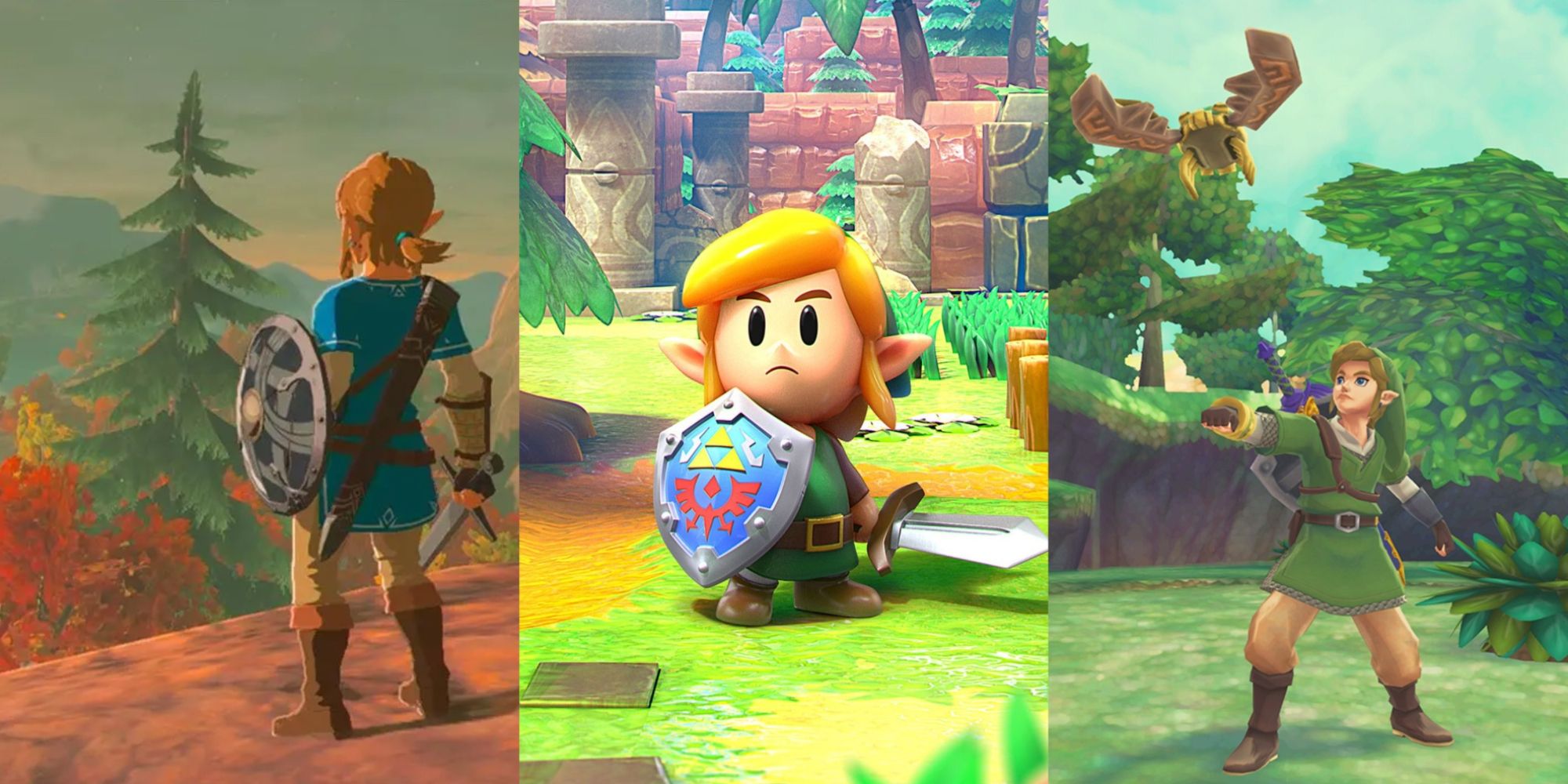
Look, we need to be honest. Difficulty in Zelda isn't just about how hard a boss hits you or how many hearts you lose when you fall into a pit. It’s about that specific brand of "Zelda logic" that makes you stare at a wall for forty minutes because you didn't realize you could burn a specific tapestry. Or, in the case of the newer games, it's about the physics engine deciding to launch a rock at your head at Mach 5. Ranking Zelda games by difficulty is a nightmare because everyone struggles with different things. Some people breeze through combat but get paralyzed by the Water Temple. Others can parry a Guardian scout with their eyes closed but can't figure out a block puzzle to save their lives.
Zelda games ranked by difficulty usually start with the NES era, and for good reason. Those games were designed during a time when "player friendliness" wasn't a concept. They wanted you to buy the Nintendo Power guide. If you didn't have that guide, you were basically just stabbing bushes until your thumb bled. But as the series evolved, the difficulty shifted from "where do I go?" to "how do I survive this encounter?" and eventually to "how do I manipulate these complex systems?"
It's a weird spectrum. You have the brutal, unforgiving combat of the 8-bit era, the cerebral navigation of the N64 and GameCube days, and the "survive the elements" vibe of the Switch titles. Let's get into what actually makes these games hard.
The Relentless Brutality of the 8-Bit Era
The original The Legend of Zelda (1986) is a punch in the face. It's awesome, but it's mean. There is almost zero direction. You start on a screen, grab a sword, and the world is your oyster—an oyster filled with Blue Darknuts that will absolutely end your run in seconds. The difficulty here is purely mechanical and navigational. There’s no map markers. No "Sheikah Slate" telling you where the next objective is. You just wander. Honestly, the Second Quest is even worse; it rearranges the dungeons and makes them significantly more vindictive.
Then there’s Zelda II: The Adventure of Link.
This is the black sheep for a reason. It is legitimately the hardest Zelda game ever made. It’s not even a debate. The side-scrolling combat requires frame-perfect blocking with your shield. If you miss a beat against an Iron Knuckle, you’re done. Death is punishing. You lose your XP progress toward the next level, and if you run out of lives, you’re sent all the way back to the North Castle. It’s a grind. It’s exhausting. It’s the only Zelda game that feels like it’s actively trying to make you quit.
Most people who say they've beaten every Zelda game usually have an asterisk next to this one. They probably used save states on the Switch Online service. No judgment. The Great Palace is a literal gauntlet of despair.
The Puzzle Box Dungeons of the 2D Handhelds
When the series moved to the Game Boy and DS, the difficulty pivoted. It became less about "can you dodge this?" and more about "can you keep the entire dungeon layout in your head?"
The Legend of Zelda: Oracle of Ages is the prime example. While its sister game, Oracle of Seasons, focused more on combat, Ages went all-in on puzzles. The color-based puzzles and the time-traveling mechanics between the past and present are genuinely taxing. You have to remember how a change in the past affects a specific screen in the present. It’s a lot of mental bookkeeping.
Link’s Awakening (the original and the remake) has its moments, too. Remember the Eagle’s Tower? Throwing that metal ball to collapse the pillars? If you didn't understand the spatial layout of that building, you were stuck for days. But compared to Oracle of Ages, it’s a cakewalk.
Then we have the DS titles, Phantom Hourglass and Spirit Tracks. Their difficulty is... controversial. It’s mostly control-based. Using a stylus to move Link feels "kinda" clunky to some, and the Temple of the Ocean King is a timed stealth dungeon that you have to repeat multiple times. That's a different kind of difficulty—the difficulty of patience.
The 3D Era: Navigation vs. Combat
When Ocarina of Time hit the scene, Nintendo had to figure out how to make Zelda hard in three dimensions. They settled on environmental awareness.
Ocarina of Time and the Water Temple Mythos
The Water Temple isn't actually "hard" in terms of enemies. It's hard because of the menu-swapping (in the original N64 version) and the verticality. Changing water levels meant you had to remember exactly which doors were accessible at which height. If you missed one small key, you were stuck backtracking through three floors of slow-moving water. It was a test of administrative skill more than anything.
Majora’s Mask, however, upped the ante. The three-day cycle adds a layer of persistent anxiety. You aren't just fighting bosses; you're fighting the clock. If you’re halfway through the Stone Tower Temple and the moon is about to fall, you have to reset. You lose your consumable items. You have to start the puzzles over. That pressure makes the game feel much more difficult than Ocarina, even if the actual combat is similar.
Twilight Princess and Skyward Sword
These two are generally considered on the easier side of the Zelda games ranked by difficulty. Twilight Princess has some of the best dungeon designs in the series, but Link is so powerful that most enemies aren't a threat. You get hidden skills like the "Helm Splitter" and "Back Slice" that trivialization most encounters.
Skyward Sword is a weird one. Its difficulty is entirely dependent on how well you jive with the motion controls. If the Wii Remote (or Joy-Con) isn't calibrated perfectly, fighting a Lizalfos becomes an exercise in frustration. The puzzles are clever, but the game holds your hand a lot. Fi, your companion, basically solves the puzzles for you before you've even had a chance to look at them. It’s the "modern Nintendo" problem—too much hand-holding.
The Open World Paradigm Shift
Breath of the Wild and Tears of the Kingdom redefined difficulty for the franchise. It’s no longer about "the one way" to solve a puzzle. It’s about systemic difficulty.
In the early game of Breath of the Wild, you are incredibly fragile. A single Blue Bokoblin can one-shot you. You have to worry about:
- Temperature (freezing to death in the mountains).
- Lightning (getting struck because you're wearing metal armor).
- Stamina (falling off a cliff because you ran out of juice).
- Weapon durability (your sword breaking in the middle of a fight).
This is a "survival" difficulty. It’s hard at the start, but it becomes very easy once you get high-end armor and food that grants extra hearts. Tears of the Kingdom is slightly harder because the enemies (especially in the Depths) deal "Gloom" damage that permanently removes your heart containers until you heal at a lightroot. Plus, the building mechanics require a level of engineering creativity that some players find overwhelming. Building a hoverbike is easy. Building a complex machine to solve a shrine puzzle while things are exploding? That's a challenge.
Rankings: From "Easy" to "Good Luck"
Let's organize this properly. If we're looking at the series as a whole, this is how the hierarchy generally shakes out for an average player.
Tier 1: The Gatekeepers (Hardest)
- Zelda II: The Adventure of Link: Brutal combat, punishing death system, confusing map.
- The Legend of Zelda (1986): No directions, hidden secrets required for progress, tough late-game enemies.
- Oracle of Ages: The most complex puzzles in the 2D series.
Tier 2: The Mental Tax (Moderate to Hard)
- Majora’s Mask: The time limit and the complexity of the side quests.
- Tears of the Kingdom: Early game lethality and complex building systems.
- A Link to the Past: The Dark World transition significantly spikes the combat difficulty.
Tier 3: The Standard Experience (Balanced)
- Ocarina of Time: Classic puzzle logic with a few confusing spikes (Water Temple).
- Breath of the Wild: Difficult at first, but becomes easy as you gear up.
- Skyward Sword: Hard if the controls don't click, easy if they do.
Tier 4: The Relaxing Quest (Easiest)
- The Wind Waker: Enemies drop plenty of hearts, and the parry mechanic is very forgiving.
- Twilight Princess: Generous health and incredibly powerful combat moves.
- The Minish Cap: Short, sweet, and mostly intuitive.
Why "Hard" is Subjective in Hyrule
We have to acknowledge the outliers. For some, A Link Between Worlds is "easy" because you can rent any item at any time. But for someone else, that freedom is paralyzing because they don't know which item to bring to which dungeon.
There's also the "Master Quest" versions of games like Ocarina of Time. These remixed versions intentionally break the internal logic of the original game to mess with veteran players. Putting a Cow inside a wall in the Jabu-Jabu’s Belly dungeon isn't "difficult" in a traditional sense—it’s just weird. It’s designed to troll you.
The most difficult Zelda experience isn't even a base game; it’s usually a self-imposed challenge. The "Three-Heart Run" is a staple of the community. When you play Twilight Princess without picking up any Heart Containers, the game suddenly becomes a high-stakes action title where one mistake means a Game Over.
How to Approach the Harder Games
If you're looking to tackle the "top tier" of difficulty, don't go in blind. The Zelda community has spent decades documenting every frame of these games.
- For Zelda II: Learn the "downstab." It’s your best friend. Also, don't be afraid to grind for levels early on. Leveling up your Life and Attack before hitting the third dungeon makes a world of difference.
- For Oracle of Ages: Keep a notebook. Seriously. Mapping out the time-travel triggers yourself is much more satisfying than looking up a walkthrough, and it helps you keep the logic straight.
- For Breath of the Wild / Tears of the Kingdom: Cook everything. The difficulty of these games is effectively a "gear check." If you have enough "Hearty" radishes and "Mighty" bananas, you can brute-force almost any encounter.
The difficulty in Zelda is rarely about fast reflexes like a "Souls" game. It's about your willingness to experiment. The games are designed to be "solved" rather than just "beaten."
Final Practical Advice for Players
If you find yourself stuck in a Zelda game, the answer is rarely "get better at clicking buttons." It's usually "look around the room." Nintendo almost always places the solution to a puzzle right in front of you, but they hide it with lighting, camera angles, or a distracting enemy.
- Check the ceiling. 3D Zelda games love putting switches on the ceiling.
- Talk to everyone. NPCs in Zelda aren't just flavor text; they often give you the exact hint you need for a dungeon three towns away.
- Use your map. The map often shows rooms you haven't entered or chests you've missed, which are usually the key to progressing.
Zelda games ranked by difficulty provide a roadmap of how game design has changed over 40 years. From the "survival of the fittest" mentality of the 80s to the "creative problem solving" of the 2020s, the series remains the gold standard for challenging the player's brain as much as their hands.